


Canine Histiocytic and Hemophagocytic Histiocytic Sarcomas Display KRAS and Extensive PTPN11/SHP2 Mutations and Respond In Vitro to MEK Inhibition by Cobimetinib
- PMID: 39202410
- PMCID: PMC11353564
- DOI: 10.3390/genes15081050
Canine Histiocytic and Hemophagocytic Histiocytic Sarcomas Display KRAS and Extensive PTPN11/SHP2 Mutations and Respond In Vitro to MEK Inhibition by Cobimetinib
Abstract
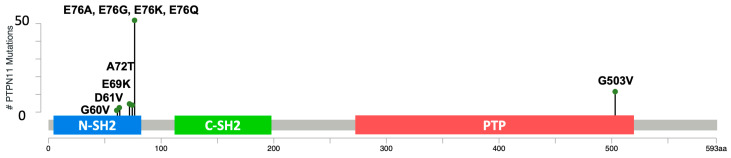
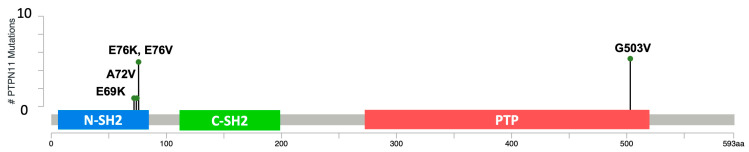
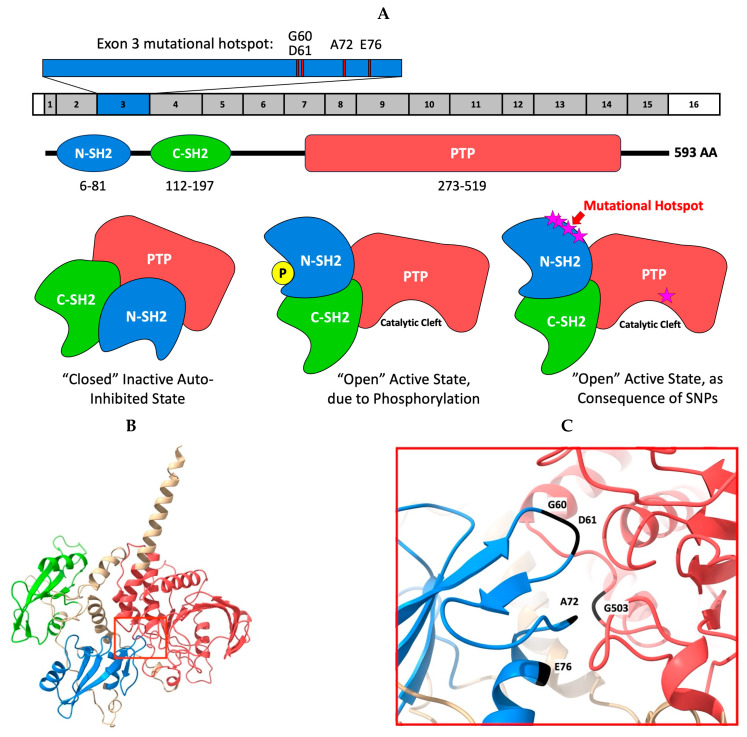
Histiocytic sarcoma (HS) is a rare and highly aggressive cancer in humans and dogs. In dogs, it has a high prevalence in certain breeds, such as Bernese mountain dogs (BMDs) and flat-coated retrievers. Hemophagocytic histiocytic sarcoma (HHS) is a unique form of HS that presents with erythrophagocytosis. Due to its rareness, the study of HHS is very limited, and mutations in canine HHS patients have not been studied to date. In previous work, our research group identified two major PTPN11/SHP2 driver mutations, E76K and G503V, in HS in dogs. Here, we report additional mutations located in exon 3 of PTPN11/SHP2 in both HS and HHS cases, further supporting that this area is a mutational hotspot in dogs and that mutations in tumors and liquid biopsies should be evaluated utilizing comprehensive methods such as Sanger and NextGen sequencing. The overall prevalence of PTPN11/SHP2 mutations was 55.8% in HS and 46.2% in HHS. In addition, we identified mutations in KRAS, in about 3% of HS and 4% of HHS cases. These findings point to the shared molecular pathology of activation of the MAPK pathway in HS and HHS cases. We evaluated the efficacy of the highly specific MEK inhibitor, cobimetinib, in canine HS and HHS cell lines. We found that the IC50 values ranged from 74 to 372 nM, which are within the achievable and tolerable ranges for cobimetinib. This finding positions cobimetinib as a promising potential candidate for future canine clinical trials and enhances our understanding of the molecular defects in these challenging cancers.
Keywords: KRAS; MAPK pathway; MEK inhibitors; PTPN11; SHP2; cancer genetics; cobimetinib; comparative oncology; hemophagocytic histiocytic sarcoma; histiocytic sarcoma; myeloid tumors.
Conflict of interest statement
The authors declare no conflicts of interest. The funders had no role in the design of the study; in the collection, analyses, or interpretation of data; in the writing of the manuscript; or in the decision to publish the results.
Figures
Similar articles
-
Gain-of-function mutation in PTPN11 in histiocytic sarcomas of Bernese Mountain Dogs.Vet Comp Oncol. 2018 Jun;16(2):220-228. doi: 10.1111/vco.12357. Epub 2017 Sep 20. Vet Comp Oncol. 2018. PMID: 28929581
-
Activating Mutations in PTPN11 and KRAS in Canine Histiocytic Sarcomas.Genes (Basel). 2019 Jul 4;10(7):505. doi: 10.3390/genes10070505. Genes (Basel). 2019. PMID: 31277422 Free PMC article.
-
PTPN11 mutations in canine and human disseminated histiocytic sarcoma.Int J Cancer. 2020 Sep 15;147(6):1657-1665. doi: 10.1002/ijc.32991. Epub 2020 Apr 8. Int J Cancer. 2020. PMID: 32212266
-
One Health: Therapies Targeting Genetic Variants in Human and Canine Histiocytic and Dendritic Cell Sarcomas.Vet Comp Oncol. 2024 Sep;22(3):322-339. doi: 10.1111/vco.12988. Epub 2024 Jun 12. Vet Comp Oncol. 2024. PMID: 38867335 Review.
-
A review of histiocytic diseases of dogs and cats.Vet Pathol. 2014 Jan;51(1):167-84. doi: 10.1177/0300985813510413. Vet Pathol. 2014. PMID: 24395976 Review.
Cited by
-
Transcriptome Analysis of Canine Histiocytic Sarcoma Tumors and Cell Lines Reveals Multiple Targets for Therapy.Cancers (Basel). 2025 Mar 12;17(6):954. doi: 10.3390/cancers17060954. Cancers (Basel). 2025. PMID: 40149290 Free PMC article.
References
-
- Boerkamp K.M., van der Kooij M., van Steenbeek F.G., van Wolferen M.E., Groot Koerkamp M.J., van Leenen D., Grinwis G.C.M., Penning L.C., Wiemer E.A.C., Rutteman G.R. Gene expression profiling of histiocytic sarcomas in a canine model: The predisposed flatcoated retriever dog. PLoS ONE. 2013;8:e71094. doi: 10.1371/journal.pone.0071094. - DOI - PMC - PubMed
-
- Abadie J., Hedan B., Cadieu E., De Brito C., Devauchelle P., Bourgain C., Parker H.G., Vaysse A., Margaritte-Jeannin P., Galibert F., et al. Epidemiology, pathology, and genetics of histiocytic sarcoma in the Bernese mountain dog breed. J. Hered. 2009;100((Suppl. S1)):S19–S27. doi: 10.1093/jhered/esp039. - DOI - PMC - PubMed
-
- Shearin A.L., Hedan B., Cadieu E., Erich S.A., Schmidt E.V., Faden D.L., Cullen J., Abadie J., Kwon E.M., Gröne A., et al. The MTAP-CDKN2A locus confers susceptibility to a naturally occurring canine cancer. Cancer Epidemiol. Biomark. Prev. 2012;21:1019–1027. doi: 10.1158/1055-9965.EPI-12-0190-T. - DOI - PMC - PubMed
MeSH terms
Substances
LinkOut - more resources
Full Text Sources
Miscellaneous
