. 2024 Jul 25;16(8):1198.
doi: 10.3390/v16081198.

Generation of Recombinant Authentic Live Attenuated Human Rotavirus Vaccine Strain RIX4414 (Rotarix®) from Cloned cDNAs Using Reverse Genetics

Affiliations

Generation of Recombinant Authentic Live Attenuated Human Rotavirus Vaccine Strain RIX4414 (Rotarix®) from Cloned cDNAs Using Reverse Genetics

Saori Fukuda et al. Viruses. .

Abstract

The live attenuated human rotavirus vaccine strain RIX4414 (Rotarix®) is used worldwide to prevent severe rotavirus-induced diarrhea in infants. This strain was attenuated through the cell culture passaging of its predecessor, human strain 89-12, which resulted in multiple genomic mutations. However, the specific molecular reasons underlying its attenuation have remained elusive, primarily due to the absence of a suitable reverse genetics system enabling precise genetic manipulations. Therefore, we first completed the sequencing of its genome and then developed a reverse genetics system for the authentic RIX4414 virus. Our experimental results demonstrate that the rescued recombinant RIX4414 virus exhibits biological characteristics similar to those of the parental RIX4414 virus, both in vitro and in vivo. This novel reverse genetics system provides a powerful tool for investigating the molecular basis of RIX4414 attenuation and may facilitate the rational design of safer and more effective human rotavirus vaccines.

Keywords: Rotarix®; human rotavirus; live attenuated rotavirus vaccine; reverse genetics.


Conflict of interest statement

We have no conflicts of interest to declare.

Figures
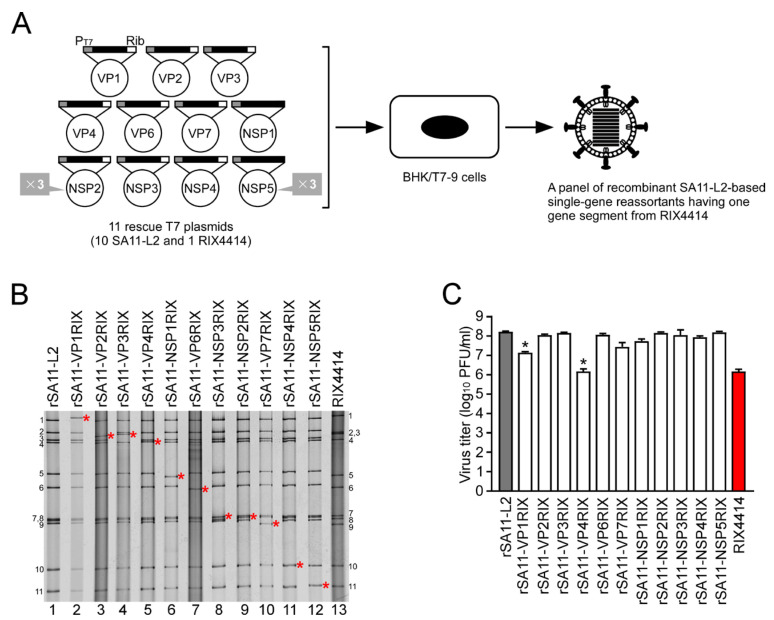
Figure 1
Figure 1
Generation of a panel of recombinant SA11-L2-based single-segment reassortants having one gene segment from RIX4414. (A) Schematic presentation of an 11-plasmid reverse genetics system to generate SA11-L2-based single-segment reassortants. The 11 rescue T7 plasmids include the full-length segment of cDNA of each dsRNA segment of RVA, flanked by the T7 RNA polymerase promoter (PT7) and the HDV ribozyme (Rib). To generate SA11-L2-based single-segment reassortants having one gene segment from RIX4414, BHK/T7-9 cells were cotransfected with the 11 rescue T7 plasmids (10 for SA11-L2 plus one for RIX4414) with 3-fold increased amounts of the two plasmids carrying the NSP2 and NSP5 genes. A panel of recombinant SA11-L2-based single-segment reassortants having one segment from RIX4414 were rescued from the cultures of the transfected BHK/T7-9 cells. (B) PAGE analysis of recombinant SA11-L2-based single-segment reassortants with each of the 11 segments from RIX4414. Lanes 1 and 13, dsRNAs from rSA11-L2 (lane 1) and RIX4414 (lane 13); lanes 2–12, dsRNAs from rescued rSA11-VP1RIX (lane 2), rSA11-VP2RIX (lane 3), rSA11-VP3RIX (lane 4), rSA11-VP4RIX (lane 5), rSA11-NSP1RIX (lane 6), rSA11-VP6RIX (lane 7), rSA11-NSP3RIX (lane 8), rSA11-NSP2RIX (lane 9), rSA11-VP7RIX (lane 10), rSA11-NSP4RIX (lane 11), and rSA11-NSP5RIX (lane 12). Red asterisks indicate the positions of the cDNA-derived RIX4414 segments. The numbers on the left and right indicate the orders of the genomic dsRNA segments of rSA11-L2 and RIX4414, respectively. (C) Infectivity of recombinant SA11-L2-based single-segment reassortants with each of the 11 segments from RIX4414. MA104 cells were infected with RVAs at an MOI of 0.01 and then incubated for 36 h. The viral titers in the cultures were determined by plaque assay. The data shown are the mean viral titers and standard deviations (SDs) for three independent cell cultures. Asterisks indicate significant differences between rSA11-L2 and recombinant single-segment reassortants; *, p < 0.05 (as calculated by two-way ANOVA with Sidak’s post-test).
Figure 2
Figure 2
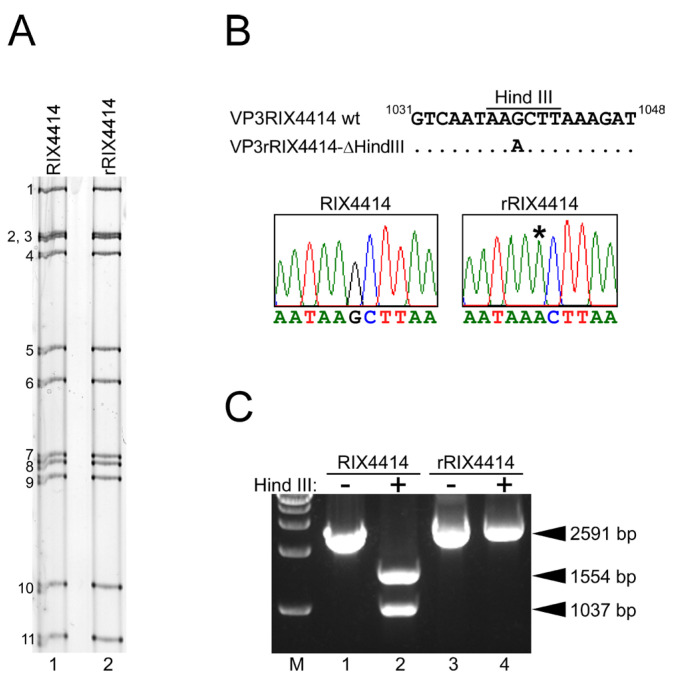
Generation of recombinant authentic rRIX4414 virus entirely from cloned cDNAs. (A) PAGE of viral genomic dsRNAs extracted from the parental RIX4414 and rescued rRIX4414. Lane 1, dsRNAs from the parental RIX4414; lane 2, dsRNAs from rescued rRIX4414. The numbers on the left indicate the order of the genomic dsRNA segments of RIX4414. (B) Rescued rRIX4414 contains a signature mutation (synonymous mutation) in its VP3 gene, because a nucleotide substitution (G-to-A at nucleotide position 1039) was introduced to abolish a unique HindIII site. The VP3 genes of RIX4414 and rRIX4414 were amplified by RT-PCR using specific primers, and sequencing electrograms show that indeed rRIX4414 possesses a G-to-A mutation at nucleotide position 1039. An asterisk indicates the G-to-A mutation introduced into the VP3 gene of rRIX4414. (C) Confirmation of the expected susceptibility to HindIII digestion. The 2591-bp VP3 gene RT-PCR products obtained for RIX4414 (lanes 1 and 2) and rRIX4414 (lanes 3 and 4) were treated with HindIII (+) or not (−), and separated in a 1% agarose gel. M, 1-kb DNA ladder marker.
Figure 3
Figure 3
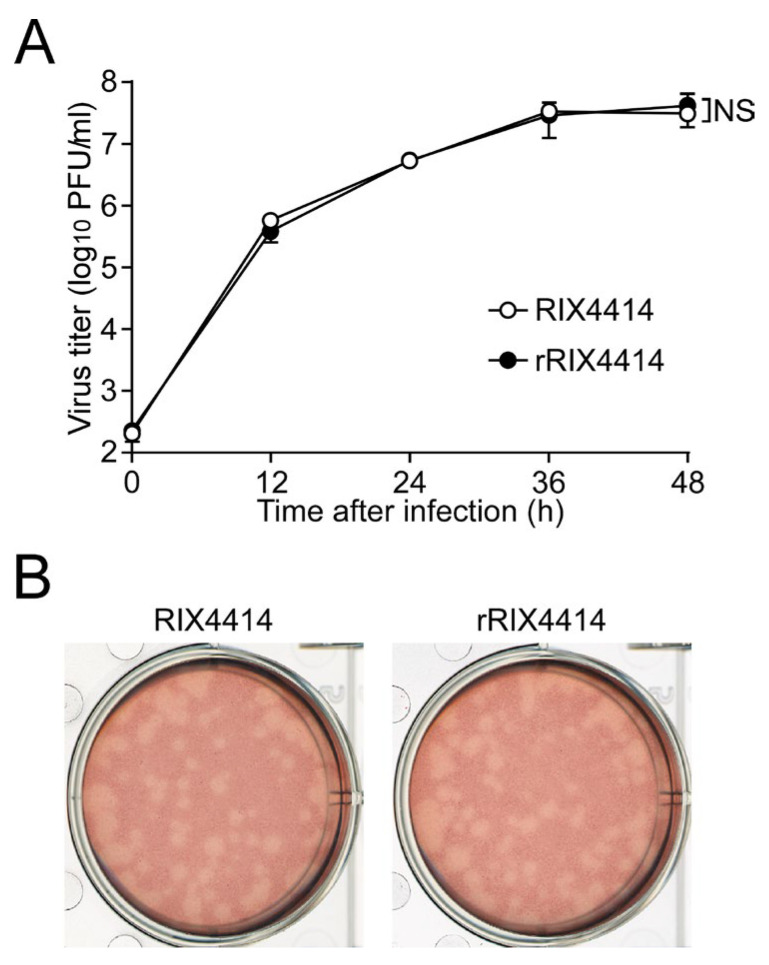
Growth properties of rRIX4414 virus in cultured cells. (A) Multiple-step growth curves for RIX4414 and rRIX4414. MA104 cells were infected with RIX4414 or rRIX4414 at an MOI of 0.01 and then incubated for various times (0, 12, 24, 36, and 48 h). The viral titers in the cultures were determined by plaque assay. The data shown are the mean viral titers and SDs from three independent cell cultures. NS, p > 0.05 (as calculated by two-way ANOVA with Sidak’s post-test). (B) Plaque formation by RIX4414 and rRIX4414. RIX4414 or rRIX4414 was directly plated onto CV-1 cells to form plaques. The experiment was repeated three times with similar results, and representative results are shown.
Figure 4
Figure 4
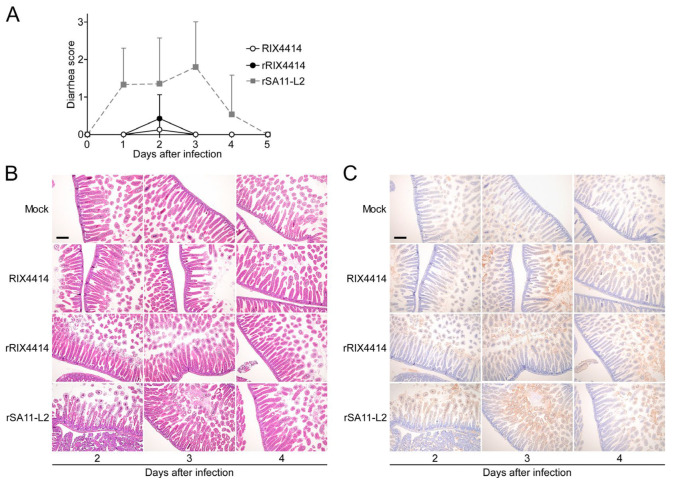
Biological properties of rRIX4414 virus in suckling mice. Five-day-old suckling mice were orally administered 50 μL of cell culture supernatants containing RIX4414, rRIX4414, rSA11-L2, or a mock infection. (A) Induction of diarrhea after infection with RIX4414, rRIX4414, or rSA11-L2. Diarrhea scores for individual mice were monitored daily. The data presented are the mean diarrhea scores and SDs for 9–28 pups. (B) Cytological changes in the small intestines. Small intestines were removed daily from day 2 to 4 after infection. Paraffin-embedded sections were stained with HE reagent. Two pups from each RVA-infected group were sacrificed for HE staining with similar results, and representative results are shown. From the mock-infection group, only one pup was sacrificed for HE staining. The bar represents 200 μm. (C) Histological analysis of rotaviral antigen expression in the small intestines. Small intestines of the infected mice were prepared as described in (B). Sections were stained by immunohistochemistry using a monoclonal antibody recognizing RVA VP6 antigen. VP6 protein expression in villus enterocytes was detected. The bar represents 200 μm.

References

    1. Tate J.E., Burton A.H., Boschi-Pinto C., Parashar U.D., World Health Organization–Coordinated Global Rotavirus Surveillance Network Global, regional, and national estimates of rotavirus mortality in children <5 years of age, 2000–2013. Clin. Infect. Dis. 2016;62:S96–S105. doi: 10.1093/cid/civ1013. - DOI - PMC - PubMed
    1. Troeger C., Khalil I.A., Rao P.C., Cao S., Blacker B.F., Ahmed T., Armah G., Bines J.E., Brewer T.G., Colombara D.V., et al. Rotavirus vaccination and the global burden of rotavirus diarrhea among children younger than 5 years. JAMA Pediatr. 2018;172:958–965. doi: 10.1001/jamapediatrics.2018.1960. - DOI - PMC - PubMed
    1. Estes M.K., Greenberg H.B. Rotaviruses. In: Knipe D.M., Howley P.M., Cohen J.I., Griffin D.E., Lamb R.A., Martin M.A., Racaniello V.R., Roizman B., editors. Fields Virology. 6th ed. Wolters Kluwer Health/Lippincott Williams & Wilkins; Philadelphia, PA, USA: 2013. pp. 1347–1401.
    1. Bernstein D.I., Ward R.L. Rotarix: Development of a live attenuated monovalent human rotavirus vaccine. Pediatr. Ann. 2006;35:38–43. doi: 10.3928/0090-4481-20060101-12. - DOI - PubMed
    1. Burnett E., Parashar U.D., Tate J.E. Global impact of rotavirus vaccination on diarrhea hospitalizations and deaths among children <5 years old: 2006–2019. J. Infect. Dis. 2020;222:1731–1739. - PMC - PubMed

Publication types

Associated data

LinkOut - more resources