


Improving outcome measures in late onset Pompe disease: Modified Rasch-Built Pompe-Specific Activity scale
- PMID: 39205420
- PMCID: PMC11554865
- DOI: 10.1111/ene.16397
Improving outcome measures in late onset Pompe disease: Modified Rasch-Built Pompe-Specific Activity scale
Abstract
Background and purpose: The Rasch-Built Pompe-Specific Activity (R-PAct) scale is a patient-reported outcome measure specifically designed to quantify the effects of Pompe disease on daily life activities, developed for use in Dutch- and English-speaking countries. This study aimed to validate the R-PAct for use in other countries.
Methods: Four other language versions (German, French, Italian, and Spanish) of the R-PAct were created and distributed among Pompe patients (≥16 years old) in Germany, France, Spain, Italy, and Switzerland and pooled with data of newly diagnosed patients from Australia, Belgium, Canada, the Netherlands, New Zealand, the USA, and the UK and the original validation cohort (n = 186). The psychometric properties of the scale were assessed by exploratory factor analysis and Rasch analysis.
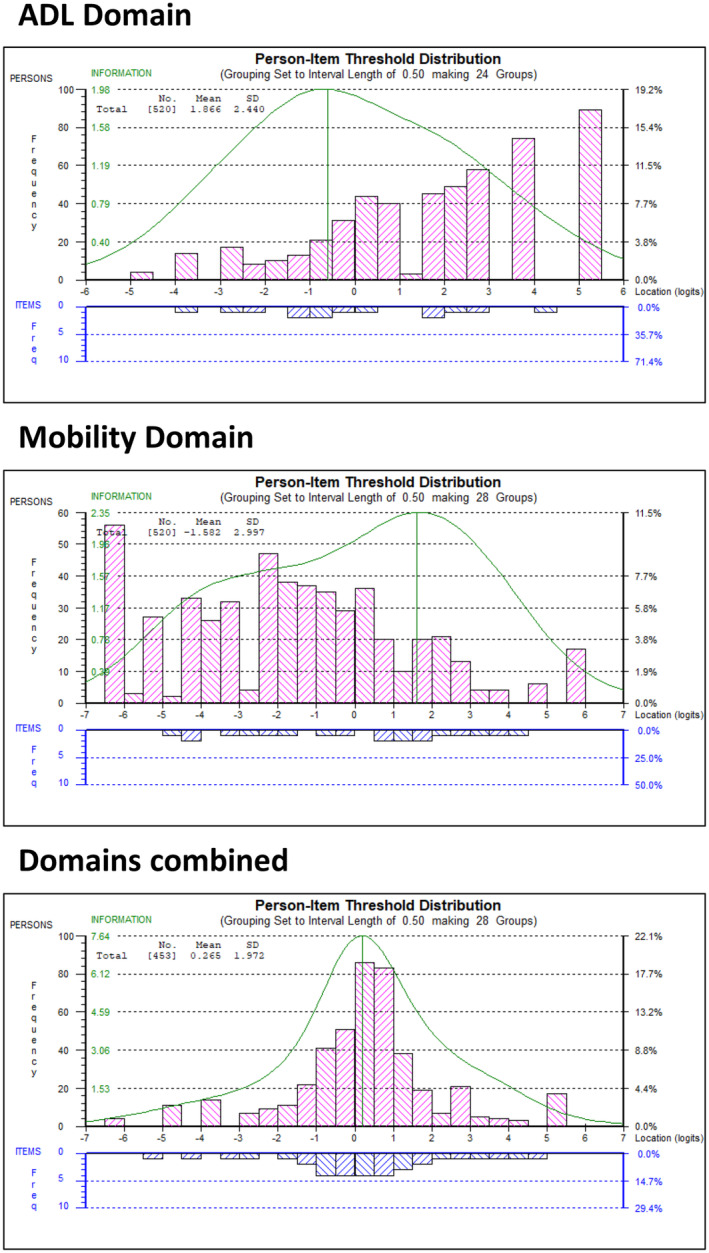
Results: Data for 520 patients were eligible for analysis. Exploratory factor analysis suggested that the items separated into two domains: Activities of Daily Living and Mobility. Both domains independently displayed adequate Rasch model measurement properties, following the removal of one item ("Are you able to practice a sport?") from the Mobility domain, and can be added together to form a "higher order" factor as well. Differential item functioning (DIF)-by-language assessment indicated DIF for several items; however, the impact of accounting for DIF was negligible. We recalibrated the nomogram (raw score interval-level transformation) for the updated 17-item R-PAct scale. The minimal detectable change value was 13.85 for the overall R-PAct.
Conclusions: After removing one item, the modified-R-PAct scale is a valid disease-specific patient-reported outcome measure for patients with Pompe disease across multiple countries.
Keywords: Pompe disease; Rasch analysis; daily life activities; patient‐reported outcome measure.
© 2024 The Author(s). European Journal of Neurology published by John Wiley & Sons Ltd on behalf of European Academy of Neurology.
Conflict of interest statement
K.G.C. has received consulting fees for advisory boards and/or received speaker honoraria from Alnylam, Amicus, ArgenX, Biogen, CSL Behring, Ipsen, Janssen, Lupin, Pfizer, Roche, Sanofi‐Genzyme, and UCB. K.G.C. is Chairholder of the Emil von Behring Chair for Neuromuscular and Neurodegenerative Disorders for CSL Behring. T.H. has received consulting fees and/or travel expenses from Amicus therapeutics, Sanofi Genzyme, Bayer, and NovoCure and has received research grants from Bayer. J.D.‐M. has received payment for consultancy from Sanofi, Astellas, Amicus, and Spark and has received grants from Sanofi and Spark. A.T.v.d.P. has received funding for research and clinical trials and advisory fees from Sanofi‐Genzyme, Amicus Therapeutics, BioMarin, Ultragenyx, Sarepta, Audentes, and Spark Therapeutics, under agreements with Erasmus MC University Medical Center and the relevant industry. N.A.M.E.v.d.B. has received consulting fees for advisory boards and/or received speaker honoraria from Sanofi under agreements with Erasmus MC University Medical Center and the relevant industry. None of the other authors has any conflict of interest to disclose.
Figures
References
-
- van der Ploeg AT, Reuser AJ. Pompe's disease. Lancet. 2008;372(9646):1342‐1353. - PubMed
-
- Winkel LP, Hagemans ML, van Doorn PA, et al. The natural course of non‐classic Pompe's disease; a review of 225 published cases. J Neurol. 2005;252(8):875‐884. - PubMed
-
- Hagemans ML, Laforêt P, Hop WJ, et al. Impact of late‐onset Pompe disease on participation in daily life activities: evaluation of the Rotterdam Handicap Scale. Neuromuscul Disord. 2007;17(7):537‐543. - PubMed
MeSH terms
LinkOut - more resources
Full Text Sources
Medical
Miscellaneous
