. 2024 Oct;11(40):e2404741.
doi: 10.1002/advs.202404741. Epub 2024 Aug 29.

Optically Tunable Many-Body Exciton-Phonon Quantum Interference

Affiliations

Optically Tunable Many-Body Exciton-Phonon Quantum Interference

Si-Jie Chang et al. Adv Sci (Weinh). 2024 Oct.

Abstract

This study introduces a novel paradigm for achieving widely tunable many-body Fano quantum interference in low-dimensional semiconducting nanostructures, beyond the conventional requirement of closely matched energy levels between discrete and continuum states observed in atomic Fano systems. Leveraging Floquet engineering, the remarkable tunability of Fano lineshapes is demonstrated, even when the original discrete and continuum states are separated by over 1 eV. Specifically, by controlling the quantum pathways of discrete phonon Raman scattering using femtosecond laser pulses, the Raman intermediate states across the excitonic Floquet band are tuned. This manipulation yields continuous transitions of Fano lineshapes from antiresonance to dispersive and to symmetric Lorentzian profiles, accompanied by significant variations in Fano parameter q and Raman intensity spanning 2 orders of magnitude. A subtle shift in the excitonic Floquet resonance is further shown, achieved by controlling the intensity of the femtosecond laser, which profoundly modifies quantum interference strength from destructive to constructive interference. The study reveals the crucial roles of Floquet engineering in coherent light-matter interactions and opens up new avenues for coherent control of Fano quantum interference over a broad energy spectrum in low-dimensional semiconducting nanostructures.

Keywords: fano resonance; floquet state; low‐dimensional semiconductors; optical manipulation; quantum interference.


Conflict of interest statement

The authors declare no conflict of interest.

Figures
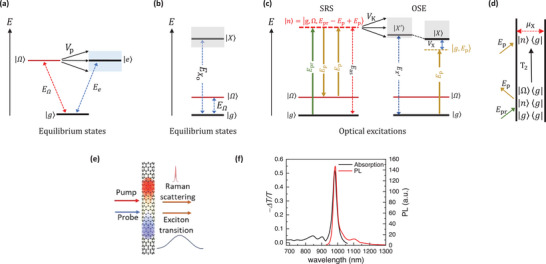
Figure 1
Figure 1
Schematics of Fano quantum interference. a) Classical model of Fano interference between coupled discrete phonon |Ω〉 and continuum state |e〉 with closely matched excitation energies. The blue‐shaded area shows the bandwidth of the continuum. b) Excitation energy of bare exciton |X〉 and discrete phonon |Ω〉 states in low‐dimensional semiconductors. The grey‐shaded area shows the bandwidth of the exciton continuum. c) Schematic diagram describing the optically‐driven quantum interference arising from the phonon Raman intermediate state |n〉 coupled to the excitonic Floquet band |X′〉 through electron‐phonon coupling V K (black double arrow). Under optical excitation, the Floquet states |g, E p〉 hybridize with |X〉 through optical Stark effects (OSE) governed by electron‐photon coupling V X (indicated by blue double arrow), leading to energy blueshift of the excitonic Floquet states |X′〉 (right panel). The interplays between electrons, phonons, and photons lead to rich stimulated Raman scattering (SRS) phenomena (left panel), a four‐wave mixing process. Following the generation of vibrational coherence by E p and E pr, interactions with another E p give rise to third‐order phonon Raman intermediate state |n〉, an admixture of electronic and phonon state |g, Ω, E prE p + E p〉, with energy depends on E pr and E p in the 3 field‐matter interactions. By employing a broadband probe with energy spans across exciton resonance, and controlling the pump energy, the outgoing Raman scattered photon, E as, can be tuned to align with the exciton resonance. d) The double‐sided Feynman diagram showing the evolution of the density matrix during the SRS described in (c). Arrows pointing into (away from) the diagram denote the absorption (emission) of photons. The horizontal dashed red arrow shows the overlap of bra and ket states mediated by the transition dipole moment μX to give the third‐order polarization. T 2 describes the dephasing rate of vibrational coherence |Ω〉〈g| e) Illustration of the ultrafast pump‐probe spectroscopy on SWCNTs. f) The absorption (− ΔT/T, black solid line) and emission (PL, red solid line) spectra of semiconducting SWCNTs.
Figure 2
Figure 2
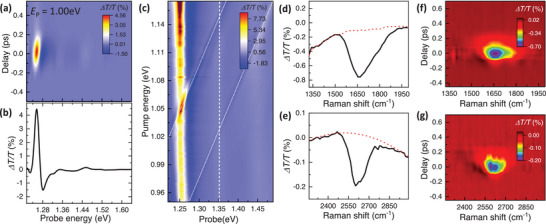
Energy‐dependent pump‐probe spectroscopy. a) Pump‐probe spectra of SWCNTs at room temperature. The color scale, vertical axis, and horizontal axis represent the transmission change ΔT/T, the pump‐probe time delay τ, and probe photon energy, respectively. The positive (negative) ΔT/T represents a decrease (increase) in absorption. The sample was excited with a linearly polarized pump at a photon energy E p of 1.00 eV. b) At τ = 0 ps, the pump‐induced signals show spectral responses that are dominated by energy blueshift near the exciton resonance, signifying a blueshift of excitonic Floquet state |X′〉 under negatively detuned driving pump excitations. c) 2D plot of pump‐probe spectra at τ = 0 ps under different pump energies. The pump intensity was kept constant at 0.7 GW cm−2. The color scale, horizontal axis, and vertical axis represent transmission change ΔT/T, pump, and probe photon energy, respectively. Close to the exciton resonance, the optical responses are dominated by the optical Stark shift of exciton transition. Additionally, 2 prominent pump‐probe signals emerge diagonally across the 2D plot (indicated with white dotted lines), where the peak energy of the signals shifts by the same amount as E p, a defining signature of stimulated Raman scattering. d, e). Transient pump‐probe signals extracted along a line cut shown in (c) at a probe energy of 1.351 eV (vertical white dashed line). The horizontal axis corresponds to the Raman shift deduced from the energy difference between the probe and pump. The sharp features at energies close to 1650 cm−1 (d) and 2610 cm−1 (e) correspond to G‐mode and 2D‐mode phonon resonances in SWCNTs, respectively. f, g) Stimulated Raman scattering signals for G‐mode (f) and 2D‐mode (g) phonons at different τ (broad electronic transition backgrounds are subtracted) detected along E pr = 1.351 eV probe channel.
Figure 3
Figure 3
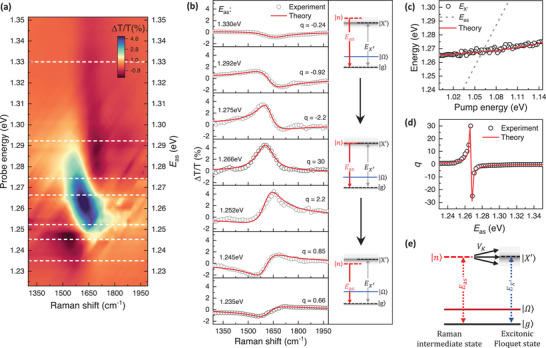
Raman spectra of the optically tunable many‐body Fano resonance. a) 2D plot of transient Raman spectra at various probe energies at τ = 0 ps. For SRS detected along the probe direction, the probe energy simply coincides with the Raman scattering resonance E as (right vertical axis). The horizontal axis shows the Raman shift calculated from the energy difference between the pump and probe for each probe energy. The color scale represents transmission change ΔT/T. b) The transient Raman spectra extracted from the line cuts (white dashed lines) shown in (a) at various probe energies. Red curves are fitted with Fano lineshapes based on equation 1. The right panel shows the evolution of the Raman quantum pathways |n〉 and excitonic Floquet band |X′〉. c) Measured exciton resonance (black circles) as a function of driving pump energy for a driving intensity of 0.7 GW cm−2. The dependence can be nicely described by an inverse proportional relationship (red line). The dashed line shows the calculated Raman scattering frequency E as as a function of pump energy. d) The Fano q‐factor extracted by fitting the Raman spectra based on Equation 1 (black circles) is in good agreement with the predictions based on Equation 2 (red solid line). e) Schematic diagram illustrating the effective coupling between the phonon Raman intermediate state |n〉 and excitonic Floquet states |X′〉 under driving pump irradiation. The interactions are governed by the electron‐phonon coupling constant Vk .
Figure 4
Figure 4
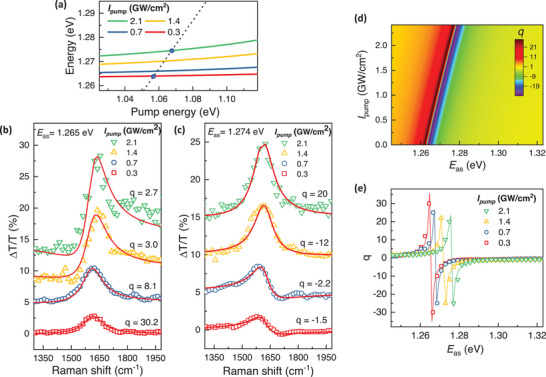
Pump intensity dependence of Fano resonance. a) Calculated exciton resonance as a function of driving pump energy at different driving intensities I pump (solid lines). Depending on the pump intensity, the Raman scattering frequency E as (black dashed line) intercepts with the exciton resonance at different energies. The blue circles show the resonant Raman scattering conditions for driving pump intensities set to 0.3 and 2.1 GW cm−2. b, c) Driving pump intensity‐dependent Fano lineshapes at (b) E as = 1.265 eV and (c) E as = 1.274 eV. By controlling the driving pump intensity, the Fano lineshapes for a given E as varies from asymmetric dispersive feature to symmetric Lorentzian, corresponding to a change of interference parameter from |q| ≈ 1 to |q| ≫ 1. d) The Fano q‐parameter calculated based on Equation 2 for different driving pump intensities I pump. e) The Fano q‐parameter as a function of E as at different excitation intensities. Symbols are q values obtained from fitting the Raman spectra based on Fano lineshapes described in Equation 1 and solid lines are fitting based on Equation 2.

References

    1. Fano U., Phys. Rev. 1961, 124, 1866.
    1. Fano U., Cooper J. W., Rev. Mod. Phys. 1968, 40, 441.
    1. Miroshnichenko A. E., Flach S., Kivshar Y. S., Rev. Mod. Phys. 2010, 82, 2257.
    1. Limonov M. F., Rybin M. V., Poddubny A. N., Kivshar Y. S., Nat. Photonics 2017, 11, 543.
    1. Tang T.‐T., Zhang Y., Park C.‐H., Geng B., Girit C., Hao Z., Martin M. C., Zettl A., Crommie M. F., Louie S. G., Shen Y. R., Wang F., Nat. Nanotechnol. 2010, 5, 32. - PubMed

LinkOut - more resources