Comparative Study
. 2024 Dec;132(12):788-798.
doi: 10.1002/cncy.22900. Epub 2024 Aug 29.

Comparative genomic and immunopathologic analysis of lung adenocarcinomas with and without cytology-proven malignant pleural effusions

Affiliations
Comparative Study

Comparative genomic and immunopathologic analysis of lung adenocarcinomas with and without cytology-proven malignant pleural effusions

Cristiana M Pineda et al. Cancer Cytopathol. 2024 Dec.

Abstract

Background: Lung cancer complicated by malignant pleural effusions (MPEs) is associated with significantly increased morbidity and mortality, yet the mechanisms of MPE development remain poorly understood. This study sought to elucidate whether there were specific genomic alterations and/or immunologic biomarkers associated with the presence of MPEs.

Methods: Analysis of comprehensive genomic and immunologic profiling for 275 locally advanced (stage III) or advanced (stage IV) lung adenocarcinomas was subcategorized into cytology-confirmed MPE-positive (MPE+; n = 139 stage IV) and MPE-negative (MPE-; n = 30 stage III + n = 106 stage IV) groups.

Results: Smoking frequency (p = .0001) and tumor mutational burden (p < .001) were demonstrated to be lower in the MPE+ group compared to the MPE- group. Median overall survival in the MPE+ group was shorter than in the MPE- group across all data (2.0 vs. 5.5 years; p < .0001) and for smokers (1.2 vs. 6.4 years; p < .0001). There were a number of differences at the genomic level across all cases and when stratifying by smoking status, including a higher frequency of EGFR mutations and a lower frequency of STK11 mutations in the MPE+ cohort. Finally, investigation of the comutational profiles of tumors by MPE status revealed differences in TP53- and STK11-mutant tumors between the two groups.

Conclusions: Overall, these findings imply that there are both clinical and genetic factors associated with advanced lung adenocarcinoma MPEs. Future studies of these alterations may prove important both for understanding the pathophysiology of MPE development in advanced cancer and for the earlier detection of at-risk patients.

Keywords: advanced‐stage lung adenocarcinoma; comutational profile; cytology; malignant pleural effusion; next‐generation sequencing (NGS); tumor mutational burden (TMB).


Conflict of interest statement

Adnan Majid reports receiving consulting fees and honoraria from Olympus America and Latin America, Boston Scientific, Cook Medical, Pulmonx, Praxis Medical, Steris, Pinnacle Biologics, and UpTo-Date, unrelated to the current work. Daniel B. Costa reports receiving consulting fees and honoraria from Takeda/Millennium Pharmaceuticals, AstraZeneca, Pfizer, Blueprint Medicines, and Janssen; institutional research support from Takeda/Millennium Pharmaceuticals, AstraZeneca, Pfizer, Merck Sharp and Dohme, Merrimack Pharmaceuticals, Bristol-Myers Squibb, Clovis Oncology, Spectrum Pharmaceuticals, Tesaro, and Daiichi Sankyo; consulting fees from Teladoc and Grand Rounds/Included Health; and royalties from Life Technologies, unrelated to the current work. Paul A. VanderLaan reports receiving consulting fees from Gala/Galvanize Therapeutics, Ruby Robotics, Intuitive Surgical, Veracyte, and Agilent Technologies, unrelated to the current work. The other author declares no conflicts of interest

Figures
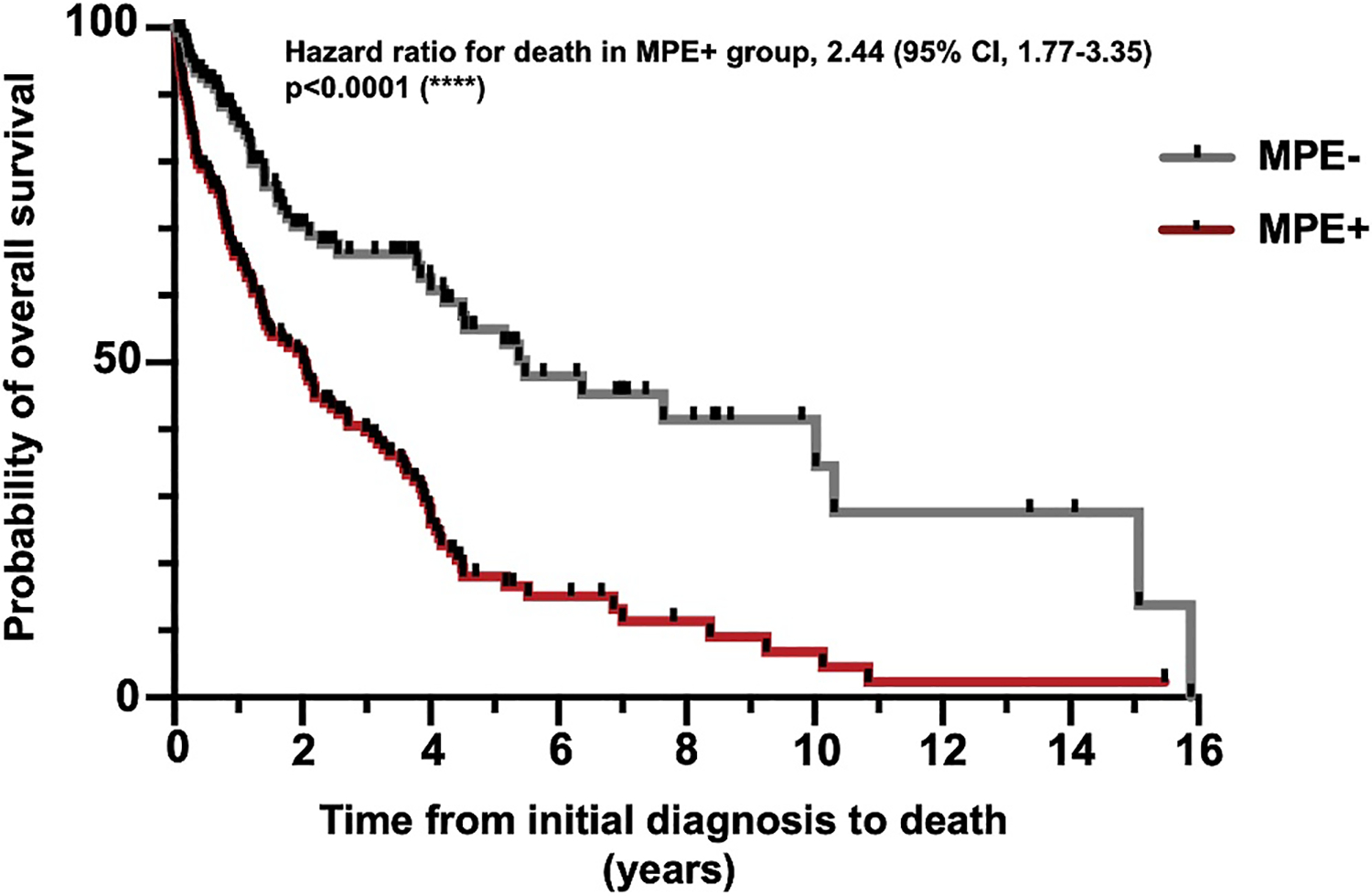
FIGURE 1
FIGURE 1
Comparison of overall survival between the MPE+ and MPE− groups. The MPE+ group (n = 134; five patients lost to follow-up) had decreased overall survival compared to the MPE− group (n = 123; 13 patients lost to follow-up) within the entire cohort (****p < .0001). MPE indicates malignant pleural effusion.
FIGURE 2
FIGURE 2
Comparison of TMB and PD-L1 TPS in MPE+ versus MPE− cases. (A) The MPE+ group has a lower overall TMB across the entire data set (p = .0009; n = 232) and in the smokers group (p = .009; n = 161). Among nonsmokers, there is not a significant difference in TMB between the MPE+ and MPE− groups (n = 71). (B) The proportion of TMB-high cases (≥10 mut/Mb) was significantly higher in the MPE− group compared to the MPE+ group among all data (33.33 vs. 14.78; p = .0009) and smokers (40.66 vs. 22.86; p = .02) but not nonsmokers. (C) Sorting cases into PD-L1–negative (TPS, <1%), low-positive (TPS, 1%–49%), and high-positive (TPS, ≥50%) groups reveals there is no statistically significant difference in the distribution of PD-L1 TPS grouping between the MPE+ and MPE− groups across all data (n = 260), smokers-only data (n = 180), or nonsmokers-only data (n = 80). *p < .05, **p < .01, ***p < .001. MPE indicates malignant pleural effusion; mut/mb, mutations per megabase; NS, not significant; PD-L1, programmed cell death ligand 1; TMB, tumor mutational burden; TPS, tumor proportion score.
FIGURE 3
FIGURE 3
Comparative mutational frequency of MPE+ versus MPE− cases. Genomic alterations in MPE+ and MPE− lung adenocarcinoma cases, including mutations in the common driver oncogenes (A) EGFR, (B) KRAS, and (C) BRAF and modulatory genes including (D) TP53, (E) CDKN2A/B, and (F) STK11. In MPE+ tumors there is a trend toward an increased frequency of EGFR mutations (p = .03), whereas in MPE− tumors there is a trend toward an increased frequency of STK11 mutations (p = .01). *p < .05. MPE indicates malignant pleural effusion; NS, not significant.
FIGURE 4
FIGURE 4
Comparison of mutation frequency in MPE+ versus MPE− cases stratified by smoking status. Genomic alterations in MPE+ and MPE− lung adenocarcinoma cases, including mutations in the common driver oncogenes (A) EGFR, (B) KRAS, and (C) BRAF and modulatory genes including (D) TP53, (E) CDKN2A/B, and (F) STK11. Among smokers, there is a trend toward an increased frequency of STK11 mutations (p = .02) in the MPE− group. *p < .05. MPE indicates malignant pleural effusion; NS, not significant.
FIGURE 5
FIGURE 5
Detailed analysis of EGFR- and KRAS-mutant tumors. (A,B) The EGFR-L858R mutation is more frequent in the MPE+ group among all cases (p = .04) and smokers (p = .02). The exon 20 mutation is more frequent in MPE− nonsmokers (p = .02). (C,F) EGFR-mutant (n = 83) and KRAS-mutant (n = 84) tumors do not have any significant differences in comutational profile between MPE+ and MPE− cases across the above selected genes. (D,E) There is no significant difference in the mutational frequency of the KRAS-G12C mutation subtype or all other non-G12C mutations between the MPE+ (n = 44) and MPE− (n = 40) groups among all cases, smokers-only cases, or nonsmokers-only cases. *p < .05. MPE indicates malignant pleural effusion; NS, not significant; PD-L1, programmed cell death ligand 1; TPS, tumor proportion score.

References

    1. Siegel RL, Giaquinto AN, Jemal A. Cancer statistics, 2024. CA Cancer J Clin. 2024;74(1):12–49. doi: 10.3322/caac.21820 - DOI - PubMed
    1. Cancer Stat Facts: Lung and Bronchus Cancer. National Cancer Institute Surveillance, Epidemiology, and End Results Program. Accessed May 19, 2024. https://seer.cancer.gov/statfacts/html/lungb.html
    1. Morgensztern D, Waqar S, Subramanian J, Trinkaus K, Govindan R. Prognostic impact of malignant pleural effusion at presentation in patients with metastatic non-small-cell lung cancer. J Thorac Oncol. 2012;7(10):1485–1489. doi: 10.1097/JTO.0b013e318267223a - DOI - PubMed
    1. Aydin Y, Turkyilmaz A, Intepe YS, Eroglu A. Malignant pleural effusions: appropriate treatment approaches. Eurasian J Med. 2009;41(3):186–193. - PMC - PubMed
    1. Lew M, Cantley R, Heider A, Jing X. Diagnosis and categorization of malignant effusions: a 6-year review from a single academic institution. Diagn Cytopathol. 2021;49(5):615–621. doi: 10.1002/dc.24433 - DOI - PubMed

Publication types

MeSH terms
