


The use of text messages as an alternative invitation method for breast cancer screening: A randomized controlled trial (M-TICS study)
- PMID: 39208325
- PMCID: PMC11361687
- DOI: 10.1371/journal.pone.0306720
The use of text messages as an alternative invitation method for breast cancer screening: A randomized controlled trial (M-TICS study)
Abstract
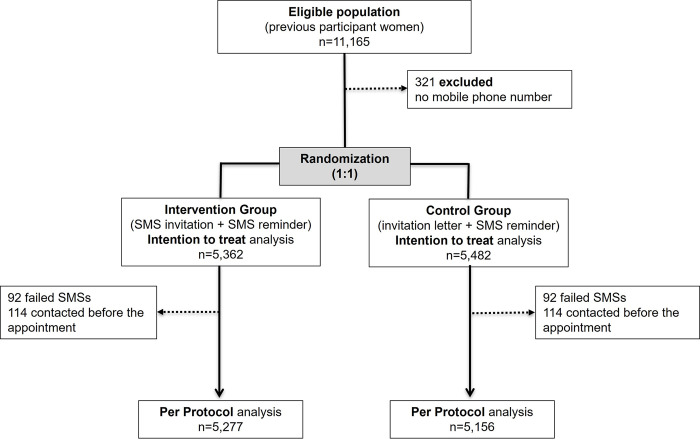
This study aimed to determine whether a text message is as good as a postal letter as an invitation method for previous screenees in a breast cancer screening program, considering a non-inferiority margin of -2 percent points on participation rate. A non-inferiority randomized control trial was conducted. Women in the intervention group (n = 5,362) were invited by text message, and women in the control group (n = 5,482) were invited by letter, which is the standard invitation procedure of the program. In both groups, the invitation included a fixed appointment for mammography and a text message reminder 96 hours before the appointment. The primary outcome was screening participation rate (completing mammography within 12 weeks of invitation). Secondary outcomes included mammography attendance to initial or rescheduled appointments and cancellation rate. The intention-to-treat analysis showed a participation rate of 87.3% and 86.6% in the control and intervention groups, respectively. The difference in participation rate was -0.7 percentage points (95% confidence interval [CI], -1.8 to ∞), indicating non-inferiority of text messages compared to letter invitations. The per-protocol analysis showed similar results. Attendance at the initial appointment was higher in women who received the text message invitation compared to those in the control group (P<0.002). Women who received the invitation by letter canceled more the initial appointment scheduled compared to the text message group (21.1% and 15.1%, P<0.007). In conclusion, we found that a text message invitation for women who had previously participated in breast cancer screening was not inferior to the standard letter. This randomized controlled trial provides valuable insights into the use of alternative invitation methods for population-based cancer screening programs. However, further research is needed to determine the best timing and frequency of text messages for better outcomes and identify strategies for facilitating rescheduling or cancellation. Trial Registration: Clinicaltrials.gov NCT04343950, (04/09/2020).
Copyright: © 2024 Vives et al. This is an open access article distributed under the terms of the Creative Commons Attribution License, which permits unrestricted use, distribution, and reproduction in any medium, provided the original author and source are credited.
Conflict of interest statement
The authors have declared that no competing interests exist.
Figures

Update of
-
Text messaging as a tool to improve cancer screening programs (M-TICS Study): A randomized controlled trial protocol.PLoS One. 2021 Jan 22;16(1):e0245806. doi: 10.1371/journal.pone.0245806. eCollection 2021. PLoS One. 2021. Update in: PLoS One. 2024 Aug 29;19(8):e0306720. doi: 10.1371/journal.pone.0306720. PMID: 33481914 Free PMC article. Updated.
References
-
- Sardanelli F, Aase HS, Álvarez M, Azavedo E, Baarslag HJ, Balleyguier C, et al. Position paper on screening for breast cancer by the European Society of Breast Imaging (EUSOBI) and 30 national breast radiology bodies from Austria, Belgium, Bosnia and Herzegovina, Bulgaria, Croatia, Czech Republic, Denmark, Estonia, Finland, France, G. Eur Radiol. 2017;27: 2737–2743. doi: 10.1007/s00330-016-4612-z - DOI - PMC - PubMed
-
- International Agency for Research on Cancer. Cancer Screening in the European Union. Report on the implementation of the Council Recommendation on cancer screening (second report). Brussels: European Commission; 2017.
-
- General Direction of Health Planning. [Catalan Health Survey, 2022]. Barcelona: General Direction of Health Planning; 2023.
-
- European Commission. European guidelines for quality assurance in breast cancer screening and diagnosis. Fourth edition. Perry N, Broeders M, de Wolf C, Törnberg S, Holland R, von Karsa L, editors. Luxembourg: Office for Official Publications of the European Communities; 2006. - PubMed
