


Positronium lifetime validation measurements using a long-axial field-of-view positron emission tomography scanner
- PMID: 39210079
- PMCID: PMC11362402
- DOI: 10.1186/s40658-024-00678-4
Positronium lifetime validation measurements using a long-axial field-of-view positron emission tomography scanner
Abstract
Background: Positron emission tomography (PET) traditionally uses coincident annihilation photons emitted from a positron interacting with an electron to localize cancer within the body. The formation of positronium (Ps), a bonded electron-positron pair, has not been utilized in clinical applications of PET due to the need to detect either the emission of a prompt gamma ray or the decay of higher-order coincident events. Assessment of the lifetime of the formed Ps, however, can potentially yield additional diagnostic information of the surrounding tissue because Ps properties vary due to void size and molecular composition. To assess the feasibility of measuring Ps lifetimes with a PET scanner, experiments were performed in a Biograph Vision Quadra (Siemens Healthineers). Quadra is a long-axial field-of-view (LA-FOV) PET scanner capable of producing list-mode data from single interaction events.
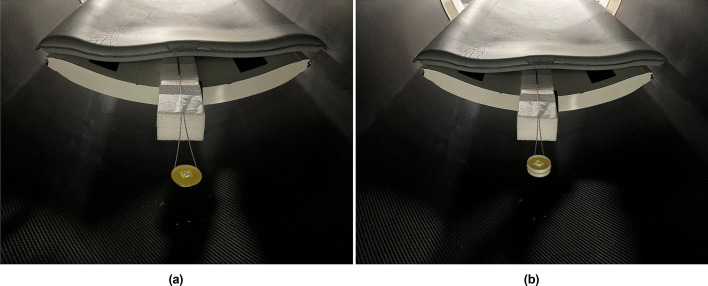
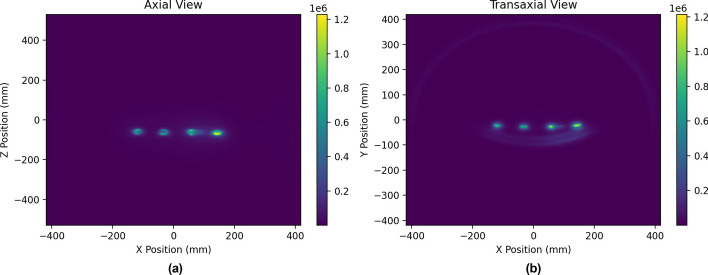
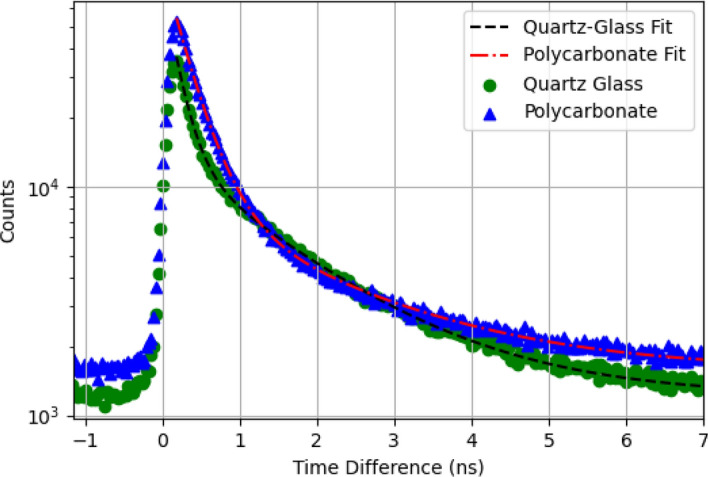
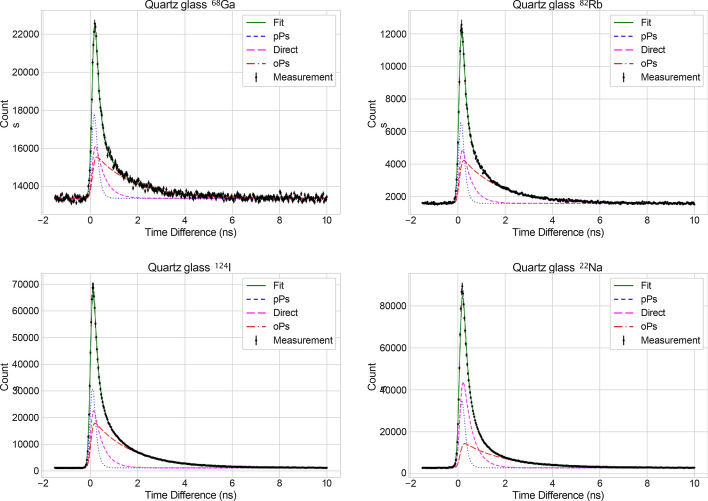
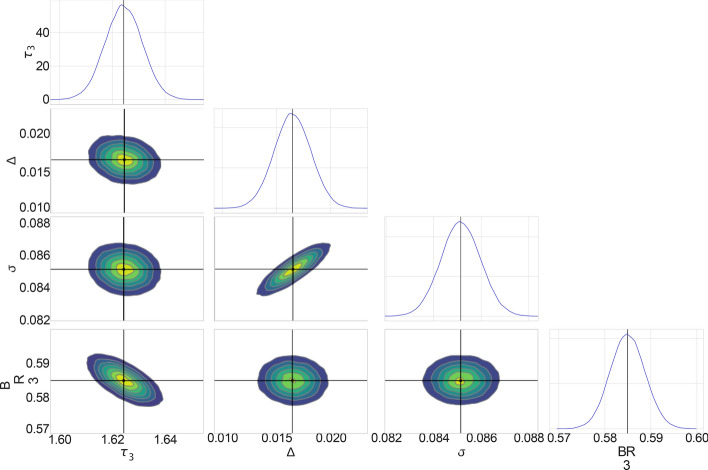
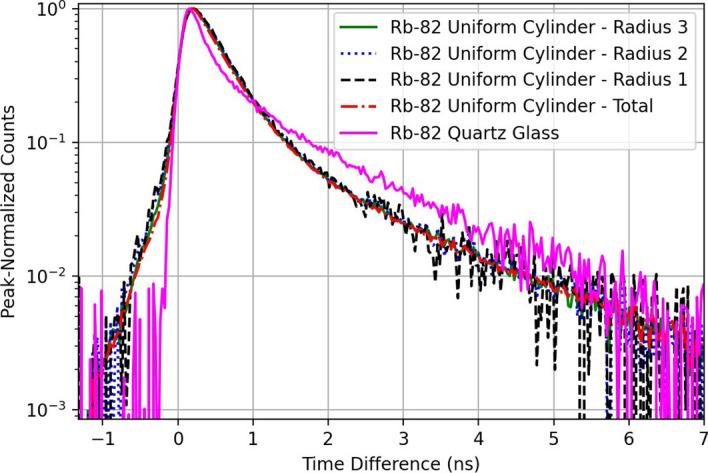
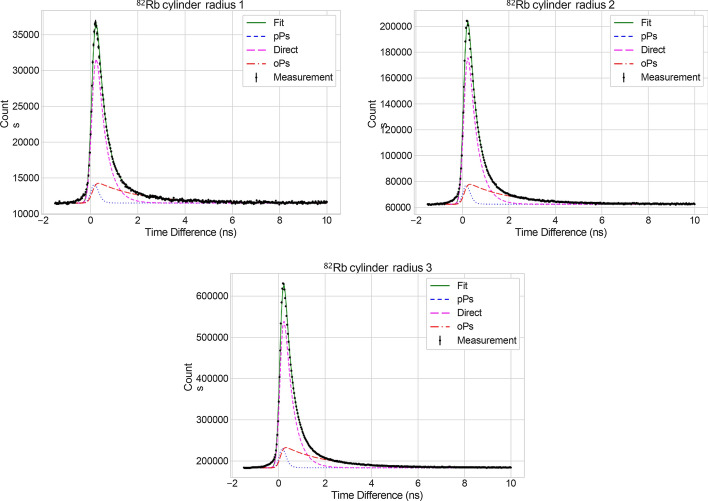
Results: Ortho-Ps (o-Ps) lifetimes were measured for quartz-glass and polycarbonate samples using a positron source. Results produced o-Ps lifetimes of 1.538 ± 0.036 ns for the quartz glass and 1.927 ± 0.042 ns for the polycarbonate. Both o-Ps lifetimes were determined using a double-exponential fit to the time-difference distribution between the emission of a prompt gamma ray and the annihilation of the correlated positron. The measured values match within a single standard deviation of previously published results. The quartz-glass samples were additional measured with , Ga and to validate the lifetime using clinically available sources. A double-exponential fit was initially chosen as a similar methodology to previously published works, however, an exponentially-modified Gaussian distribution fit to each lifetime more-accurately models the data. A Bayesian method was used to estimate the variables of the fit and o-Ps lifetime results are reported using this methodology for the three clinical isotopes: 1.59 ± 0.03 ns for , 1.58 ± 0.07 ns for and 1.62 ± 0.01 ns for . The impact of scatter and attenuation on the o-Ps lifetime was also assessed by analyzing a water-filled uniform cylinder (20 30 cm ) with an added solution. Lifetimes were extracted for various regions of the cylinder and while there is a shape difference in the lifetime due to scatter, the extracted o-Ps lifetime of the water, 1.815 ± 0.013 ns, agrees with previously published results.
Conclusion: Overall, the methodology presented in this manuscript demonstrates the repeatability of Ps lifetime measurements with clinically available isotopes in a commercially-available LA-FOV PET scanner. This validation work lays the foundation for future in-vivo patient scans with Quadra.
Keywords: Molecular imaging; Positron emission tomography; Positronium imaging.
© 2024. The Author(s).
Conflict of interest statement
W.M.S, J.B., H.S. and M.C. are employees of Siemens Medical Solutions USA, Inc., and Siemens Healthineers International AG. P. M. is an inventor on a patent related to this work. Patent nos.: (Poland) PL 227658, (Europe) EP 3039453, and (United States) US 9,851,456], filed (Poland) 30 August 2013, (Europe) 29 August 2014, and (United States) 29 August 2014; published (Poland) 23 January 2018, (Europe) 29 April 2020, and (United States) 26 December 2017. A.R. has received research support and speaker honoraria from Siemens. K.S. received research grants from Novartis and Siemens, further conference sponsorships from United Imaging, Siemens, and Subtle Medical outside of the submitted work.
Figures







References
-
- Bass SD, Mariazzi S, Moskal P, Stępień E. Colloquium: positronium physics and biomedical applications. Rev Modern Phys. 2023;95(2): 021002. 10.1103/RevModPhys.95.021002 - DOI
-
- Charlton MJ. Positron physics. Cambridge Monographs on Atomic, Molecular and Chemical Physics. Cambridge: The Press Syndicate of the University of Cambridge; 2001.
-
- Weisberg H, Berko S. Positron lifetimes in metals. Phys Rev. 1967;154(2):249. 10.1103/PhysRev.154.249. 10.1103/PhysRev.154.249 - DOI
-
- Kotera K, Saito T, Yamanaka T. Measurement of positron lifetime to probe the mixed molecular states of liquid water. Phys Lett A. 2005;345(1–3):184–90. 10.1016/j.physleta.2005.07.018. 10.1016/j.physleta.2005.07.018 - DOI
Grants and funding
LinkOut - more resources
Full Text Sources
Miscellaneous
