. 2024 Aug 29;6(1):obae029.
doi: 10.1093/iob/obae029. eCollection 2024.

Jumping Performance and Behavior of the Globular Springtail Dicyrtomina minuta

Affiliations

Jumping Performance and Behavior of the Globular Springtail Dicyrtomina minuta

A A Smith et al. Integr Org Biol. .

Abstract

Springtails are among the most abundant arthropods on earth and they exhibit unique latch-mediated spring-actuated jumping behaviors and anatomical systems. Despite this, springtail jumps have not been well described, especially for those with a globular body plan. Here, we provide a complete description and visualization of jumping in the globular springtail Dicyrtomina minuta. A furca-powered jump results in an average take-off velocity of 1 ms-1 in 1.7 ms, with a fastest acceleration to liftoff of 1938 ms-2. All jumps involve rapid backwards body rotation throughout, rotating on average at 282.2 Hz with a peak rate of 368.7 Hz. Despite body lengths of 1-2 mm, jumping resulted in a backwards trajectory traveling up to 102 mm in horizontal distance and 62 mm in vertical. Escape jumps in response to posterior stimulation did not elicit forward-facing jumps, suggesting that D. minuta is incapable of directing a jump off a flat surface within the 90° heading directly in front of them. Finally, two landing strategies were observed: collophore-anchoring, which allows for an immediate arrest and recovery, and uncontrolled landings where the springtail chaotically tumbles. In comparison to other fast jumping arthropods, linear performance measures globular springtail jumps place them between other systems like fleas and froghoppers. However, in angular body rotation, globular springtails like D. minuta surpass all other animal systems. Given the extraordinary performance measures, unique behavioral responses, and understudied nature of these species, globular springtails present promising opportunities for further description and comparison.


Conflict of interest statement

The authors have no conflict of interests to declare.

Figures
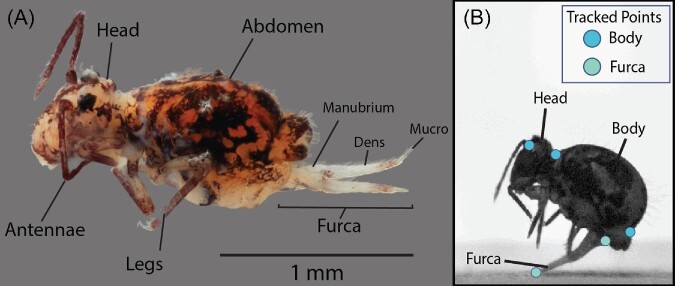
Fig. 1
Fig. 1
Dicytromina minuta springtails are found in the top layers of leaf litter. (A) Light microscope image of D. minuta showing a lateral view with posterior end of the animal to the right. Anatomical reference points relevant to body orientation and jumping morphology are shown on the panel. The collophore is underneath the body and not everted and therefore not visible in the image. (B) A D. minuta springtail during a jump where the furca is pushing down on the substrate and lifting the springtail into a jump. Circles on the body represent the points tracked during a jump and used to calculate jump kinematics.
Fig. 2
Fig. 2
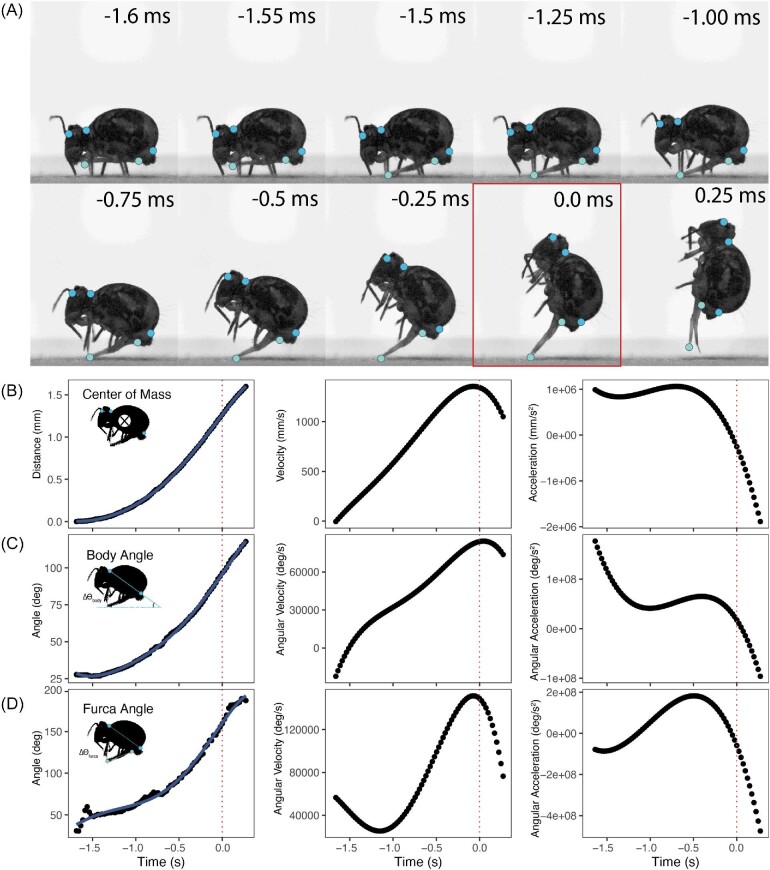
Liftoff process from furca release until airborne. (A) Anatomical reference points and sequential extracted frames from a single sequence captured at 40,322 frames per second showing furca release, body rotation, and initial liftoff. Time stamps indicate milliseconds relative to the last point of contact with the ground (outlined). (B) Distance, velocity, and acceleration measured from centroid point of the body during the sequence shown in A. Dotted line indicates last point of ground contact. (C and D) Body and furca angle relative to the ground, rotational velocity, rotational acceleration during the sequence shown in A. Dotted line indicates last point of ground contact.
Fig. 3
Fig. 3
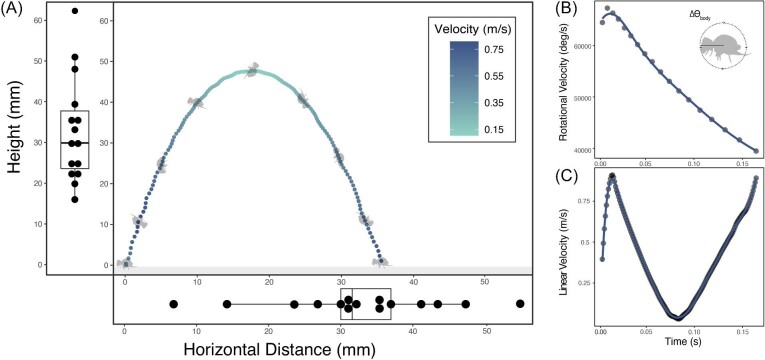
Mid-air trajectory and performance of full jumps. (A) An example trajectory tracking height and horizontal distance of a jump. Darkness value of the point represents velocity as indicated in key. Summary maximum height and distance data for all jumps presented as median, 25% 75%, and range, individuals denoted as points. (B) Rotational velocity measured by the frame at which a flip was completed during the same jump that height and distance was tracked and displayed in panel A. Each point in panel B is complete flip tracked across the mid-air duration of a jump. (C) Linear velocity throughout the complete trajectory of the jump.
Fig. 4
Fig. 4
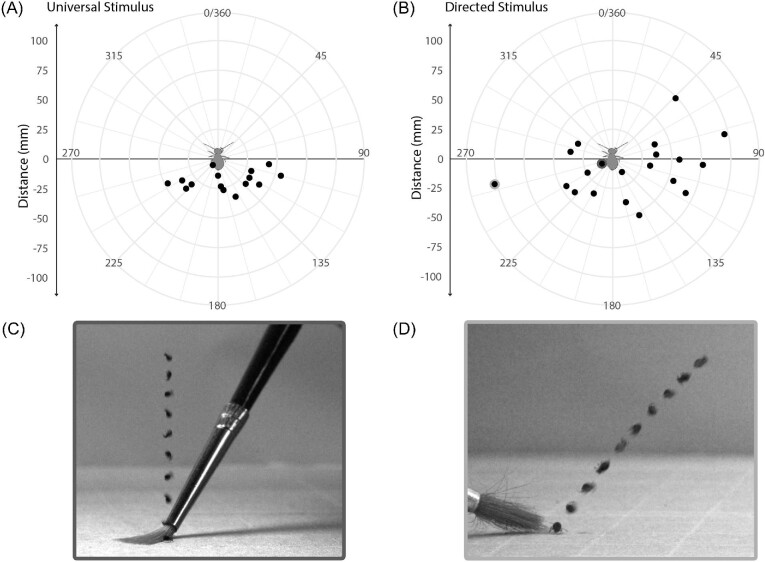
Polar plots displaying jump distance and trajectory in response to a universal stimulus of bright light (A) and a directed stimulus of light plus posterior contact from a paint brush (B). Plots simulate a view from above where the springtail is standing with its head pointed up (forward) and abdomen pointed down (backward). Individual directed stimulus jumps outlined in light and dark values in panel B are depicted in panels C and D. Panel C shows the initial trajectory of the jump with the smallest horizontal distance, while panel D shows the initial trajectory of the jump with the farthest horizontal trajectory.
Fig. 5
Fig. 5
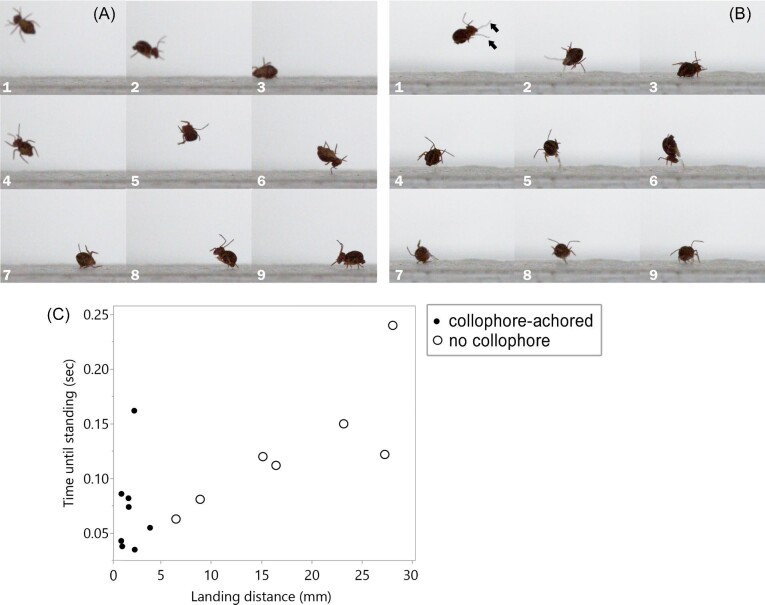
Landing to self-righting process after direct-stimulation escape jumps. (A and B) Close-up high-speed video captures demonstrating two observed landing styles: (A) uncontrolled bouncing (4/14 sequences), (B) collophore anchoring (10/14 sequences). Arrows in panel 1 of C show the branched arms of the collophore extended as the springtail is descending. (C) Time from first touching the ground until first standing compared to horizontal distance traveled during that time. These data are the 15 of the 20 jumps recorded directional escape jumping displayed in Fig. 3B. The remaining five of that data set came to a stop stranded on their backs or did not self-right in the recording.

References

    1. Ant Lab . 2021. Springtail Jumps off Water and in Super Slow Motion! YouTube. https://youtu.be/MXeSnWY6DNc (16 April 2024, date last accessed).
    1. Askew GN, Marsh RL, Ellington CP. 2001. The mechanical power output of the flight muscles of blue-breasted quail (Coturnix chinensis) during take-off. J Exp Biol 204:3601–19. - PubMed
    1. Bauer T, Christian E. 1987. Habitat dependent differences in the flight behaviour of collembola. Pedobiologia 30:233–9.
    1. Bennet-Clark HC. 1975. The energetics of the jump of the locust Schistocerca gregaria. J Exp Biol 63:53–83. - PubMed
    1. Brackenbury J. 1990. A novel method of self-righting in the springtail Sminthurus viridis (Insecta: collembola). J Zool, London 222: 117–9.

LinkOut - more resources