Comparative Study
. 2025 Jun;47(3):3539-3549.
doi: 10.1007/s11357-024-01330-w. Epub 2024 Aug 30.

Do people reach 100 by surviving, delaying, or avoiding diseases? A life course comparison of centenarians and non-centenarians from the same birth cohorts

Affiliations
Comparative Study

Do people reach 100 by surviving, delaying, or avoiding diseases? A life course comparison of centenarians and non-centenarians from the same birth cohorts

Yuge Zhang et al. Geroscience. 2025 Jun.

Abstract

Centenarians are perceived as pioneers of longevity, possessing the secrets to surpassing age 100. It remains unclear whether they achieve this by surviving, delaying, or avoiding diseases to a greater extent than their shorter-lived peers. This register-based study encompassed all individuals aged 60 and older, born between 1912 and 1922 in Stockholm County, Sweden (N = 170,787). Using historical data, individuals were prospectively followed from 1972 to 2022 and stratified by their age at death. Age-specific incidence rates and remaining lifetime risk from age 60 were calculated for stroke, myocardial infarction, hip fracture, and various cancers (including colorectal, breast, and prostate), and compared between those who survived to age 100 and their shorter-lived counterparts. Centenarians had lower age-specific incidence rates for almost all diseases and ages. Despite longer life spans, their lifetime risks for all diseases except hip fracture were lower than those of non-centenarians. This suggests that centenarians delay, and even avoid, many of the major age-related diseases rather than surviving them to a higher extent. The findings that centenarians not only exhibit lower disease rates at younger ages compared to their shorter-lived peers but throughout their lives challenge the notion that longer life span inevitably leads to higher disease rates or a simple shift of diseases to older ages.

Keywords: Age-specific incidence rate; Birth cohort; Centenarians; Lifetime risk; Longevity.


Conflict of interest statement

Declarations. Ethic approval: This study was performed in line with the principles of the Declaration of Helsinki. This study was approved by the regional ethics committee in Stockholm (Dnr 2011/136–31/5). Conflict of interest: The authors declare no competing interests.

Figures
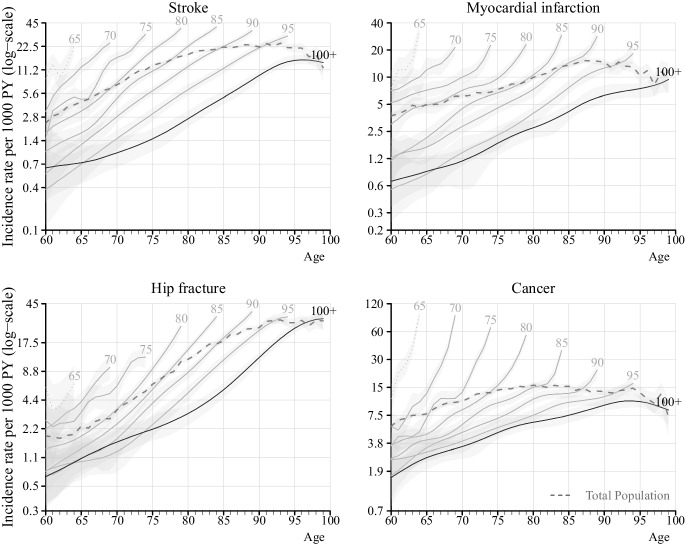
Fig. 1
Fig. 1
Age-specific incidence rates of stroke, myocardial infarction, hip fractures, and cancer from age 60 for individuals born between 1912 and 1922, by age at death, in Stockholm County, Sweden. Notes: Solid lines represent the smoothed rates while dashed line for age 65 represents the observed rates. The light grey area represents the 95% confidence interval. The x-axis represents the chronological ages of everyone followed from age 60 until death or becoming centenarians. The numbers by each line represent age at death
Fig. 2
Fig. 2
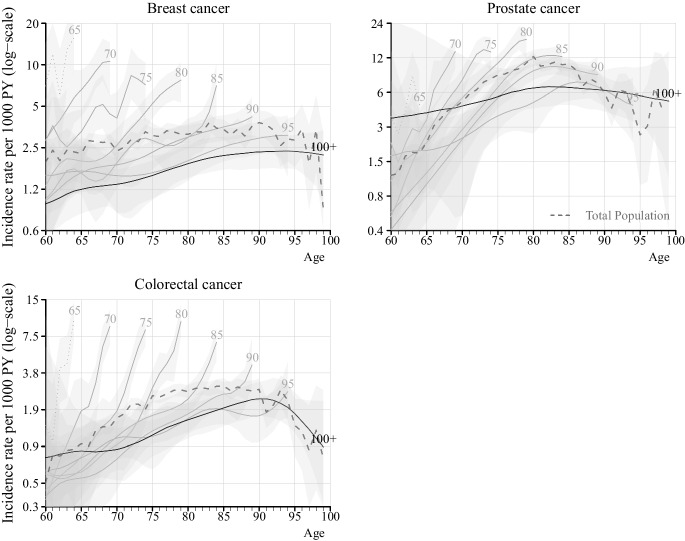
Age-specific incidence rates of breast, prostate, and colorectal cancer from age 60 for individuals born between 1912 and 1922, by age at death, in Stockholm County, Sweden. Notes: Solid lines represent the smoothed rates while dashed line for age 65 represents the observed rates. The light grey area represents the 95% confidence interval. The x-axis represents the chronological ages of everyone followed from age 60 until death or becoming centenarians. The numbers by each line represent age at death
Fig. 3
Fig. 3
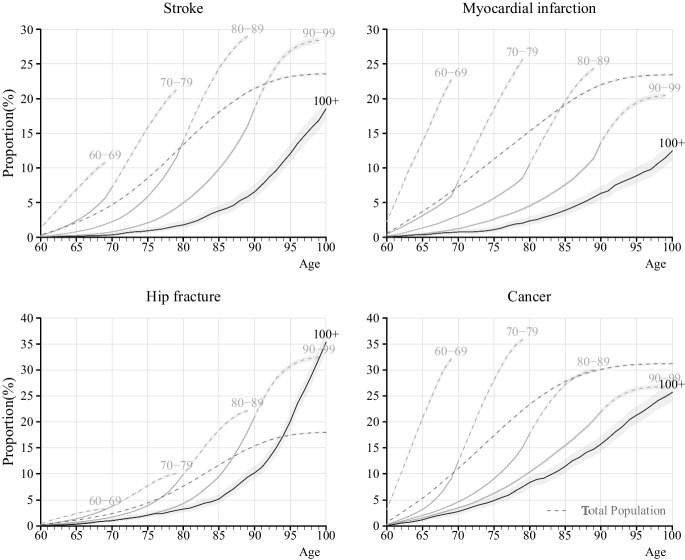
Cumulative incidence of stroke, myocardial infarction, hip fractures, and cancer from age 60 for individuals born between 1912 and 1922, by age at death, in Stockholm County, Sweden. Note: The lines for the cumulative incidence are dashed when part of the individuals in the age-at-death group has died, and solid when conditioning on survival; i.e., in the group that dies between ages 80–89, the line is solid up until age 80, and thereafter dashed. The lightgrey area represents the 95% confidence interval of respective age groups
Fig. 4
Fig. 4
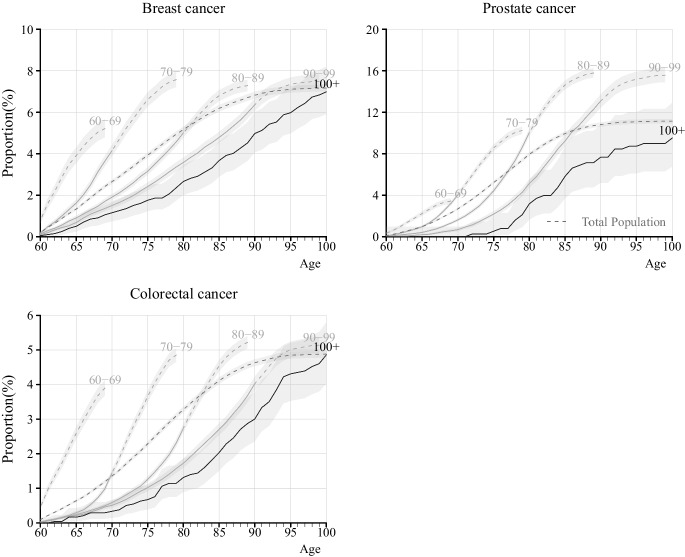
Cumulative incidence of breast, prostate, and colorectal cancer from age 60 for individuals born between 1912 and 1922, by age at death, in Stockholm County, Sweden. Note: The lines for the cumulative incidence are dashed when part of the individuals in the age-at-death group has died, and solid when conditioning on survival; i.e., in the group that dies between ages 80–89, the line is solid up until age 80, and thereafter dashed. The light grey area represents the 95% confidence interval of respective age groups

References

    1. Willcox DC, Willcox BJ, Poon LW. Centenarian studies: important contributors to our understanding of the aging process and longevity. Curr Gerontol Geriatr Res. 2010;2010:484529. 10.1155/2010/484529. - DOI - PMC - PubMed
    1. Motta M, Bennati E, Ferlito L, et al. Successful aging in centenarians: myths and reality. Arch Gerontol Geriatr. 2005;40(3):241–51. 10.1016/j.archger.2004.09.002. - DOI - PubMed
    1. Terry DF, Sebastiani P, Andersen SL, Perls TT. Disentangling the roles of disability and morbidity in survival to exceptional old age. Arch Intern Med. 2008;168(3):277–83. 10.1001/archinternmed.2007.75. - DOI - PMC - PubMed
    1. Hazra NC, Dregan A, Jackson S, Gulliford MC. Differences in health at age 100 according to sex: population-based cohort study of centenarians using electronic health records. J Am Geriatr Soc. 2015;63(7):1331–7. 10.1111/jgs.13484. - DOI - PMC - PubMed
    1. Rochon PA, Gruneir A, Wu W, et al. Demographic characteristics and healthcare use of centenarians: a population-based cohort study. J Am Geriatr Soc. 2014;62(1):86–93. 10.1111/jgs.12613. - DOI - PubMed

Publication types

Grants and funding

LinkOut - more resources