


Comparison of Two High-Dose Versus Two Standard-Dose Influenza Vaccines in Adult Allogeneic Hematopoietic Cell Transplant Recipients
- PMID: 39219510
- PMCID: PMC10724468
- DOI: 10.1093/cid/ciad458
Comparison of Two High-Dose Versus Two Standard-Dose Influenza Vaccines in Adult Allogeneic Hematopoietic Cell Transplant Recipients
Abstract
Background: Adult hematopoietic cell transplant (HCT) recipients are at high risk for influenza-related morbidity and mortality and have suboptimal influenza vaccine immune responses compared to healthy adults, particularly within 2 years of transplant.
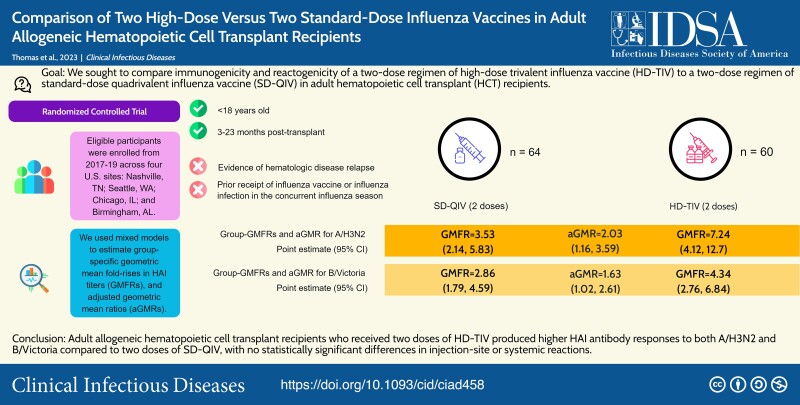
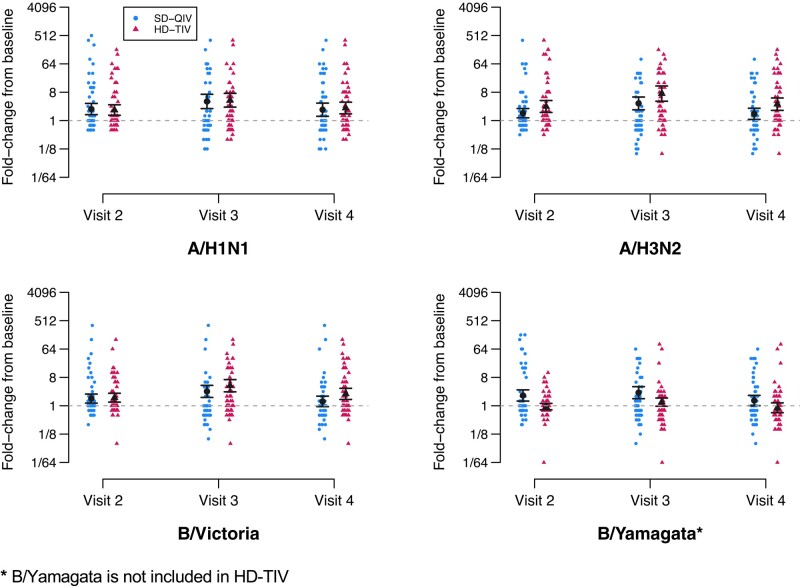
Methods: This phase II, double-blind, multicenter randomized controlled trial compared 2 doses of high-dose trivalent (HD-TIV) to 2 doses of standard-dose quadrivalent (SD-QIV) influenza vaccine administered 1 month apart in adults 3-23 months post-allogeneic HCT. Hemagglutinin antibody inhibition (HAI) titers were measured at baseline, 4 weeks following each vaccine dose, and approximately 7 months post-second vaccination. Injection-site and systemic reactions were assessed for 7 days post-vaccination. The primary immunogenicity comparison was geometric mean HAI titer (GMT) at visit 3 (4 weeks after the second dose); we used linear mixed models to estimate adjusted GMT ratios (aGMRs) comparing HD-TIV/SD-QIV for each antigen.
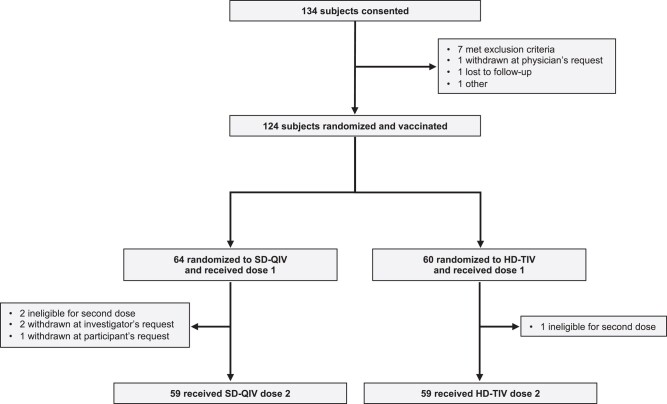
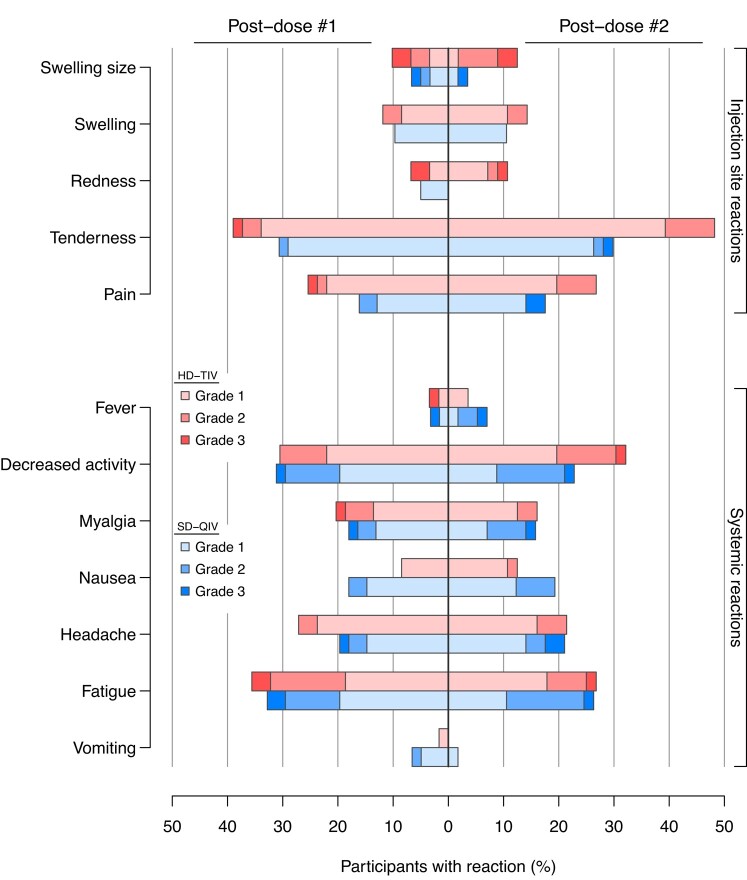
Results: We randomized 124 adults; 64 received SD-QIV and 60 received HD-TIV. Following the second vaccination, HD-TIV was associated with higher GMTs compared to SD-QIV for A/H3N2 (aGMR = 2.09; 95% confidence interval [CI]: [1.19, 3.68]) and B/Victoria (aGMR = 1.61; 95% CI: [1.00, 2.58]). The increase was not statistically significant for A/H1N1 (aGMR = 1.16; 95% CI: [0.67, 2.02]). There was a trend to more injection-site reactions for HD-TIV after the second vaccination compared to SD-QIV (50% vs 33%; adjusted odds ratio [aOR] = 4.53; 95% CI: [0.71, 28.9]), whereas systemic reactions were similar between groups with both injections.
Conclusions: Adult allogeneic HCT recipients who received 2 doses of HD-TIV produced higher HAI antibody responses for A/H3N2 and B/Victoria compared with 2 doses of SD-QIV, with comparable injection-site or systemic reactions.
Keywords: hematopoietic cell transplant; influenza vaccine.
© The Author(s) 2023. Published by Oxford University Press on behalf of Infectious Diseases Society of America.
Conflict of interest statement
Potential conflicts of interest. M. I. has received research support, paid to Northwestern University, from GlaxoSmithKline and reports grant number UL1TR001422, which supported the author and the research capacity used for this project; payment for consultation from Adagio, ADMA Biologics, Adamis, AlloVir, Atea, Cidara, Genetech, Invivyd, Inc, Roche, Janssen, Shionogi, Takeda, Telaris, and Viracor Eurofins; royalties from UpToDate, and is a paid member of an independent data monitoring committee for Adamis, AlloVir, Merck, Sequiris/CSL, Takeda and Talaris. He also reports a role as Chair of ISIRV AVG and as Editor-in-Chief of Transplant Infectious Disease. All conflicts were ended effective 4 December 2022 except for UpToDate. S. A. P. receives research support from Global Life Technologies, Inc, and he participates in clinical trials with F2G, Symbio, and Cidarra. He also reports that Sanofi Pasteur supplied vaccines and hemagglutination titers for this study. N. B. H. has formerly received grant funding from SANOFI and Quidel. She currently receives funding from Merck for an investigator-initiated grant. D. D. reports that Eurofins-Viracor provided assay performance for investigator-initiated research on cytomegalovirus (no payments made); consulting fees paid to author from Horizon Pharmaceuticals. S. K. reports that Sanofi Pasteur supplied vaccines and hemagglutination titers for this study. A. J. S reports participation on a Data Safety Monitoring Board or Advisory Board for Integrated Health Services to reduce opioid use while managing chronic pain and the effect and contribution of a perioperative ketamine infusion in an established enhanced recovery pathway. H. H. reports VIPER T32 grant. E. T. O. reports grants or contracts paid to institution from ViiV Healthcare, Gilead Sciences, and Janssen. L. D. T. reports Sanofi Pasteur supplied vaccines and hemagglutination titers for this study. All other authors report no potential conflicts. All authors have submitted the ICMJE Form for Disclosure of Potential Conflicts of Interest. Conflicts that the editors consider relevant to the content of the manuscript have been disclosed.
Figures
References
-
- Cordonnier C, Einarsdottir S, Cesaro S, et al. Vaccination of haemopoietic stem cell transplant recipients: guidelines of the 2017 European Conference on Infections in Leukaemia (ECIL 7). Lancet Infect Dis 2019; 19:e200–12. - PubMed
-
- Rubin LG, Levin MJ, Ljungman P, et al. 2013 IDSA clinical practice guideline for vaccination of the immunocompromised host. Clin Infect Dis 2014; 58:309–18. - PubMed
-
- Natori Y, Humar A, Lipton J, et al. A pilot randomized trial of adjuvanted influenza vaccine in adult allogeneic hematopoietic stem cell transplant recipients. Bone Marrow Transplant 2017; 52:1016–21. - PubMed
Publication types
MeSH terms
Substances
Grants and funding
LinkOut - more resources
Full Text Sources
Medical
