Systems issues limiting acute fracture care delivery at a tertiary care hospital in Northern Tanzania
- PMID: 39220554
- PMCID: PMC11364886
- DOI: 10.11604/pamj.2024.48.29.41286
Systems issues limiting acute fracture care delivery at a tertiary care hospital in Northern Tanzania
Abstract
Introduction: sub-Saharan Africa experiences a significant musculoskeletal trauma burden. Among patients who receive surgical treatment, there have been no reports as to how often surgical care is determined to be "adequate" or, if "inadequate", then what hospital and orthopaedic specialty-specific systems limitations might be prohibitive.
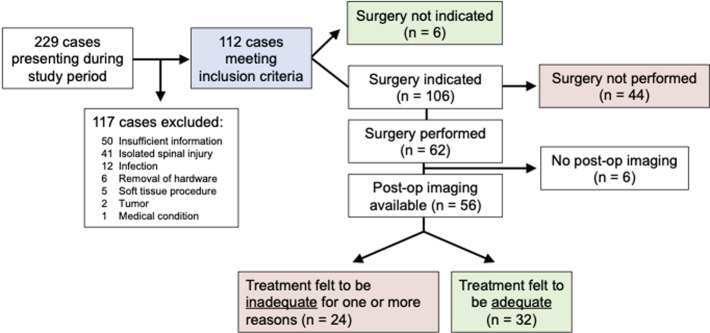
Methods: data from patients presenting to the orthopaedic trauma service at a tertiary care center in sub-Saharan Africa were prospectively collected over a 6-week period and then retrospectively reviewed to determine whether the surgical treatment was "adequate" (or otherwise, "inadequate") according to the principle of restoring length, alignment, and rotation. Exclusion criteria included insufficient clinical information; isolated spinal injury; infection; cases involving only removal of hardware; soft-tissue procedures; tumor cases; and medical (non-surgical) conditions.
Results: 112 cases were included for analysis. Surgery was indicated in 106 of 112 cases (94.6%), and of those, surgery was performed in 62 cases (58.4%). Among patients who underwent surgery with available post-operative imaging (n=56), surgical treatment was "inadequate" in 24 cases (42.9%). The most common reasons treatment was deemed "inadequate" included unavailability of appropriate implants (n=16), unavailability of intraoperative fluoroscopy (n=10) and incomplete intraoperative evaluation of injury (n=5).
Conclusion: several systems limitations prevent the delivery of adequate surgical treatment in patients with acute orthopaedic traumatic injuries, including lack of intraoperative fluoroscopy and lack of implant availability. This study will serve as a useful baseline for ongoing efforts seeking to improve orthopaedic specialty resource availability and facilitate more effective fracture care in this region.
Keywords: Orthopaedics; capacity building; fluoroscopy; fracture fixation; road traffic crash; trauma.
Copyright: Papa Kwadwo Morgan-Asiedu et al.
Conflict of interest statement
The authors declare no competing interests.
Figures
References
-
- Premkumar A, Ying X, Mack Hardaker W, Massawe HH, Mshahaba DJ, Mandari F, et al. Access to Orthopaedic Surgical Care in Northern Tanzania: A Modelling Study. World J Surg. 2018 Oct;42(10):3081–3088. - PubMed
-
- Nelson S, Wongworawat M. 2nd edition. Loma Linda, CA: Loma Linda University Press; 2005. Tolerances: An Orthopaedic Reference Manual.
-
- GlobalSurg Collaborative. Mortality of emergency abdominal surgery in high-, middle-and low-income countries. Br J Surg. 2016 Jul;103(8):971–988. - PubMed
MeSH terms
LinkOut - more resources
Full Text Sources
Medical