


Trends and Disparities in Waterpipe Tobacco Smoking Among US Adolescents and Adults: PATH Study 2013-2021
- PMID: 39220627
- PMCID: PMC11363053
- DOI: 10.1177/1179173X241275352
Trends and Disparities in Waterpipe Tobacco Smoking Among US Adolescents and Adults: PATH Study 2013-2021
Abstract
Background: Waterpipe tobacco smoking (WTS) is a popular mode of nicotine delivery among young people. We examined the trends and disparities in WTS from 2013 to 2021 among US adolescents and adults.
Methods: Data were from Wave 1 (initially conducted among 32 320 adults and 13 651 adolescents) to Wave 6 (2013-2021) of the Population Assessment of Tobacco and Health Study. We assessed the weighted prevalence of ever and current (past 30-day) WTS for adults and adolescents across waves stratified by demographics.
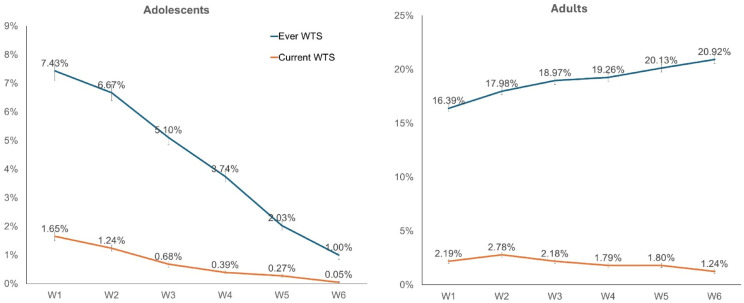
Results: From 2013-2021 among adolescents, the prevalence of ever and current WTS decreased by 86.5% (7.4% to 1.00%; p = 0.0364) and 97.1% (1.65% to 0.05%; p = 0.0012), respectively. Despite the decreasing trends among adolescents across all waves, females had a higher prevalence of ever and current WTS compared to males (p 's < 0.001 for all trends). Hispanics had the highest prevalence of ever WTS compared to other races/ethnicities (p 's < 0.001). Adolescents aged 15-17 had a higher (except Wave 6) prevalence of ever and current WTS than 12-14 years old (p 's < 0.001). For adults, the prevalence of ever WTS increased by 27.4% (16.39% to 20.92%; p = 0.0006), and current WTS decreased by 45.5% (2.19% to 1.24%; p = 0.0012). Young adults aged 18-24 experienced increasing trends in WTS and had the highest prevalence of ever and current WTS compared to other age groups (p 's < 0.001) across all waves.
Conclusions: Our study indicates a notable decrease in adolescent WTS prevalence from 2013 to 2021 but an increase of ever WTS among adults. Demographic differences underscore disparities in WTS, calling for tailored interventions.
Keywords: adolescents; adults; population assessment of tobacco and health; waterpipe tobacco smoking.
© The Author(s) 2024.
Conflict of interest statement
The author(s) declared no potential conflicts of interest with respect to the research, authorship, and/or publication of this article.
Figures
References
Grants and funding
LinkOut - more resources
Full Text Sources
Miscellaneous
