


Protocol-driven approach to guideline-directed medical therapy optimization for heart failure: A real-world application to recovery
- PMID: 39220718
- PMCID: PMC11362780
- DOI: 10.1016/j.ahjo.2024.100438
Protocol-driven approach to guideline-directed medical therapy optimization for heart failure: A real-world application to recovery
Abstract
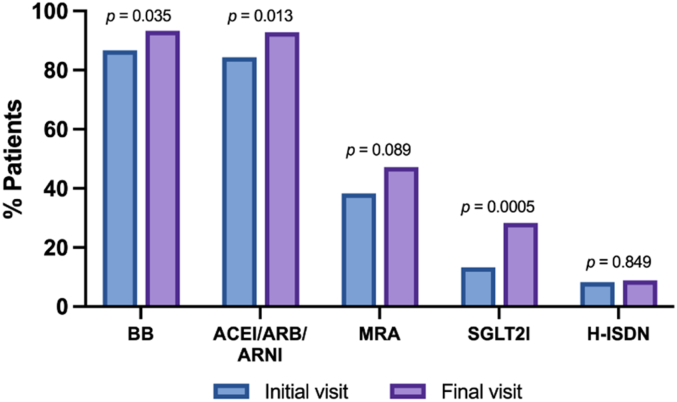
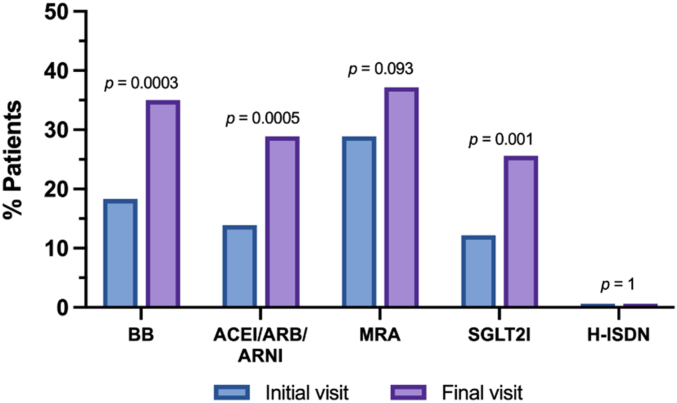
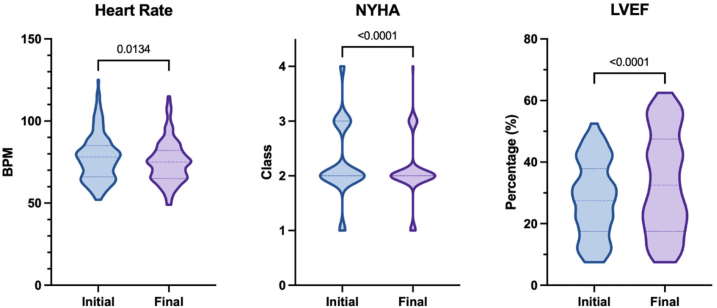
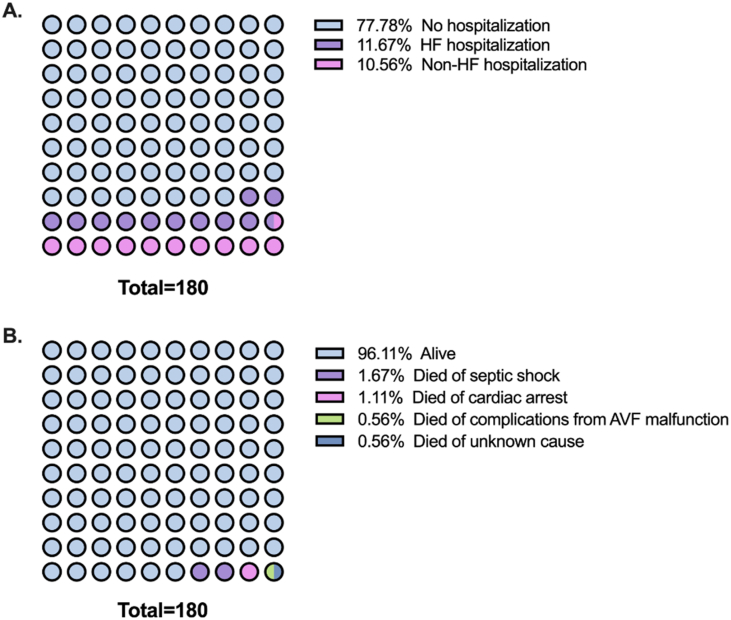
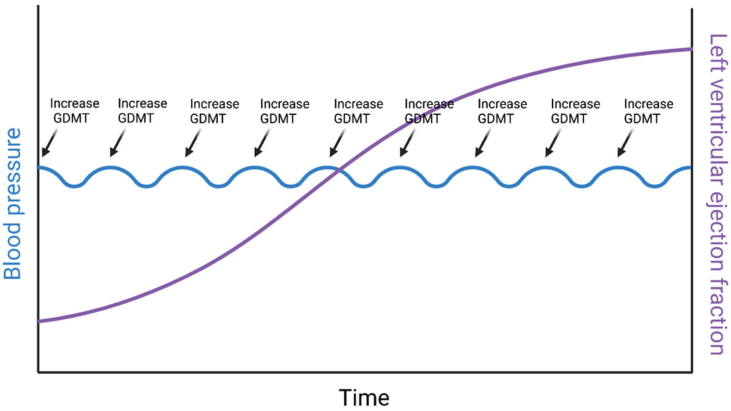
The objective of our study was to evaluate the real-world effects of an aggressive, personalized protocol for guideline-directed medical therapy (GDMT) titration in patients with heart failure (HF) with reduced ejection fraction (HFrEF). We conducted a two-center retrospective cohort study. Patients with HFrEF who presented to a HF clinic from January 2020 to December 2022 were placed on a GDMT protocol. 180 patients were included in the study. Mean GDMT score significantly increased from 4.7 to 5.9 (p < 0.001) between initial and final visits. Mean left ventricular ejection fraction (LVEF) significantly increased from 28 % to 33 % (+5 %, p < 0.001). 27 (15.7 %) of the 172 patients with complete New York Heart Association (NYHA) classification data had improvement by at least 1 class, while 2 (1.2 %) patients had worsening NYHA classification. 140 (77.8 %) patients had no unplanned hospitalizations between visits. 21 (11.7 %) patients had an unplanned hospitalization for acute HF during the study period with a mean time from first clinic visit to hospitalization of 183 days (range: 13-821 days). 2 (1.1 %) patients were hospitalized due to GDMT-associated adverse drug events (i.e. hypotension, hyperkalemia). 7 (3.9 %) patients died during the study period, which was lower than the predicted 1-year death rate for our cohort (12.3 %) using the MAGGIC score. In conclusion, an aggressive, personalized protocol for GDMT titration in patients with HFrEF led to significant improvements in LVEF, NYHA classification, hospitalization, and mortality in a real-world setting. This protocol may help serve as a road map to lessen the gap between clinical knowledge and practice surrounding optimization of GDMT and move HFrEF patients toward a path to recovery.
Keywords: Guideline-directed medical therapy; Heart failure; Protocol; Reduced ejection fraction; Titration.
© 2024 The Authors.
Conflict of interest statement
The authors have no conflicts of interest.
Figures
References
-
- Heidenreich P.A., Bozkurt B., Aguilar D., Allen L.A., Byun J.J., Colvin M.M., et al. 2022 AHA/ACC/HFSA guideline for the management of heart failure: a report of the American College of Cardiology/American Heart Association Joint Committee on Clinical Practice Guidelines. Circulation. 2022;145(18):e895–e1032. - PubMed
-
- Greene S.J., Butler J., Albert N.M., DeVore A.D., Sharma P.P., Duffy C.I., et al. Medical therapy for heart failure with reduced ejection fraction: the CHAMP-HF registry. J. Am. Coll. Cardiol. 2018;72(4):351–366. - PubMed
-
- Pocock S.J., Ariti C.A., McMurray J.J.V., Maggioni A., Køber L., Squire I.B., et al. Predicting survival in heart failure: a risk score based on 39 372 patients from 30 studies. Eur. Heart J. 2012;34(19):1404–1413. - PubMed
LinkOut - more resources
Full Text Sources
Research Materials
Miscellaneous
