


Encoding and display technologies for combinatorial libraries in drug discovery: The coming of age from biology to therapy
- PMID: 39220863
- PMCID: PMC11365444
- DOI: 10.1016/j.apsb.2024.04.006
Encoding and display technologies for combinatorial libraries in drug discovery: The coming of age from biology to therapy
Abstract
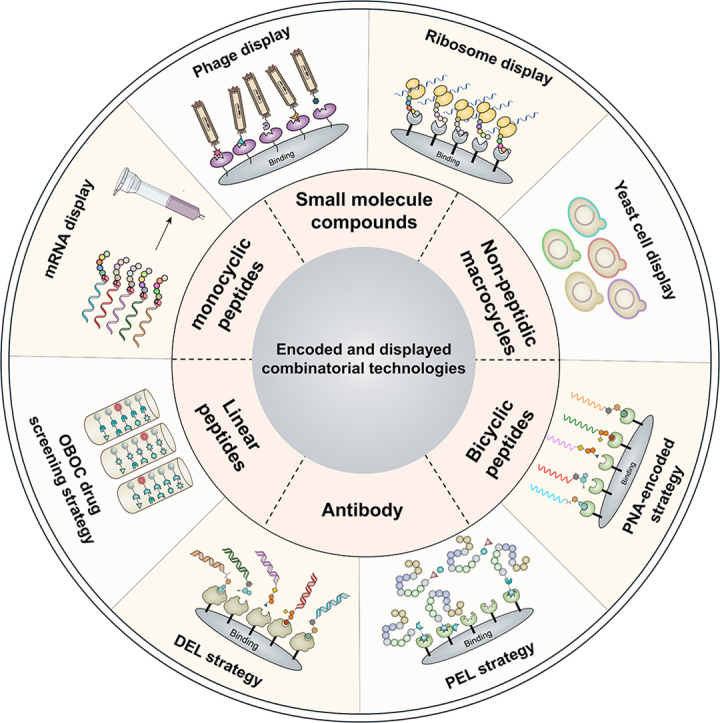
Drug discovery is a sophisticated process that incorporates scientific innovations and cutting-edge technologies. Compared to traditional bioactivity-based screening methods, encoding and display technologies for combinatorial libraries have recently advanced from proof-of-principle experiments to promising tools for pharmaceutical hit discovery due to their high screening efficiency, throughput, and resource minimization. This review systematically summarizes the development history, typology, and prospective applications of encoding and displayed technologies, including phage display, ribosomal display, mRNA display, yeast cell display, one-bead one-compound, DNA-encoded, peptide nucleic acid-encoded, and new peptide-encoded technologies, and examples of preclinical and clinical translation. We discuss the progress of novel targeted therapeutic agents, covering a spectrum from small-molecule inhibitors and nonpeptidic macrocycles to linear, monocyclic, and bicyclic peptides, in addition to antibodies. We also address the pending challenges and future prospects of drug discovery, including the size of screening libraries, advantages and disadvantages of the technology, clinical translational potential, and market space. This review is intended to establish a comprehensive high-throughput drug discovery strategy for scientific researchers and clinical drug developers.
Keywords: Clinical drugs; DNA-encoded chemical libraries; Drug screening; Peptide-encoded chemical libraries; Phage display.
© 2024 The Authors.
Conflict of interest statement
The authors have declared that no conflict of interest exists.
Figures


References
-
- Jones L.H., Bunnage M.E. Applications of chemogenomic library screening in drug discovery. Nat Rev Drug Discov. 2017;16:285–296. - PubMed
-
- Mahdavi S.Z.B., Oroojalian F., Eyvazi S., Hejazi M., Baradaran B., Pouladi N., et al. An overview on display systems (phage, bacterial, and yeast display) for production of anticancer antibodies; advantages and disadvantages. Int J Biol Macromol. 2022;208:421–442. - PubMed
-
- Corbett P.T., Leclaire J., Vial L., West K.R., Wietor J.L., Sanders J.K.M., et al. Dynamic combinatorial chemistry. Chem Rev. 2006;106:3652–3711. - PubMed
-
- Lehn J.-M., Eliseev A.V. Dynamic combinatorial chemistry. Science. 2001;291:2331–2332. - PubMed
-
- Uttamchandani M., Walsh D.P., Yao S.Q., Chang Y.T. Small molecule microarrays: recent advances and applications. Curr Opin Chem Biol. 2005;9:4–13. - PubMed
Publication types
LinkOut - more resources
Full Text Sources
