Review
. 2024 Aug 5:20:100546.
doi: 10.1016/j.jvacx.2024.100546. eCollection 2024 Oct.

COVID-19 vaccines are effective at preventing symptomatic and severe infection among healthcare workers: A clinical review

Affiliations
Review

COVID-19 vaccines are effective at preventing symptomatic and severe infection among healthcare workers: A clinical review

Oliver Galgut et al. Vaccine X. .

Abstract

Introduction: Health care workers (HCWs) have been at increased risk of infection during the SARS-CoV-2 pandemic and as essential workers have been prioritised for vaccination. Due to increased exposure HCW are considered a predictor of what might happen in the general population, particularly working age adults. This study aims to summarise effect of vaccination in this 'at risk' cohort.

Methods: Ovid MEDLINE and Embase were searched, and 358 individual articles were identified. Of these 49 met the inclusion criteria for review and 14 were included in a meta-analysis.

Results: Participants included were predominantly female and working age. Median time to infection was 51 days. Reported vaccine effectiveness against infection, symptomatic infection, and infection requiring hospitalisation were between 5 and 100 %, 34 and 100 %, and 65 and 100 % (respectively). No vaccinated HCW deaths were recorded in any study. Pooled estimates of protection against infection, symptomatic infection, and hospitalisation were, respectively, 84.7 % (95 % CI 72.6-91.5 %, p < 0.0001), 86.0 % (95 % CI 67.2 %-94.0 %; p < 0.0001), and 96.1 % (95 % CI 90.4 %-98.4 %). Waning protection against infection was reported by four studies, although protection against hospitalisation for severe infection persists for at least 6 months post vaccination.

Conclusions: Vaccination against SARS-CoV2 in HCWs is protective against infection, symptomatic infection, and hospitalisation. Waning protection is reported but this awaits more mature studies to understand durability more clearly. This study is limited by varying non-pharmacological responses to COVID-19 between included studies, a predominantly female and working age population, and limited information on asymptomatic transmission or long COVID protection.

Keywords: Adenovirus vector; COVID-19; Healthcare worker; SARS-CoV-2; Vaccine; mRNA.


Conflict of interest statement

The authors declare that they have no known competing financial interests or personal relationships that could have appeared to influence the work reported in this paper.

Figures

Fig. 1
Fig. 1
(a) Search Strategy and (b) PRISMA Diagram. Panel a indicates the terms used to search Ovid MEDLINE and Embase and their combinations. PRISMA diagram shows number of studies removed at each step in the study selection process. PRISMA=Preferred Reporting In Systematic Reviews and Meta Analyses.
Fig. 2
Fig. 2
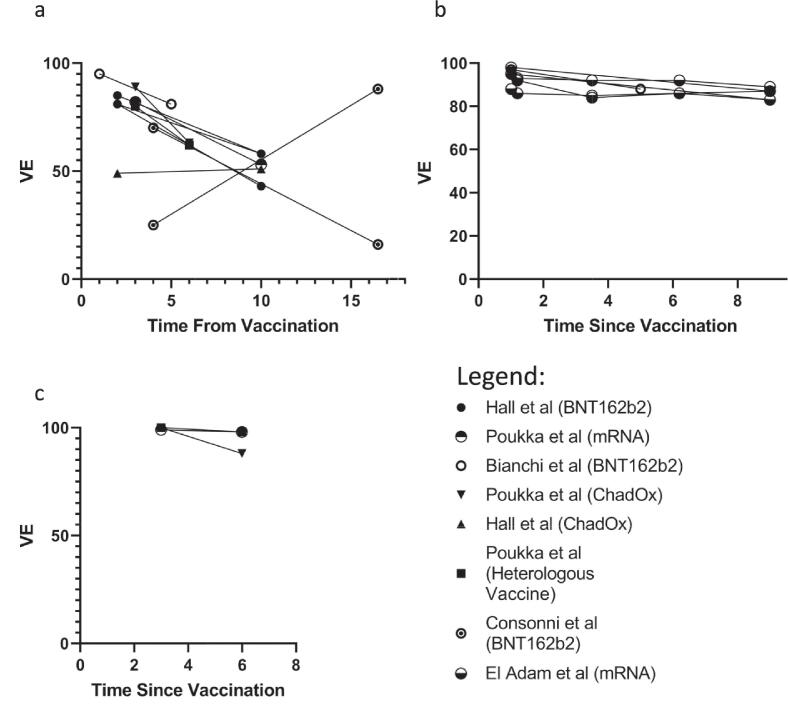
VE against (a) any SARS-CoV-2 Infection, (b) Symptomatic SARS-CoV-2, and (c) Hospitalisation from SARS-CoV-2 Infection over time. Time from vaccination is measured in months and calculated from the end of the primary vaccination course. Each estimate is plotted at the end of the period reported, e.g. a study reporting a VE between 3 and 6 months from vaccination will be plotted at 6 months. Studies that feature in more than one panel have the same symbol used throughout. VE=Vaccine Effectiveness, SARS-CoV-2 = Severe Acute Respiratory Distress Syndrome Coronavirus 2.
Fig. 3
Fig. 3
Meta-analysis of VE Estimates against (a) any SARS-CoV-2 Infection, (b) Symptomatic Infection SARS-CoV-2, and (c) Hospitalising Infection SARS-CoV-2. VE estimates of included studies are plotted as a square with horizontal bar representing 95 % CI. A study’s point estimate size is proportional to the weight of that study in the meta-analysis presented. The summary estimate is plotted as a diamond. The time after vaccination, vaccine mechanism assessed, and point estimate with 95 % CI is included. Some studies included estimates for multiple vaccines and/or multiple time points, and these are all presented where included (including different vaccines with the same mechanism where multiple are presented in a paper). Hall et al. and El Adam et al. present VE for different intervals between V1 and V2; for Hall et al. ‘Short’ indicates a dose interval < 6 weeks and ‘Long’ an interval > 6 weeks, for El Adam et al. ‘Short’, ‘Mid’, and ‘Long’ indicate dose intervals of 3–5 weeks, 6 weeks, and ≥ 6 weeks, respectively. *Lan et al. and Gaio et al. pool estimates from mRNA and adenoviral vector vaccines, therefore no mechanism is listed. VE=Vaccine Effectiveness, SARS-CoV-2 = Severe Acute Respiratory Distress Syndrome Coronavirus 2, 95 % CI=95 % Confidence Interval, V1 = first vaccine dose, V2 = second vaccine dose.

References

    1. Lamb Y.N. BNT162b2 mRNA COVID-19 Vaccine: First Approval. Drugs. 2021;81:495–501. - PMC - PubMed
    1. Polack F.P., et al. Safety and Efficacy of the BNT162b2 mRNA Covid-19 Vaccine. N Engl J Med. 2020;383:2603–2615. - PMC - PubMed
    1. Sadoff J., et al. Safety and Efficacy of Single-Dose Ad26.COV2.S Vaccine against Covid-19. N Engl J Med. 2021;384:2187–2201. - PMC - PubMed
    1. Baden L.R., et al. Efficacy and Safety of the mRNA-1273 SARS-CoV-2 Vaccine. N Engl J Med. 2021;384:403–416. - PMC - PubMed
    1. Voysey M., et al. Safety and efficacy of the ChAdOx1 nCoV-19 vaccine (AZD1222) against SARS-CoV-2: an interim analysis of four randomised controlled trials in Brazil, South Africa, and the UK. Lancet. 2021;397:99–111. - PMC - PubMed

LinkOut - more resources