. 2024 Nov;38(11):2456-2465.
doi: 10.1038/s41375-024-02396-3. Epub 2024 Sep 2.

Mosaic chromosomal alterations in hematopoietic cells and clinical outcomes in patients with multiple myeloma

Affiliations

Mosaic chromosomal alterations in hematopoietic cells and clinical outcomes in patients with multiple myeloma

Simon Husby et al. Leukemia. 2024 Nov.

Abstract

Mosaic chromosomal alterations (mCAs) in hematopoietic cells increase mortality and risk of hematological cancers and infections. We investigated the landscape of mCAs and their clinical consequences in 976 patients with multiple myeloma undergoing high-dose chemotherapy and autologous stem cell support (ASCT) with median 6.4 years of follow-up. mCAs were detected in the stem cell harvest product of 158 patients (16.2%). Autosomal aberrations were found in 60 patients (6.1%) and affected all chromosomes. Loss of chromosome X was found in 51 females (12.7%) and loss of chromosome Y in 55 males (9.6%). Overall survival and progression were similar between carriers of autosomal mCAs and non-carriers. In contrast, female patients with loss of the X chromosome had longer overall survival (age-adjusted[a.a.] HR 0.54, 95% CI 0.32-0.93, p = 0.02), lower risk of progression (a.a. HR 0.55, 95% CI 0.35-0.87; p = 0.01), and better post-transplant response (higher degree of complete response (CR) or very good partial response (VGPR)). The reason for this substantial effect is unknown. Additionally, myeloma clones in the stem cell product was confirmed by mCA analysis in the few patients with multiple mCAs (n = 12 patients). Multiple mCAs conferred inferior overall survival (a.a. HR 2.0, 95% CI 1.02-3.84; p = 0.04) and higher risk of myeloma progression (a.a. HR 3.36, 95% CI 1.67-6.81; p < 0.001), which is presumed to be driven by suspected myeloma contaminants.


Conflict of interest statement

CUN has received research grants and/or consultancy fees from AstraZeneca, Abbvie, Janssen, Takeda, Octapharma, CSL Behring, Lilly, Beigene and Genmab. The remaining authors declare no competing financial interests.

Figures
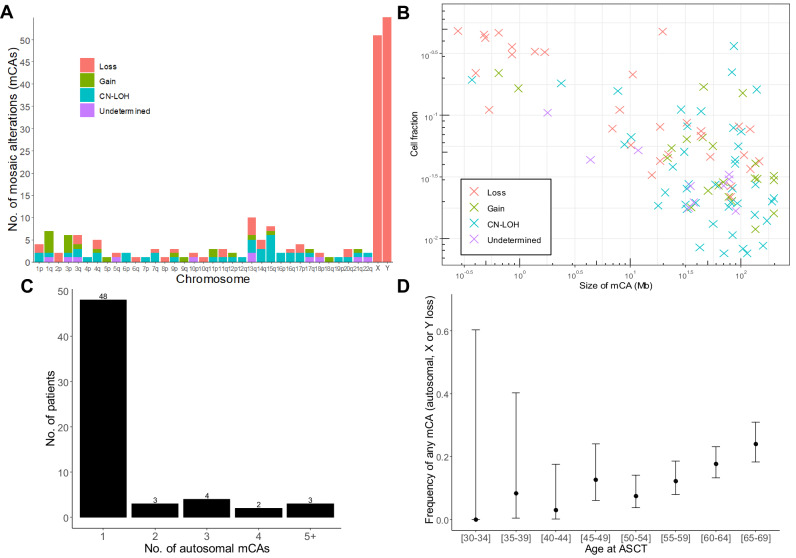
Fig. 1
Fig. 1. Landscape of mCAs in patients with multiple myeloma.
A Frequency and type of mCAs per chromosome detected in the cohort. CN-LOH, copy number neutral loss of heterozygosity. B Distribution of mCA size and clonal cell fraction. C Number of subjects with 1, 2, 3, 4 or 5+ autosomal mCAs. D Age distribution of mCA prevalence. Dots show frequency, while bars show 95% confidence interval for the specific subgroup.
Fig. 2
Fig. 2. Phenotypic associations with the presence of mCAs.
A Myeloma bone marrow infiltration at diagnosis and presence of mCA in the stem cell product. B M protein level in the peripheral blood at diagnosis and presence of mCA in the stem cell product.
Fig. 3
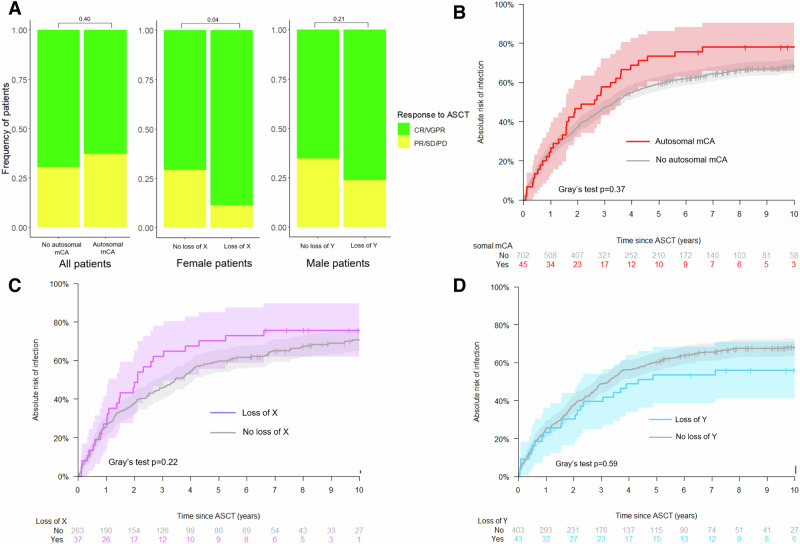
Fig. 3. Adverse events after ASCT in patients with mCAs.
A Treatment response after ASCT. CR/VGPR, complete response/very good partial response; PR/SD/PD, partial response, stable disease, progressive disease. B Cumulative incidence of admission with infection for patients with autosomal mCA. C Cumulative incidence of admission with infection among female patients with or without loss of chromosome X. D Cumulative incidence of admission with infection among male patients with or without loss of chromosome Y.
Fig. 4
Fig. 4. Survival in patients with mCAs.
A Overall survival among patients with autosomal mCA versus those without. B Cumulative incidence of myeloma progression among patients with autosomal mCA versus those without. C Overall survival among patients with two or more mCAs. D Cumulative incidence of myeloma progression among patients with two or more mCAs. E Overall survival among female patients with loss of chromosome X versus those without. F Cumulative incidence of myeloma progression among female patients with loss of chromosome X versus those without. G Overall survival among male patients with loss of chromosome Y versus those without. H Cumulative incidence of myeloma progression among male patients with loss of chromosome Y versus those without.
Fig. 5
Fig. 5. Multivariate analyses of impact of mCAs on survival.
A Results of multivariate Cox models for overall survival. B Results of multivariate cause-specific Cox models for progression-free survival. Multivariate Cox models adjusted for ISS (International Staging System), type of induction therapy, time period of stem cell harvest /ASCT, and BM (bone marrow) myeloma infiltration at diagnosis. Progression-free survival models are cause-specific. All models are adjusted for age.
Fig. 6
Fig. 6. Suspected clonal origin and outcome.
A Overall survival according to chromosomal aberrations associated with multiple myeloma (at least one of the following; amplification of chromosome 1, loss of chromosome 6q, 13, 14q, 16q, or 17p). B Overall survival according to mCAs associated with therapy-related leukemia (at least one of the following; loss of chromosome 5, 7, 12, or 17p).

References

    1. Mitchell E, Spencer Chapman M, Williams N, Dawson KJ, Mende N, Calderbank EF, et al. Clonal dynamics of haematopoiesis across the human lifespan. Nature. 2022;606:343–50. - PMC - PubMed
    1. Loh P-R, Genovese G, Handsaker RE, Finucane HK, Reshef YA, Palamara PF, et al. Insights into clonal haematopoiesis from 8342 mosaic chromosomal alterations. Nature. 2018;559:350–5. - PMC - PubMed
    1. Zekavat SM, Lin S-H, Bick AG, Liu A, Paruchuri K, Wang C, et al. Hematopoietic mosaic chromosomal alterations increase the risk for diverse types of infection. Nat Med. 2021;27:1012–24. - PMC - PubMed
    1. Mouhieddine TH, Nzerem C, Redd R, Dunford A, Leventhal M, Sklavenitis-Pistofidis R, et al. Clinical outcomes and evolution of clonal hematopoiesis in patients with newly diagnosed multiple myeloma. Cancer Res Commun. 2023;3:2560–71. - PMC - PubMed
    1. Chitre S, Stölzel F, Cuthill K, Streetly M, Graham C, Dill C, et al. Clonal hematopoiesis in patients with multiple myeloma undergoing autologous stem cell transplantation. Leukemia. 2018;32:2020–4. - PubMed

LinkOut - more resources