


Ocular blood flow dynamics following sinus rhythm restoration through catheter ablation: laser speckle flowgraphy in patients with persistent atrial fibrillation
- PMID: 39224622
- PMCID: PMC11367941
- DOI: 10.1093/ehjimp/qyae071
Ocular blood flow dynamics following sinus rhythm restoration through catheter ablation: laser speckle flowgraphy in patients with persistent atrial fibrillation
Abstract
Aims: Laser speckle flowgraphy (LSFG) is a well-established tool renowned for its non-invasive and reproducible assessment of ocular blood flow. While rhythm control therapies, such as catheter ablation (CA), have shown promise in enhancing cognitive function in atrial fibrillation (AF) patients, the acute impact of CA on microcirculatory changes, particularly in ocular blood flow, remains a topic of limited understanding. The present study aims to delve into the potential of LSFG in detecting microcirculatory alterations following the restoration of sinus rhythm (SR) through CA in patients with AF.
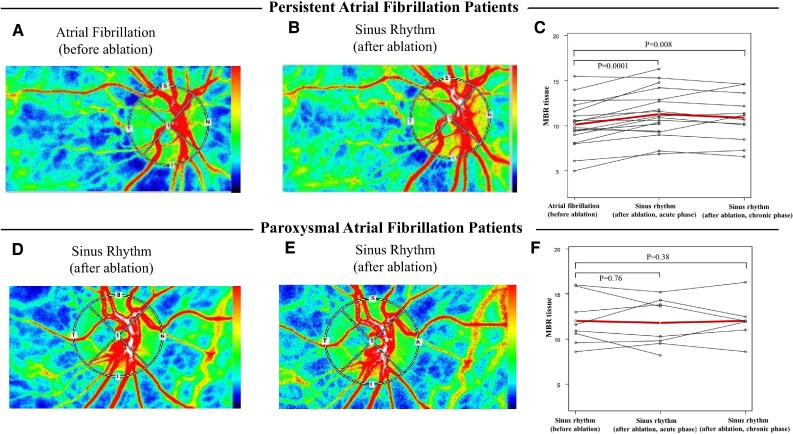
Methods and results: We studied 8 paroxysmal AF (Paf) and 20 persistent AF (PeAF) patients (mean age 67 ± 6 years, 26% female) undergoing CA. Ocular blood flow was assessed using LSFG by measuring the mean blur rate (MBR) pre- and post-CA. Post-CA, all PeAF patients achieved SR restoration, resulting in a significant increase in tissue MBR (10.0 ± 2.2 to 10.8 ± 2.9, P = 0.021). In contrast, Paf patients showed no significant difference between pre- and post-MBR (12.0 ± 2.7 vs. 11.8 ± 2.6, P = 0.76).
Conclusion: LSFG analysis effectively identified microcirculatory changes in patients undergoing CA for PeAF, suggesting that therapeutic interventions targeting the heart may have broader implications for ocular and cerebral health, establishing a novel 'cardio-oculo-cerebral relationship'.
Keywords: LSFG; atrial fibrillation; catheter ablation; cognitive impairment; microcirculation; ocular blood flow.
© The Author(s) 2024. Published by Oxford University Press on behalf of the European Society of Cardiology.
Conflict of interest statement
Conflict of interest None declared.
Figures

References
-
- Kim D, Yang PS, Sung JH, Jang E, Yu HT, Kim TH et al. Less dementia after catheter ablation for atrial fibrillation: a nationwide cohort study. Eur Heart J 2020;41:4483–93. - PubMed
-
- Wolters FJ, Zonneveld HI, Hofman A, van der Lugt A, Koudstaal PJ, Vernooij MW et al. Cerebral perfusion and the risk of dementia: a population-based study. Circulation 2017;136:719–28. - PubMed
LinkOut - more resources
Full Text Sources
Research Materials