


Overview of 37 Tear Substitutes in Europe Based on Various Physicochemical Parameters
- PMID: 39225713
- PMCID: PMC11408415
- DOI: 10.1007/s40123-024-01023-9
Overview of 37 Tear Substitutes in Europe Based on Various Physicochemical Parameters
Abstract
Introduction: Dry eye disease (DED) is one of the most prevalent eye conditions worldwide, with artificial tears serving as a primary treatment option. Despite their wide availability on the European market, there is a lack of established classifications based on their physicochemical properties. The aim of our study was therefore (i) to develop an analytical method that measures the concentration and the molecular weight (MW) of the hyaluronic acid (HA) in commercialized products, and (ii) to propose an overview based on their various physicochemical parameters.
Methods: The intrinsic viscosity and MW of the HA, as well as osmolarity, pH, rheological profile, and viscosity, were measured or determined. A specific method was developed to measure the average intrinsic viscosity and HA content using a liquid size-exclusion chromatography system. The MW was determined using the Mark-Houwink equation.
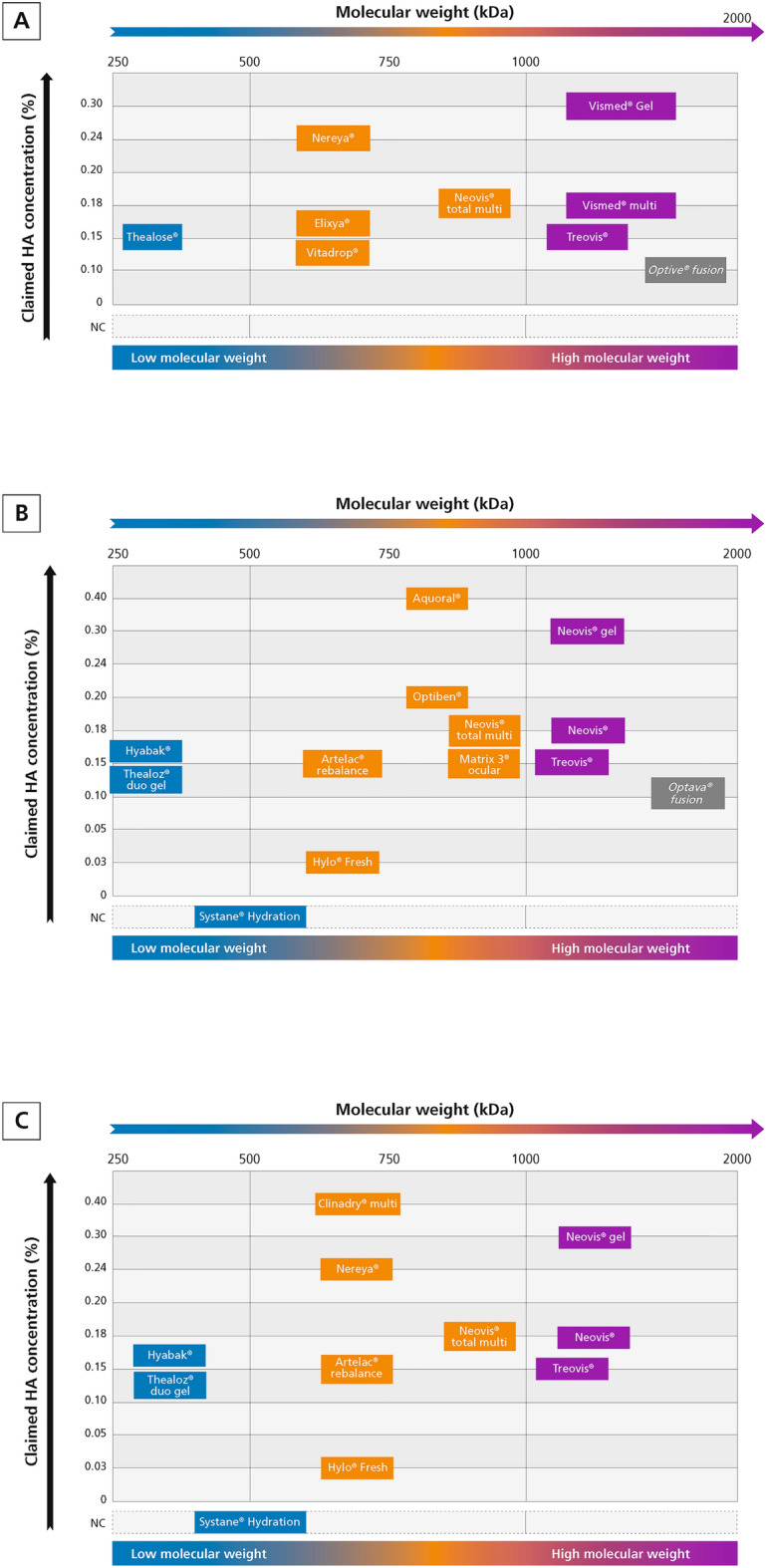
Results: Thirty-seven products commercialized in Europe were analyzed, with 21 of them containing HA. The HA MW was lowest (300 kDa) for Thealose®, Thealoz Duo® Gel, and Hyabak®, and highest (1300 kDa) for Vismed® Multi, Vismed® Gel, and Neovis® Gel. The pH values varied between 5.94 for Treovis® and 8.06 for Systane® Ultra. Osmolarity ranged between 148 mOsm/L and 325 mOsm/L for Neovis® and Treovis®, respectively. Viscosity was highly variable, ranging from 0.38 mPas·s for Hylolipid® to 337.47 mPas·s for Thealoz® Duo Gel. Finally, rheological profile analysis revealed different shear-thinning behaviors.
Conclusion: While the perfect eye drop does not exist, a multitude of options are available to choose from. This study improves our understanding of the major tear substitutes available on the European market based on several physicochemical properties. A better understanding and awareness of these parameters is crucial in order to offer the best treatment for patients with DED.
Keywords: Analytic method; Artificial tears; Dry eye disease; Eye drop; Hyaluronic acid; Molecular weight; Physicochemical parameters; Tear substitutes.
© 2024. The Author(s).
Conflict of interest statement
All authors (Adrien Paschier, Aurélie Manuelli, Laure Chauchat, Morgane Legall, Hayette Rebika, Marwan Sahyoun, Camille Guerin) were employed by Horus Pharma at the time of the article publication.
Figures
References
-
- Zemanová M. Dry eyes disease. a review. Czech Slovak Ophthalmol. 2020;77(3):107–19.
-
- The Definition and Classification of Dry Eye Disease. Report of the definition and classification subcommittee of The International Dry Eye Workshop (2007). Ocul Surf avr. 2007;5(2):75–92. - PubMed
-
- Schaumberg DA, Sullivan DA, Buring JE, Dana MR. Prevalence of dry eye syndrome among US women. Am J Ophthalmol août. 2003;136(2):318–26. - PubMed
-
- Chia E, Mitchell P, Rochtchina E, Lee AJ, Maroun R, Wang JJ. Prevalence and associations of dry eye syndrome in an older population: the Blue Mountains Eye Study. Clin Experiment Ophthalmol juin. 2003;31(3):229–32. - PubMed
-
- Stapleton F, Alves M, Bunya VY, Jalbert I, Lekhanont K, Malet F, et al. TFOS DEWS II epidemiology report. Ocul Surf juill. 2017;15(3):334–65. - PubMed
LinkOut - more resources
Full Text Sources
