. 2024 Sep 3;34(9):bhae357.
doi: 10.1093/cercor/bhae357.

Age differences in BOLD modulation to task difficulty as a function of amyloid burden

Affiliations

Age differences in BOLD modulation to task difficulty as a function of amyloid burden

Joseph P Hennessee et al. Cereb Cortex. .

Abstract

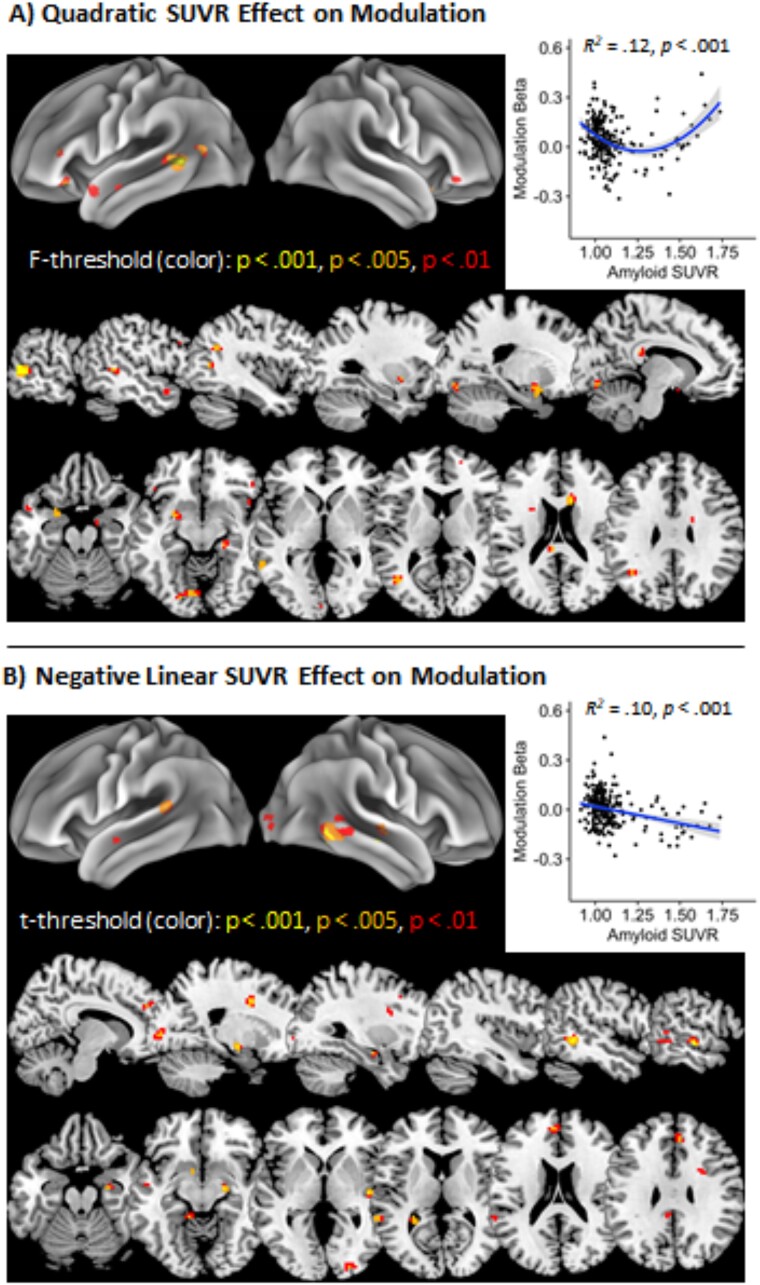
Effective cognitive performance often requires the allocation of additional neural resources (i.e. blood-oxygen-level-dependent [BOLD] activation) as task demands increase, and this demand-related modulation is affected by amyloid-beta deposition and normal aging. The present study investigated these complex relationships between amyloid, modulation, and cognitive function (i.e. fluid ability). Participants from the Dallas Lifespan Brain Study (DLBS, n = 252, ages 50-89) completed a semantic judgment task during functional magnetic resonance imaging (fMRI) where the judgments differed in classification difficulty. Amyloid burden was assessed via positron emission tomography (PET) using 18F-florbetapir. A quadratic relationship between amyloid standardized value uptake ratios (SUVRs) and BOLD modulation was observed such that modulation was weaker in those with moderately elevated SUVRs (e.g. just reaching amyloid-positivity), whereas those with very high SUVRs (e.g. SUVR > 1.5) showed strong modulation. Greater modulation was related to better fluid ability, and this relationship was strongest in younger participants and those with lower amyloid burden. These results support the theory that effective demand-related modulation contributes to healthy cognitive aging, especially in the transition from middle age to older adulthood, whereas high modulation may be dysfunctional in those with substantial amyloid deposition.

Keywords: PET; aging; fMRI; fluid intelligence; semantic.


Figures

Fig. 1
Fig. 1
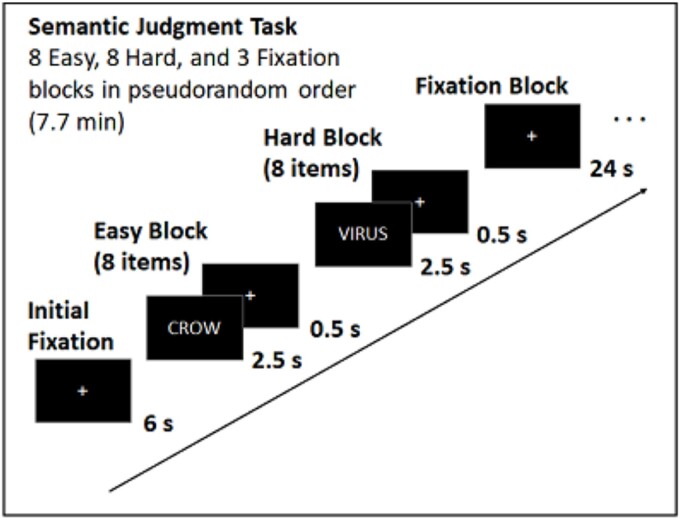
Task diagram for the fMRI semantic judgment task.
Fig. 2
Fig. 2
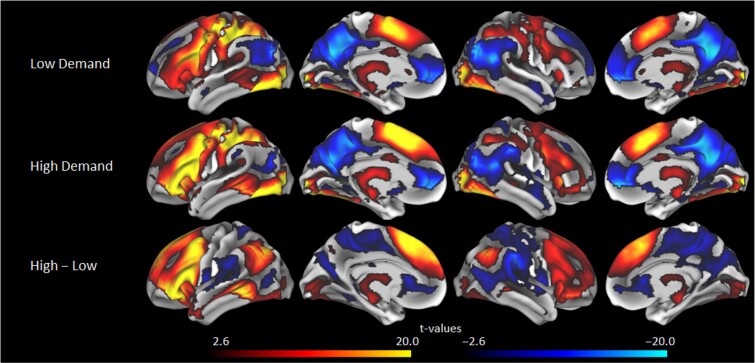
Activation t-values for low demand semantic judgments (top) and high demand judgments (middle), as well as demand-based modulation (high—Low demand; bottom) with a voxel-wise threshold of P < 0.005.
Fig. 3
Fig. 3
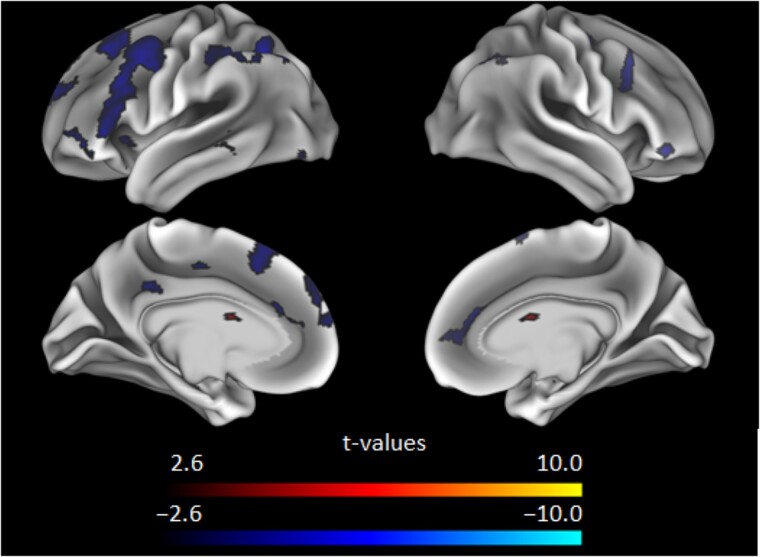
Effect of age t-values on demand-based modulation (high—Low demand) with a voxel-wise threshold of P < 0.005. Note that age almost exclusively has a negative relationship to modulation.
Fig. 4
Fig. 4
Nonlinear and linear associations between BOLD modulation and amyloid SUVR. (A) Quadratic effect of amyloid SUVR on demand-based modulation (high—Low demand) at multiple F-value thresholds in left sagittal and axial slices (bottom) and with average modulation beta weights across the full P < 0.005 map plotted (top-right). (B) Negative linear effect of amyloid SUVR on demand-based modulation (high—Low demand) at multiple t-value thresholds in right sagittal and axial slices (bottom) and with average modulation beta weights across the full P < 0.005 map plotted (top-right). Scatter plots include 95% confidence intervals for each trend in shaded gray.
Fig. 5
Fig. 5
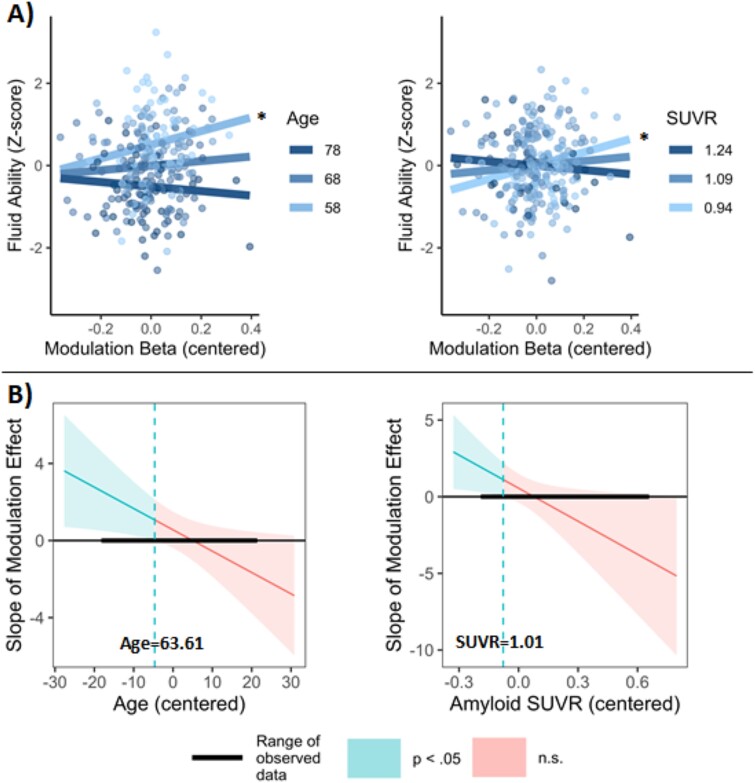
(A) Moderation effects of age and amyloid SUVR on the relationship between modulation and fluid ability. Moderator simple slopes were estimated at their mean +/− 1 SD, and modulation beta weights (high—Low demand) were extracted from the primary mask of the P < 0.005 SUVR2 effect. Asterisks indicate significant slopes: *, P < 0.05. (B) Conditional effect of modulation on fluid ability at different values of age and amyloid SUVR. Confidence bands estimated using the Johnson-Neyman procedure indicated the SUVR and age values at which modulation had a significant or nonsignificant effect. The effect of modulation was significant at ages 50–63.61 and in those with an SUVR below 1.01.

References

    1. Abramov E, Dolev I, Fogel H, Ciccotosto GD, Ruff E, Slutsky I. Amyloid-β as a positive endogenous regulator of release probability at hippocampal synapses. Nat Neurosci. 2009:12(12):1567–1576. 10.1038/nn.2433. - DOI - PubMed
    1. Bauer E, Sammer G, Toepper M. Trying to put the puzzle together: age and performance level modulate the neural response to increasing task load within left rostral prefrontal cortex. Biomed Res Int. 2015:2015(1):1–11. 10.1155/2015/415458. - DOI - PMC - PubMed
    1. Ben-Nejma IRH, Keliris AJ, Daans J, Ponsaerts P, Verhoye M, van der Linden A, Keliris GA. Increased soluble amyloid-beta causes early aberrant brain network hypersynchronisation in a mature-onset mouse model of amyloidosis. Acta Neuropathol Commun. 2019:7(1):180. 10.1186/s40478-019-0810-7. - DOI - PMC - PubMed
    1. Binder JR, Desai RH, Graves, Conant LL. Where is the semantic system? A critical review and meta-analysis of 120 functional neuroimaging studies. Cereb Cortex. 2009:19(12):2767–2796. 10.1093/cercor/bhp055. - DOI - PMC - PubMed
    1. Braak H, Braak E. Neuropathological stageing of Alzheimer-related changes. Acta Neuropathol. 1991:82(4):239–259. 10.1007/BF00308809. - DOI - PubMed

Publication types