. 2024 Sep 3;14(1):20508.
doi: 10.1038/s41598-024-71446-8.

Assessment of transthyretin instability in patients with wild-type transthyretin amyloid cardiomyopathy

Affiliations

Assessment of transthyretin instability in patients with wild-type transthyretin amyloid cardiomyopathy

Takuya Iino et al. Sci Rep. .

Abstract

The pathophysiology of variant transthyretin (TTR) amyloidosis (ATTRv) is associated with destabilizing mutations in the TTR tetramer. However, why TTR with a wild-type genetic sequence misfolds and aggregates in wild-type transthyretin amyloidosis (ATTRwt) is unknown. Here, we evaluate kinetic TTR stability with a newly developed ELISA system in combination with urea-induced protein denaturation. Compared with that in control patients, endogenous TTR in patients with wild-type transthyretin amyloid cardiomyopathy (ATTRwt-CM) exhibited thermodynamic instability, indicating that circulating TTR instability may be associated with the pathogenesis of ATTRwt as well as ATTRv. Our findings provide new insight into the underlying mechanisms of ATTRwt.

Keywords: Aging; Heart failure; Heart failure with preserved ejection fraction; Transthyretin; Wild-type transthyretin amyloid cardiomyopathy.


Conflict of interest statement

The authors declare no competing interests.

Figures
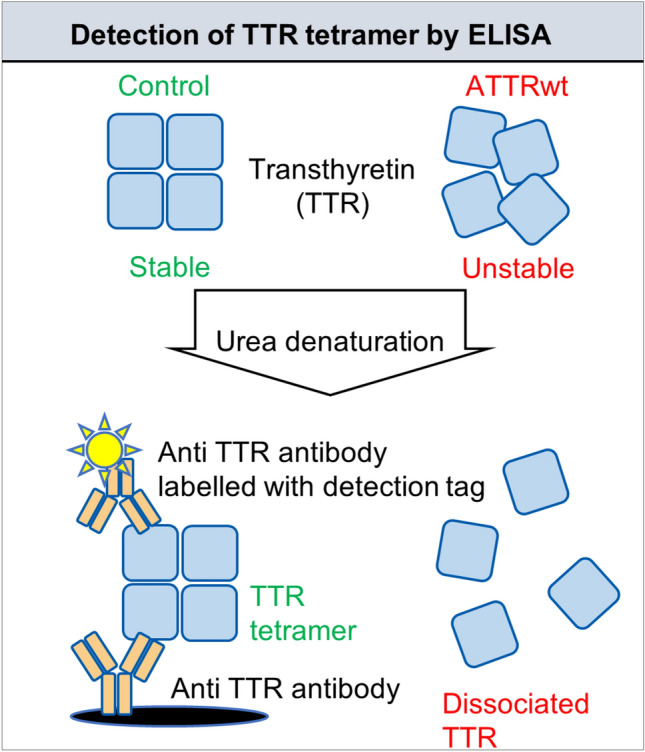
Fig. 1
Fig. 1
Workflow for assessment of TTR stability under urea conditions. TTR-containing samples were diluted tenfold with PBS containing 0–8 mol/L urea, resulting in a final concentration of 0–7.2 mol/L urea, and incubated at 25 °C for 48 h. After incubation, the samples were diluted 6180 times with PBS containing 1% BSA and applied to ELISA plate wells immediately after dilution. Tetrameric TTR levels in the samples were quantified via ELISA in duplicate. TTR stability under urea conditions was evaluated as the residual TTR tetramer percentage. ATTRwt, wild-type transthyretin amyloidosis; TTR, transthyretin; ELISA, enzyme-linked immunosorbent assay.
Fig. 2
Fig. 2
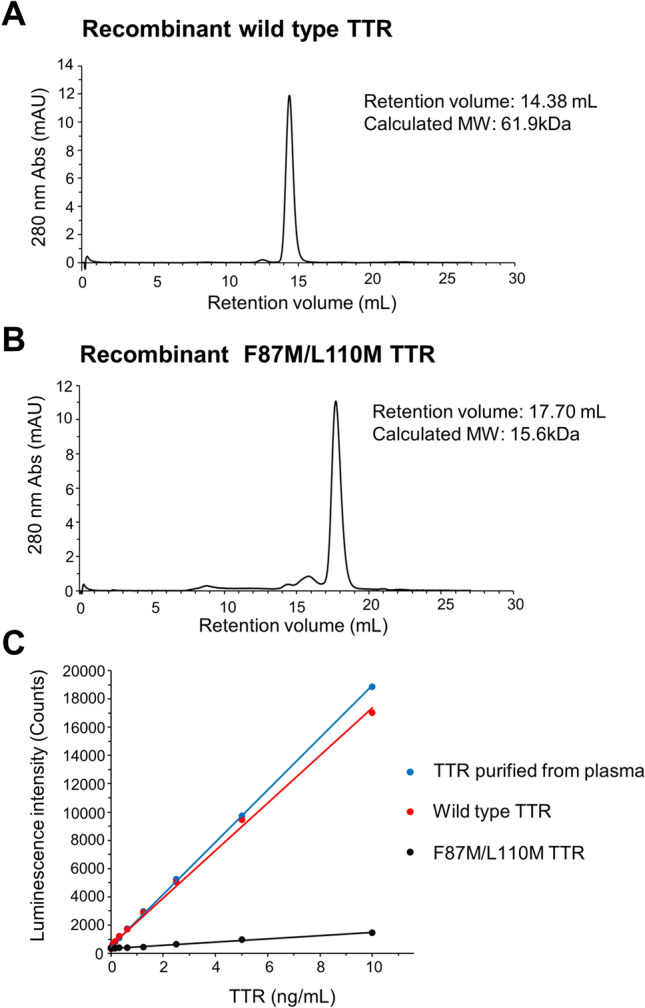
Development of an ELISA for specific reactions to the TTR tetramer. Chromatogram of recombinant wild-type TTR (A) and recombinant F87M/L110M TTR (B) obtained by gel filtration chromatography. ELISA data for recombinant wild-type TTR, recombinant F87M/L110M TTR, and TTR purified from human plasma (C). Standard curves were generated using a linear calibration model. TTR, transthyretin; MW, molecular weight; Abs, absorbance.
Fig. 3
Fig. 3
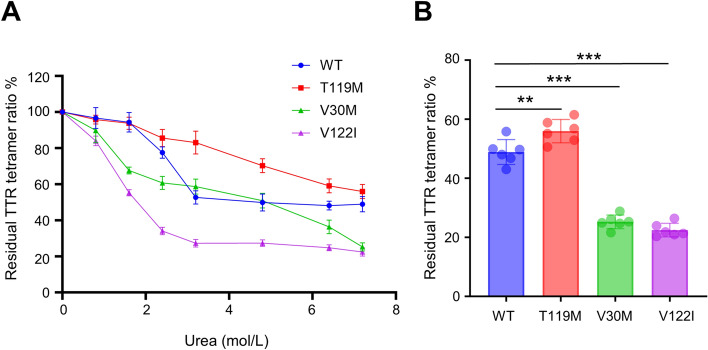
Assessment of TTR variant stability. The residual TTR tetramer percentage (%) after urea-induced denaturation of recombinant wild-type TTR, recombinant T119M TTR, recombinant V30M TTR, and recombinant V122I TTR (A). Comparison of the residual TTR tetramer formation ratio of TTRs after 7.2 mol/L urea treatment (B). Values are expressed as means ± SDs (n = 6). **p < 0.01, ***p < 0.001. Data were analyzed by one-way ANOVA with Dunnett’s multiple comparisons test. TTR, transthyretin; WT, wild-type.
Fig. 4
Fig. 4
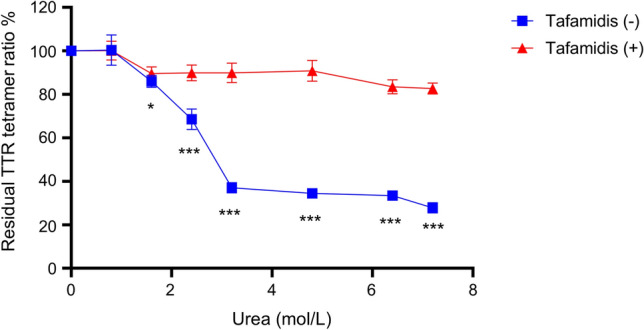
Effects of tafamidis on TTR stability in serum. The residual TTR tetramer ratio after urea-induced denaturation of TTR in serum and TTR in serum preincubated with 500 μmol/L tafamidis at room temperature for 30 min. Values are expressed as the means ± SDs (n = 6). *p < 0.05, ***p < 0.001 compared to the control vehicle. Data were analyzed by the unpaired Student’s t test. TTR, transthyretin.
Fig. 5
Fig. 5
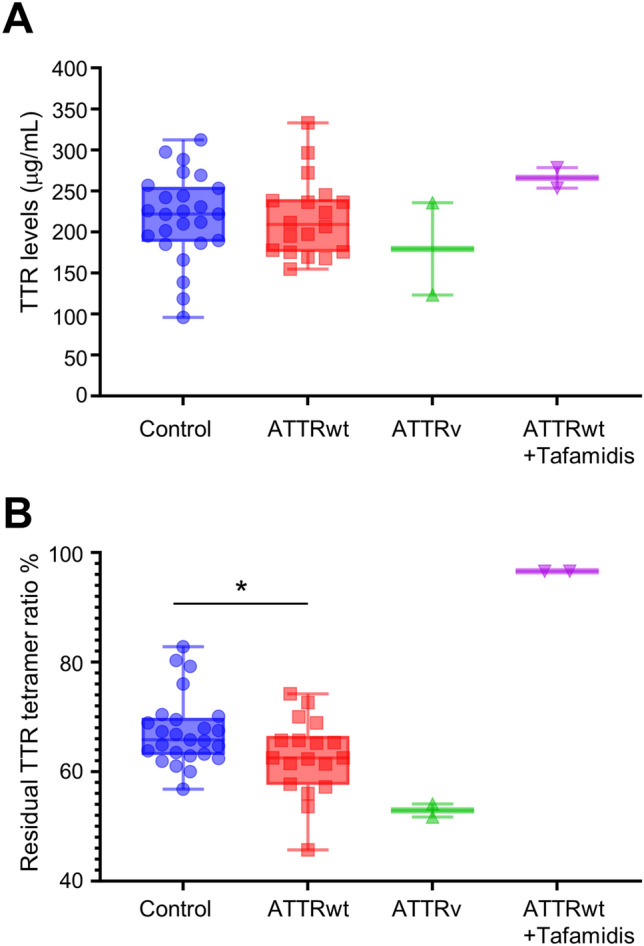
Assessment of TTR stability in ATTRwt-CM patients. TTR in serum was determined by immunoturbidimetry (A). The residual TTR tetramer percentage (%) after urea-induced denaturation of TTR in serum (B). Values are presented with medians {interquartile range (IQR)}. *p < 0.05. Data were analyzed by the unpaired Student’s t test. Control (n = 25), ATTRwt (n = 18, patients not treated with tafamidis), ATTRv (n = 2, patients not treated with tafamidis), ATTRwt + Tafamidis (n = 2, patients treated with tafamidis). ATTRwt, wild-type transthyretin amyloid cardiomyopathy; ATTRv, variant transthyretin amyloid cardiomyopathy; TTR, transthyretin; NS, not significant.

References

    1. Carroll, A. et al. Novel approaches to diagnosis and management of hereditary transthyretin amyloidosis. J. Neurol. Neurosurg. Psychiatry93, 668–678. 10.1136/jnnp-2021-327909 (2022). 10.1136/jnnp-2021-327909 - DOI - PMC - PubMed
    1. Monaco, H. L., Rizzi, M. & Coda, A. Structure of a complex of two plasma proteins: Transthyretin and retinol-binding protein. Science268, 1039–1041. 10.1126/science.7754382 (1995). 10.1126/science.7754382 - DOI - PubMed
    1. Colon, W. & Kelly, J. W. Partial denaturation of transthyretin is sufficient for amyloid fibril formation in vitro. Biochemistry31, 8654–8660. 10.1021/bi00151a036 (1992). 10.1021/bi00151a036 - DOI - PubMed
    1. Sun, X., Dyson, H. J. & Wright, P. E. Kinetic analysis of the multistep aggregation pathway of human transthyretin. Proc. Natl. Acad. Sci. USA115, E6201–E6208. 10.1073/pnas.1807024115 (2018). 10.1073/pnas.1807024115 - DOI - PMC - PubMed
    1. Ruberg, F. L., Grogan, M., Hanna, M., Kelly, J. W. & Maurer, M. S. Transthyretin amyloid cardiomyopathy: JACC state-of-the-art review. J. Am. Coll. Cardiol.73, 2872–2891. 10.1016/j.jacc.2019.04.003 (2019). 10.1016/j.jacc.2019.04.003 - DOI - PMC - PubMed

Supplementary concepts