Meta-Analysis
. 2024 Sep 4;28(1):293.
doi: 10.1186/s13054-024-05057-0.

Divergent effects of tumor necrosis factor (TNF) in sepsis: a meta-analysis of experimental studies

Affiliations
Meta-Analysis

Divergent effects of tumor necrosis factor (TNF) in sepsis: a meta-analysis of experimental studies

Christian Kassasseya et al. Crit Care. .

Abstract

Introduction: Experimental studies in animals have yielded conflicting results on the role of Tumor Necrosis Factor (TNF) in sepsis and endotoxemia, with some reporting adaptive and others inappropriate effects. A meta-analysis of the available literature was performed to determine the factors explaining this discrepancy.

Methods: The study followed the Preferred Reporting Items for Systematic Reviews and Meta-Analyses (PRISMA) statement. The protocol was registered with PROSPERO (CRD42020167384) prior to data collection. PubMed and Embase were the databases queried. Risk of bias was evaluated using the SYRCLE Risk of Bias Tool. All animal studies investigating sepsis-related mortality and modified TNF signaling were considered eligible. The exclusion criteria were: lack of mortality data, 7-day mortality rates below 10% in both wild type and TNF-altered pathway animals, and absence of an English abstract. To determine the role of TNF according to the experimental protocol, three approaches were used: first an approach based on the statistical significance of each experiment, then the pooled mortality was calculated, and finally the weighted risk ratio for mortality was assessed.

Results: A total of 175 studies were included in the analysis, comprising a total of 760 experiments and involving 19,899 animals. The main species used were mice (77%) and rats (21%). The most common method of TNF pathway modulation was TNF pathway inactivation that was primarily associated with an inappropriate secretion of TNF. At the opposite, TNF injection was associated with an adaptive role of TNF. Lipopolysaccharide (LPS) injection was the most used stimulus to establish an infectious model (42%) and was strongly associated with an inappropriate role of TNF. Conversely, live bacterial models, especially the cecal ligation and puncture (CLP) model, pneumonia, meningitis, and gastrointestinal infection, were associated with an adaptive role. This was particularly evident for Listeria monocytogenes, Streptococcus pneumoniae.

Conclusion: The role of TNF during infection varies depending on the experimental model used. Models that mimic clinical conditions, based on virulent bacteria that cause high mortality even at low inocula, demonstrated an adaptive role of TNF. Conversely, models based on LPS or low-pathogenic live bacteria, administered at doses well above physiological thresholds and combined with early antibiotic therapy, were associated with an inappropriate role.

Keywords: Experimental studies; Inactivation; LPS infection; Mortality; Pathogen; Sepsis; TNF.


Conflict of interest statement

The authors declare no competing interests.

Figures
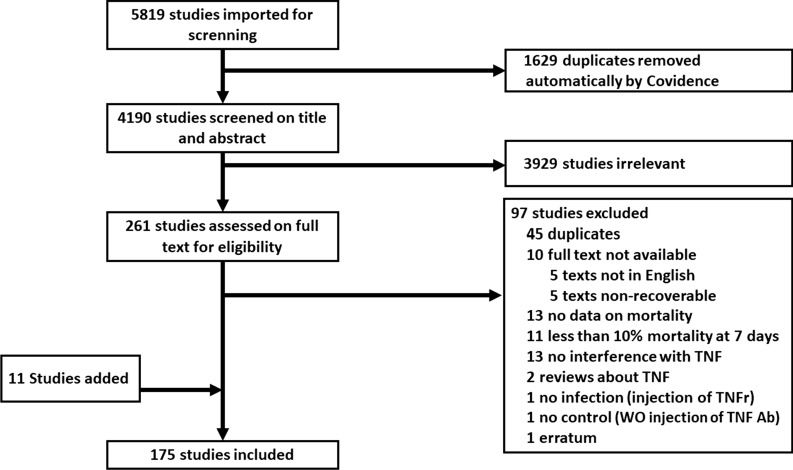
Fig. 1
Fig. 1
Flowchart
Fig. 2
Fig. 2
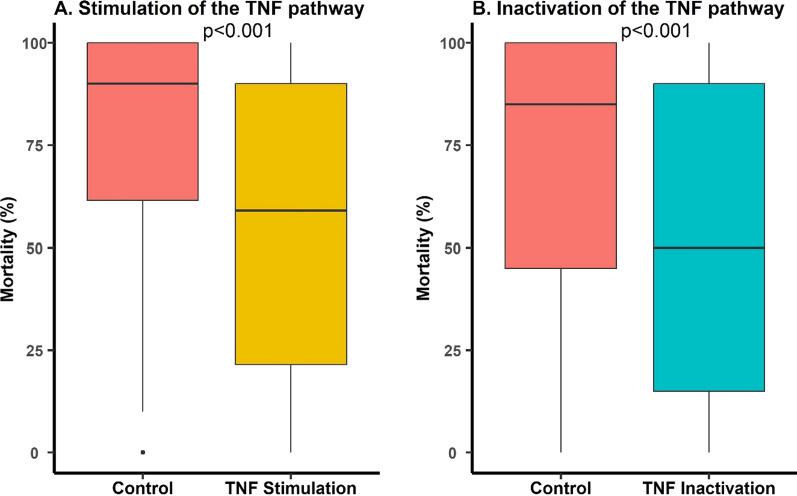
Animal mortality according to the type of TNF pathway modulation. Box plot of mortality by experiments, compared using the Mann–Whitney U test. Number of animals: A: control = 2758, TNF stimulation = 2302; B: control = 7802, TNF Inactivation = 7049.
Fig. 3
Fig. 3
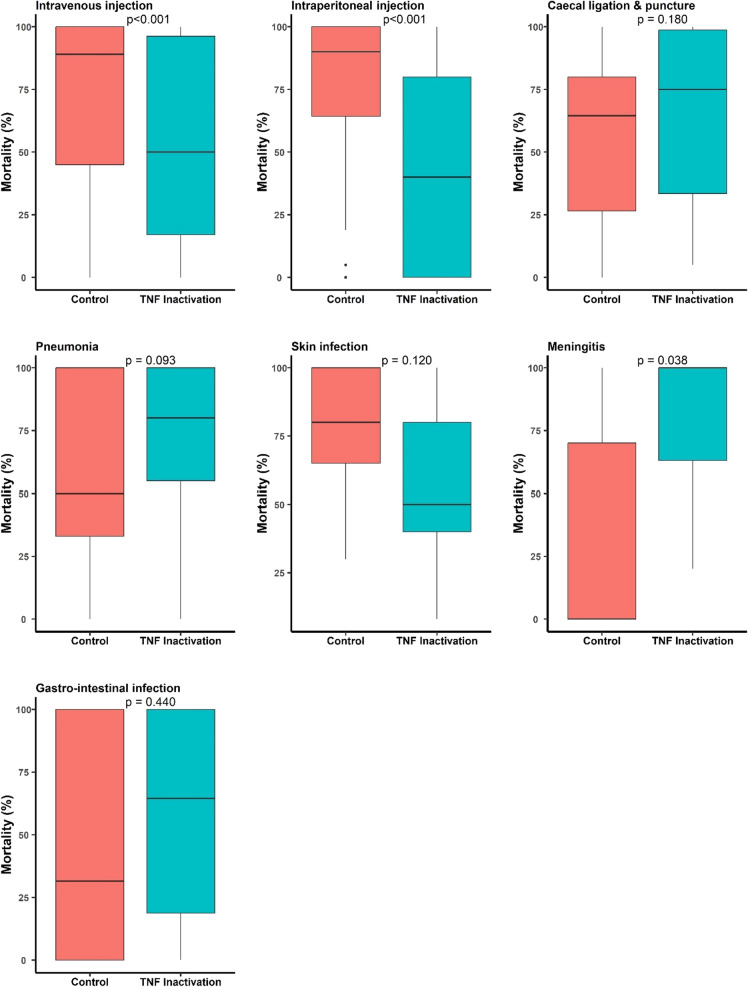
Animal mortality according to the model of sepsis, with TNF pathway inactivation. Box plot of mortality by experiments, compared using the Mann–Whitney U test. Number of animals: Intravenous injection: control = 3388, TNF inactivation = 2989; Intraperitoneal injection: control = 2424, TNF inactivation = 2224; Caecal ligation and puncture: control = 1030, TNF inactivation = 877; Pneumonia: control = 460, TNF inactivation = 444; Skin infection: control = 199, TNF inactivation = 199; Meningitis: control = 135, TNF inactivation = 144; Gastro-intestinal infection: control = 160, TNF inactivation = 166
Fig. 4
Fig. 4
Animal mortality according to the type of infectious stimulus, with TNF pathway inactivation. Box plot of mortality by experiments, compared using the Mann–Whitney U test. Number of animals: LPS injection: control = 3657, TNF inactivation = 3154; Bacteria: control = 2629, TNF inactivation = 2604; Parasite: control = 232, TNF inactivation = 177; Virus: control = 137, TNF inactivation = 122. LPS: Lipopolysaccharide
Fig. 5
Fig. 5
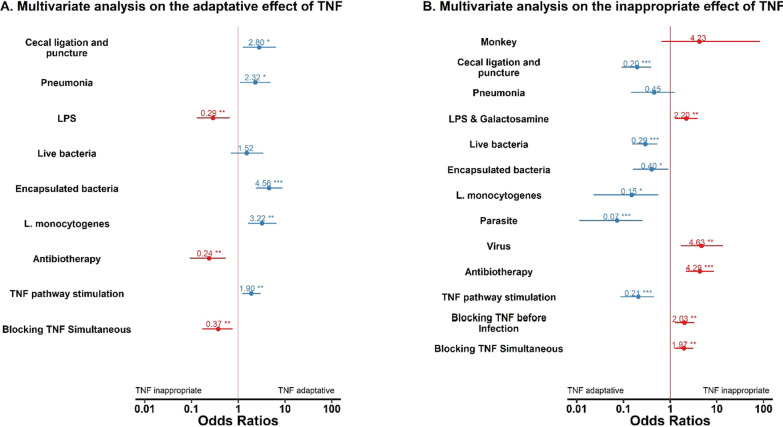
Forest plot of multivariate analysis determining role of TNF. Odds ratios and confidence intervals were calculated using a binary regression model. The interest variable was the adaptive role of TNF (A) and the inappropriate effect of TNF (B). In model A, the variable ‘adaptive role of TNF’ was coded as 1 for experiments that found an adaptive role of TNF and 0 for experiments that found an inappropriate or a non-significant role. In model B, the variable ‘inappropriate role of TNF’ was coded as 1 for experiments that found an inappropriate role of TNF and 0 for experiments that found an adaptive or a non-significant role. Number of experiments included in both analyses: 760. R2 Tjur model A: 0.310. R2 Tjur model B: 0.293. The details of the Odds ratio are given in Supplemental tables 8 and 9. In model A, LPS (Lipopolysaccharides) referred to a variable that comprised all experiments that used LPS (LPS alone or with adjuvant like galactosamine). List of variables included in both initial models: Female, Mice, Rat, Monkey, Intraperitoneal injection, Cecal ligature and puncture, Pneumonia, LPS, LPS alone, LPS and galactosamine, Alive Bacteria, Encapsulated bacteria, Listeria monocytogenes, Streptococcus pneumonia, Parasite & fungus, Virus, Antibiotherapy, TNF pathway stimulation, TNF pathway inactivation, Anti-TNF antibody, TNF soluble receptor, Blocking TNF before infection, Blocking TNF simultaneous

References

    1. Carswell EA, Old LJ, Kassel R, Green S, Fiore N, Williamson B. An endotoxin-induced serum factor that causes necrosis of tumors. Proc Natl Acad Sci. 1975;72(9):3666–70. 10.1073/pnas.72.9.3666 - DOI - PMC - PubMed
    1. Beutler B, Milsark IW, Cerami AC. Passive immunization against cachectin/tumor necrosis factor protects mice from lethal effect of endotoxin. Science. 1985;229(4716):869–71. 10.1126/science.3895437 - DOI - PubMed
    1. Tracey KJ, Lowry SF, Fahey TJ, et al. Cachectin/tumor necrosis factor induces lethal shock and stress hormone responses in the dog. Surg Gynecol Obstet. 1987;164(5):415–22. - PubMed
    1. Waage A, Halstensen A, Espevik T. Association between tumour necrosis factor in serum and fatal outcome in patients with meningococcal disease. The Lancet. 1987;329(8529):355–7. 10.1016/S0140-6736(87)91728-4 - DOI - PubMed
    1. Suffredini AF, Fromm RE, Parker MM, et al. The cardiovascular response of normal humans to the administration of endotoxin. N Engl J Med. 1989;321(5):280–7. 10.1056/NEJM198908033210503 - DOI - PubMed

Publication types

MeSH terms

Substances

LinkOut - more resources