The Association between Cardiac Arrest and Mortality in Patients with Acute Myocardial Infarction Complicated by Cardiogenic Shock
- PMID: 39228477
- PMCID: PMC11366983
- DOI: 10.31083/j.rcm2508274
The Association between Cardiac Arrest and Mortality in Patients with Acute Myocardial Infarction Complicated by Cardiogenic Shock
Abstract
Background: The impact of cardiac arrest (CA) at admission on the prognosis of patients with acute myocardial infarction (AMI) complicated by cardiogenic shock (CS) remains a subject of debate.
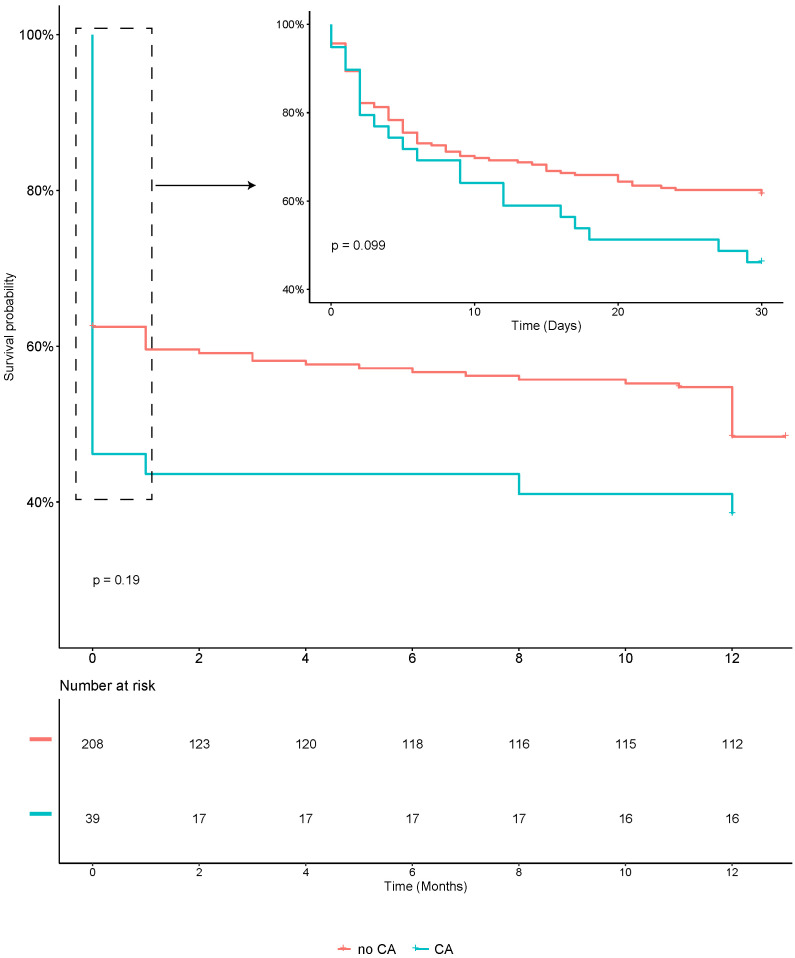
Methods: We conducted a retrospective study at West China Hospital from 2018 to 2021, enrolling 247 patients with AMI complicated by CS (AMI-CS). Patients were categorized into CA and non-CA groups based on their admission status. Univariate and multivariate Cox regression analyses were performed, with 30-day and 1-year mortality as the primary endpoints. Kaplan-Meier plots were constructed, and concordance (C)-indices of the Global Registry of Acute Coronary Event (GRACE) score, Intra-aortic Balloon Pump in Cardiogenic Shock (IABP-SHOCK) II score, and IABP-SHOCK II score with CA were calculated.
Results: Among the enrolled patients, 39 experienced CA and received cardiopulmonary resuscitation at admission. The 30-day and 1-year mortality rates were 40.9% and 47.0%, respectively. Neither univariate nor multivariate Cox regression analyses identified CA as a significant risk factor for 30-day and 1-year mortality. In C-statistics, the GRACE score exhibited a moderate effect (C-indices were 0.69 and 0.67, respectively), while the IABP-SHOCK II score had a better predictive performance (C-indices were 0.79 and 0.76, respectively) for the 30-day and 1-year mortality. Furthermore, CA did not enhance the predictive value of the IABP-SHOCK II score for 30-day (p = 0.864) and 1-year mortality (p = 0.888).
Conclusions: Cardiac arrest at admission did not influence the survival of patients with AMI-CS. Active resuscitation should be prioritized for patients with AMI-CS, regardless of the presence of cardiac arrest.
Keywords: acute myocardial infarction; cardiac arrest; cardiogenic shock; mortality.
Copyright: © 2024 The Author(s). Published by IMR Press.
Conflict of interest statement
The authors declare no conflict of interest.
Figures
References
-
- van Diepen S, Katz JN, Albert NM, Henry TD, Jacobs AK, Kapur NK, et al. Contemporary Management of Cardiogenic Shock: A Scientific Statement from the American Heart Association. Circulation . 2017;136:e232–e268. - PubMed
-
- Lauridsen MD, Josiassen J, Schmidt M, Butt JH, Østergaard L, Schou M, et al. Prognosis of myocardial infarction-related cardiogenic shock according to preadmission out-of-hospital cardiac arrest. Resuscitation . 2021;162:135–142. - PubMed
-
- Ostenfeld S, Lindholm MG, Kjaergaard J, Bro-Jeppesen J, Møller JE, Wanscher M, et al. Prognostic implication of out-of-hospital cardiac arrest in patients with cardiogenic shock and acute myocardial infarction. Resuscitation . 2015;87:57–62. - PubMed
-
- Pöss J, Köster J, Fuernau G, Eitel I, de Waha S, Ouarrak T, et al. Risk Stratification for Patients in Cardiogenic Shock After Acute Myocardial Infarction. Journal of the American College of Cardiology . 2017;69:1913–1920. - PubMed
-
- Vallabhajosyula S, Payne SR, Jentzer JC, Sangaralingham LR, Yao X, Kashani K, et al. Long-Term Outcomes of Acute Myocardial Infarction with Concomitant Cardiogenic Shock and Cardiac Arrest. The American Journal of Cardiology . 2020;133:15–22. - PubMed
LinkOut - more resources
Full Text Sources