


Hypoxic burden - definitions, pathophysiological concepts, methods of evaluation, and clinical relevance
- PMID: 39229876
- PMCID: PMC11451971
- DOI: 10.1097/MCP.0000000000001122
Hypoxic burden - definitions, pathophysiological concepts, methods of evaluation, and clinical relevance
Abstract
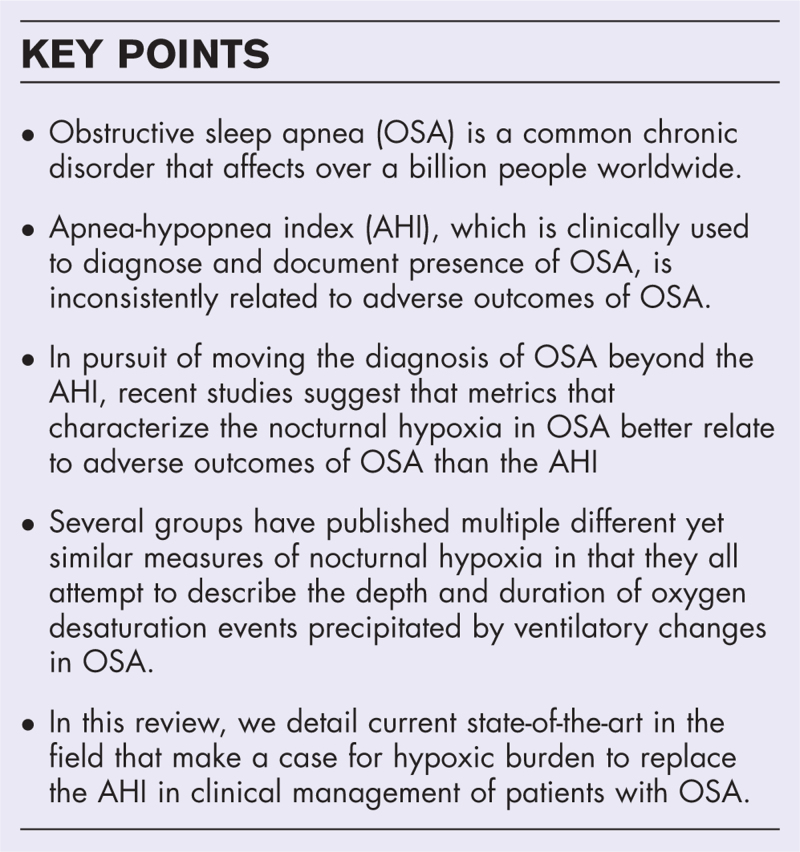
Purpose of review: Obstructive sleep apnea (OSA) is a common chronic condition that affects over a billion people worldwide and is associated with adverse cardio- and cerebrovascular consequences. Currently, the go-to clinical measure that determines the presence and severity of OSA is the apnea-hypopnea index (AHI). The AHI captures the frequency of respiratory events due to changes in ventilation that are associated with either oxygen desaturations or arousal from sleep. The AHI is poorly correlated to adverse outcomes in OSA with poor prognostic ability. To overcome the limitations of AHI and perhaps driven by the ease of acquisition, several studies have suggested characterizing nocturnal hypoxia in OSA, termed as "hypoxic burden". The purpose of this review is to focus on the hypoxic burden in OSA, its various definitions, and its utility in moving OSA diagnosis beyond the AHI.
Recent findings: Several measures and definitions of hypoxic burden have been proposed and studied that show promise in overcoming limitations of AHI and also have a greater prognostic ability than AHI. More recently, area-based measures that attempt to characterize the depth and duration of oxygen desaturations, i.e., nocturnal hypoxia in OSA, have been shown to better relate to incident cardiovascular disease than AHI. In this review, we delve into the evidence for these novel area-based metrics and also delve into the pathophysiological concepts underlying nocturnal hypoxia while cautioning the reader on interpretation of the recent findings relating hypoxic burden to adverse outcomes in OSA.
Summary: In this review on hypoxic burden, we focus on the need that has driven the sudden influx of studies assessing hypoxic burden for various outcomes of OSA, its underlying pathophysiology, the various definitions, and clinical relevance. We hope that the reader can appreciate the nuances underlying hypoxic burden in OSA and suggest the need for a cohesive framework for moving beyond the AHI with hypoxic burden.
Copyright © 2024 The Author(s). Published by Wolters Kluwer Health, Inc.
Conflict of interest statement
Figures
References
-
- Parekh A, Kam K, Wickramaratne S, et al. Ventilatory burden as a measure of obstructive sleep apnea severity is predictive of cardiovascular and all-cause mortality. Am J Respir Crit Care Med 2023; 208:1216–1226. - PMC - PubMed
-
First study that assessed the contribution of hypoxic burden to ventilatory burden in assessing severity of OSA as well as its relationship to adverse outcomes in OSA.
Publication types
MeSH terms
Grants and funding
LinkOut - more resources
Full Text Sources
Research Materials
