


Health-related quality of life and caregiver burden of pediatric patients with inborn errors of metabolism in Japan using EQ-5D-Y, PedsQL, and J-ZBI
- PMID: 39230839
- PMCID: PMC11599479
- DOI: 10.1007/s11136-024-03775-0
Health-related quality of life and caregiver burden of pediatric patients with inborn errors of metabolism in Japan using EQ-5D-Y, PedsQL, and J-ZBI
Abstract
Purpose: Inborn errors of metabolism (IEM) are known with poor long-term health concerns; however, the health-related quality of life (HRQoL) and the burden placed on families remain unclear. This study investigated the self- and proxy-reported HRQoL of pediatric patients with IEM with or without developmental disabilities and the burden placed on their caregivers.
Methods: Patients with IEM aged 8-15 years and their caregivers were asked to respond to the Pediatric Quality of Life Inventory (PedsQL), EuroQoL five-dimension questionnaire for younger populations (EQ-5D-Y), and Japanese version of the Zarit Caregiver Burden Interview (J-ZBI). We compared EQ-5D-Y scores with matched EQ-5D-Y population norms. Intraclass correlation coefficients (ICC) for self and proxy HRQoL scores of those without developmental disabilities were calculated. Correlation coefficients of HRQoL proxy responses with J-ZBI score were estimated.
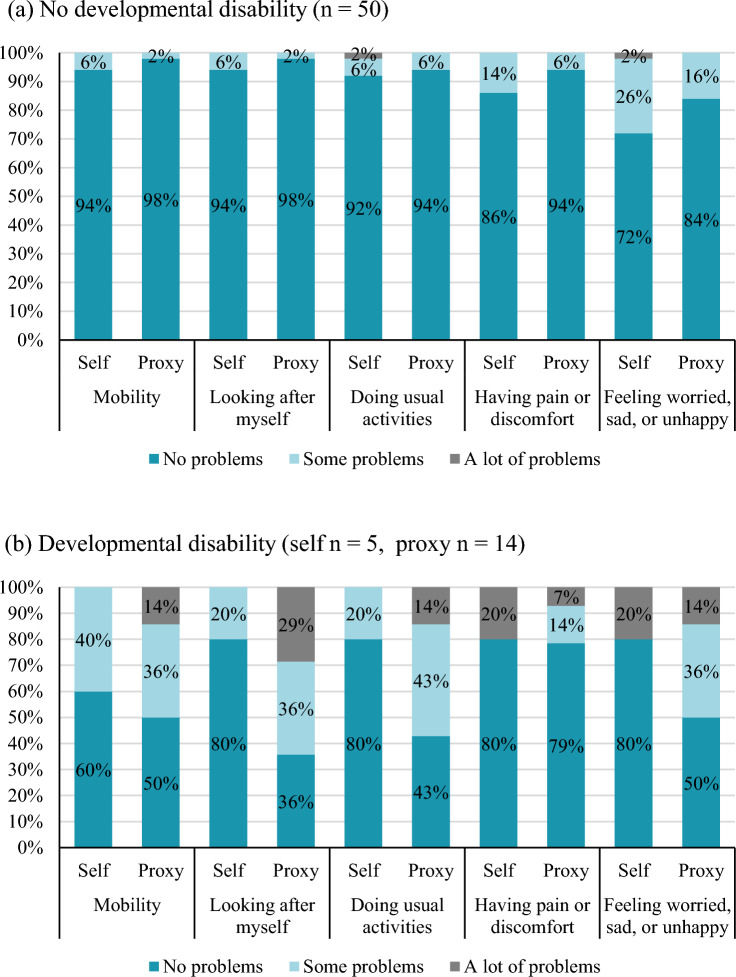
Results: We included 66 patients with IEM (mean age, 11.5 years; males, 41.2%) in the study. The mean (± standard deviation) EQ-5D-Y scores without and with developmental disabilities were 0.957 (± 0.071) and 0.821 (± 0.175), respectively. The EQ-5D-Y scores significantly increased compared with the reference values (p < 0.01, effect size = 0.337). The ICC values were 0.331 and 0.477 for the EQ-5D-Y and PedsQL scores, respectively. HRQoL proxy scores had strong negative correlations with J-ZBI scores.
Conclusion: The HRQoL of patients with IEM without developmental disabilities in our study was similar to that of the general Japanese population. The HRQoL of patients with IEM with developmental disabilities was low and associated with a tendency towards an increased burden of care.
Keywords: EQ-5D-Y; Inborn errors; J-ZBI; Metabolism; PedsQL; Quality of Life.
© 2024. The Author(s).
Conflict of interest statement
Declarations. Competing interests: The authors have no relevant financial or non-financial interests to disclose. Ethical approval: This study was approved by the Ethical Review Committee of Yamagata University Faculty of Medicine (#2019-227). Consent to participate: Written informed consent was obtained from all individual participants or their parents included in the study. Consent for publication: Not applicable.
Figures
References
-
- Therrell, B. L., Padilla, C. D., Loeber, J. G., Kneisser, I., Saadallah, A., Borrajo, G. J., & Adams, J. (2015). Current status of newborn screening worldwide: 2015. Seminars in Perinatology,39(3), 171–187. 10.1053/j.semperi.2015.03.002 - PubMed
-
- Gramer, G., Haege, G., Glahn, E. M., Hoffmann, G. F., Lindner, M., & Burgard, P. (2014). Living with an inborn error of metabolism detected by newborn screening-parents’ perspectives on child development and impact on family life. Journal of Inherited Metabolic Disease,37(2), 189–195. 10.1007/s10545-013-9639-6 - PubMed
-
- Zeltner, N. A., Huemer, M., Baumgartner, M. R., & Landolt, M. A. (2014). Quality of life, psychological adjustment, and adaptive functioning of patients with intoxication-type inborn errors of metabolism—A systematic review. Orphanet Journal of Rare Diseases,25(9), 159. 10.1186/s13023-014-0159-8 - PMC - PubMed
-
- Coene, J. R., & Reeves, P. T. (2023). Key factors affecting parental quality of life in families of children with inborn errors of metabolism requiring a restrictive diet. The Journal of Pediatrics,254, 1–3. 10.1016/j.jpeds.2022.10.007 - PubMed
MeSH terms
Grants and funding
LinkOut - more resources
Full Text Sources
Medical
