


Disparities in the access to atrial fibrillation ablation in Denmark: who gets ablated, who neglected?
- PMID: 39230873
- PMCID: PMC11411207
- DOI: 10.1093/europace/euae231
Disparities in the access to atrial fibrillation ablation in Denmark: who gets ablated, who neglected?
Abstract
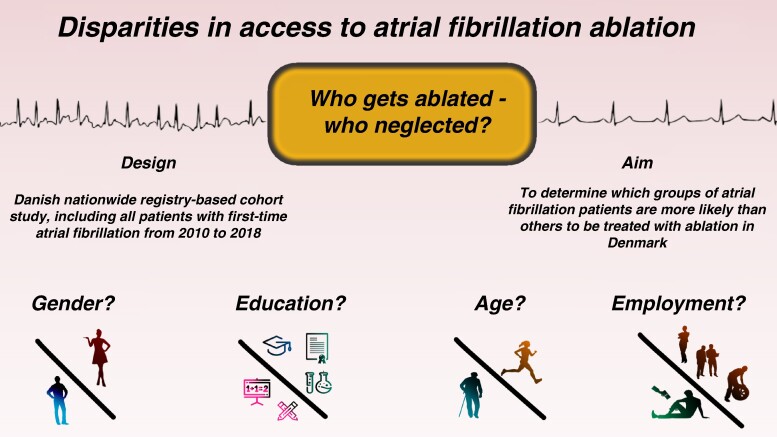
Aims: Atrial fibrillation (AF) is a common arrhythmia associated with reduced quality of life that can lead to serious complications such as stroke and heart failure. Ablation is a safe and effective treatment for AF but is not offered equally to all patients. The aim of this study is to identify demographic groups more or less likely to undergo AF ablation.
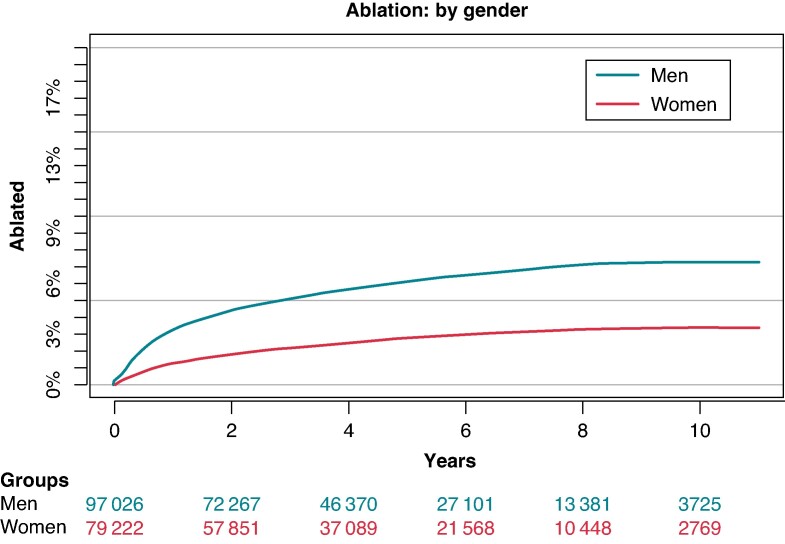
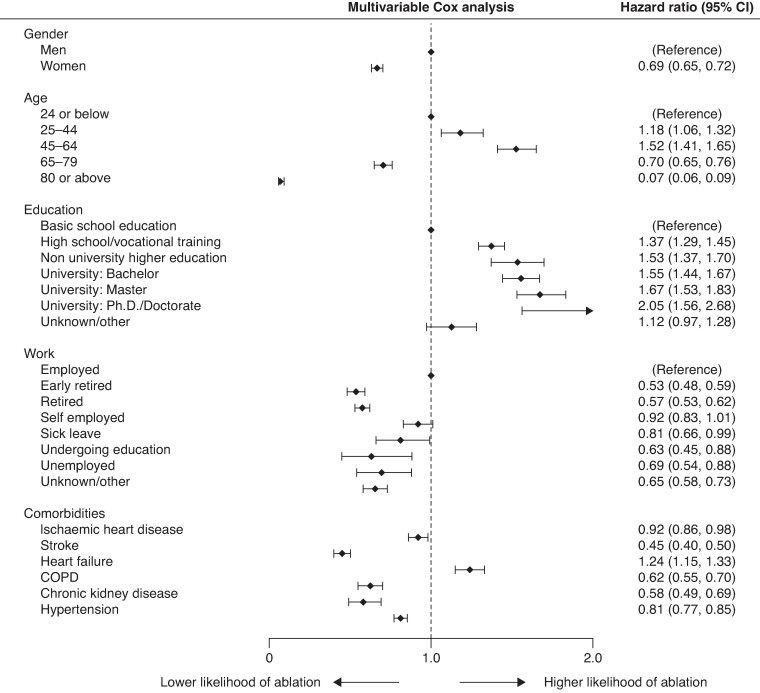
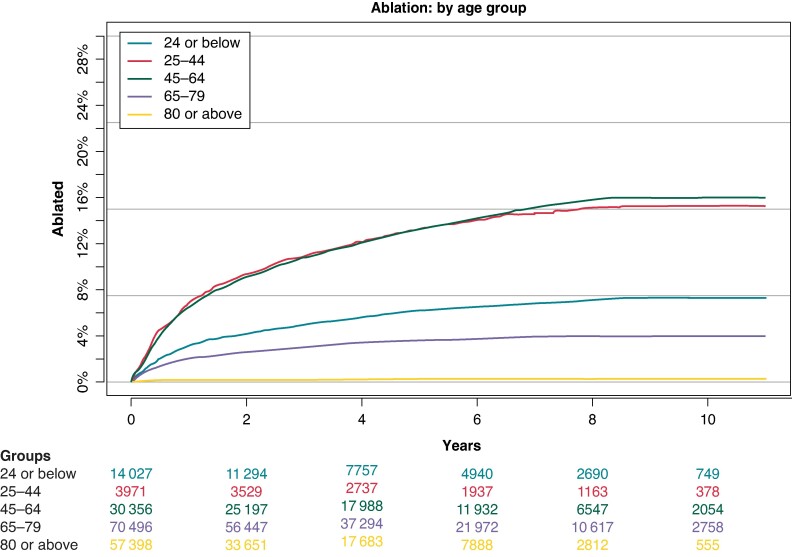
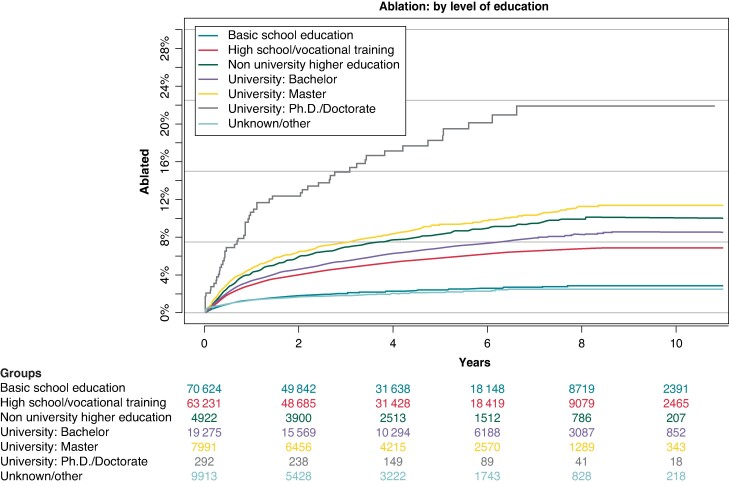
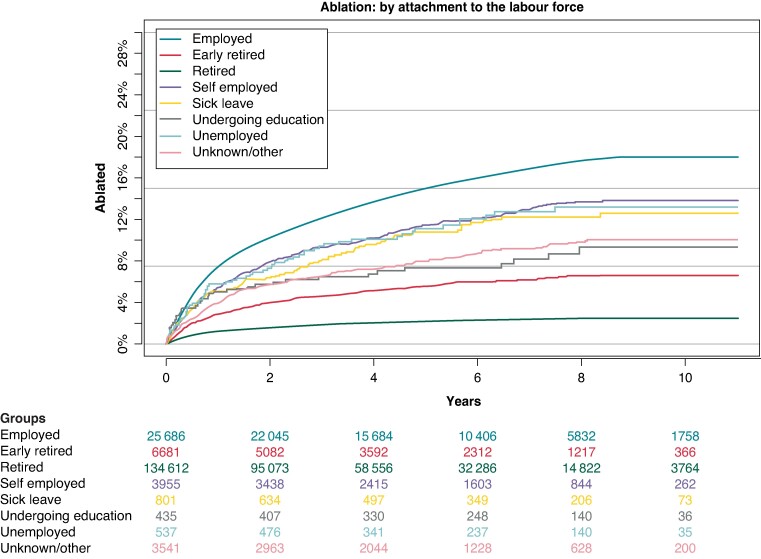
Methods and results: All patients with newly diagnosed AF between 2010 and 2018 were identified in the Danish nationwide registries. The association between gender, age, level of education and attachment to the job market, and the likelihood of receiving AF ablation was investigated using multivariable Cox proportional hazard analysis. Cumulative incidence was calculated using the Aalen-Johansen estimator. A total of 176 248 patients were included. Men were more likely to receive ablation than women (7% vs. 3%). Patients aged 25-44 and 45-64 were most likely to receive ablation, while only 0.7% of patients aged 80 or above received ablation. The rate of ablation significantly decreased with decreasing level of education. Full-time employed patients were most likely to receive ablation, followed by self-employed, unemployed, on sick leave, undergoing education, and early retired patients. Retired patients were the least likely to receive ablation (3%).
Conclusion: This study found that women, older patients, patients with lower levels of education, and patients on social benefits are less likely to receive AF ablation. These findings suggest that there are significant social and economic disparities in AF ablation treatment in Denmark.
Keywords: Ablation; Atrial fibrillation; Denmark; Disparity; Healthcare access.
© The Author(s) 2024. Published by Oxford University Press on behalf of the European Society of Cardiology.
Conflict of interest statement
Conflict of interest: none declared.
Figures
References
-
- Hindricks G, Potpara T, Dagres N, Arbelo E, Bax JJ, Blomström-Lundqvist C et al. 2020 ESC guidelines for the diagnosis and management of atrial fibrillation developed in collaboration with the European Association for Cardio-Thoracic Surgery (EACTS). Eur Heart J 2021;42:373–498. - PubMed
-
- January CT, Wann LS, Calkins H, Chen LY, Cigarroa JE, Cleveland JC et al. 2019 AHA/ACC/HRS focused update of the 2014 AHA/ACC/HRS guideline for the management of patients with atrial fibrillation: a report of the American College of Cardiology/American Heart Association task force on clinical practice guidelines and the Heart Rhythm Society in collaboration with the Society of Thoracic Surgeons. Circulation 2019;140:e125–51. - PubMed
-
- Thrall G, Lip GYH, Carroll D, Lane D. Depression, anxiety, and quality of life in patients with atrial fibrillation. Chest 2007;132:1259–64. - PubMed
-
- Aliot E, Botto GL, Crijns HJ, Kirchhof P. Quality of life in patients with atrial fibrillation: how to assess it and how to improve it. Europace 2014;16:787–96. - PubMed
-
- Tiwari S, Løchen ML, Jacobsen BK, Hopstock LA, Nyrnes A, Njølstad I et al. Atrial fibrillation is associated with cognitive decline in stroke-free subjects: the Tromsø study. Eur J Neurol 2017;24:1485–92. - PubMed
MeSH terms
Grants and funding
LinkOut - more resources
Full Text Sources
Medical
