. 2024 Sep 4;20(9):e1011384.
doi: 10.1371/journal.pgen.1011384. eCollection 2024 Sep.

Temporal epigenome modulation enables efficient bacteriophage engineering and functional analysis of phage DNA modifications

Affiliations

Temporal epigenome modulation enables efficient bacteriophage engineering and functional analysis of phage DNA modifications

Nadiia Pozhydaieva et al. PLoS Genet. .

Abstract

Lytic bacteriophages hold substantial promise in medical and biotechnological applications. Therefore a comprehensive understanding of phage infection mechanisms is crucial. CRISPR-Cas systems offer a way to explore these mechanisms via site-specific phage mutagenesis. However, phages can resist Cas-mediated cleavage through extensive DNA modifications like cytosine glycosylation, hindering mutagenesis efficiency. Our study utilizes the eukaryotic enzyme NgTET to temporarily reduce phage DNA modifications, facilitating Cas nuclease cleavage and enhancing mutagenesis efficiency. This approach enables precise DNA targeting and seamless point mutation integration, exemplified by deactivating specific ADP-ribosyltransferases crucial for phage infection. Furthermore, by temporally removing DNA modifications, we elucidated the effects of these modifications on T4 phage infections without necessitating gene deletions. Our results present a strategy enabling the investigation of phage epigenome functions and streamlining the engineering of phages with cytosine DNA modifications. The described temporal modulation of the phage epigenome is valuable for synthetic biology and fundamental research to comprehend phage infection mechanisms through the generation of mutants.


Conflict of interest statement

I have read the journal’s policy and the authors of this manuscript have the following competing interests: KH and NP filed a European Patent Application for “Engineering of Phages”, European Patent Application No. 23 175 257.7. The other authors declare no competing interests.

Figures
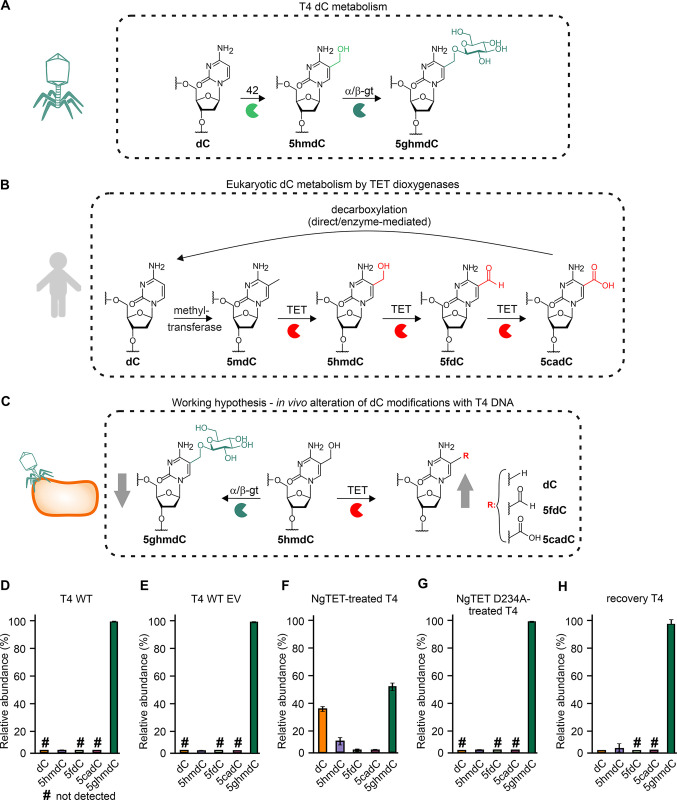
Fig 1
Fig 1. T4 phage DNA is extensively modified.
(A) Phage T4 DNA is extensively modified by deoxycytidylate 5-hydroxymethyltransferase (42) (oxidation of dC to 5hmdC), and α/β-gt (glycosylation of 5hmdC to 5ghmdC). (B) TET dioxygenase plays a crucial role in eukaryotic epigenetic regulation by demethylating 5mdC through its iterative oxidation. (C) 5hmdC present in phageT4 is one of the natural substrates of TET. Therefore, the glycosylation of 5hmdC to 5ghmdC by α-gt/β-gt is expected to be downregulated in the presence of TET due to substrate competition between TET and α-gt/β-gt. (D-H) Relative abundance (%) of 2´-deoxycytidine metabolites determined via LC-MS analysis in different T4 strains: T4 WT (D), T4 WT propagated in the presence of empty vector (EV) (T4 WT EV) (E), NgTET-treated T4 (F), NgTET D234A-treated T4 (G), and recovery T4 (H). The presence of dC traces in recovery T4 DNA (H) may be attributed to residual NgTET-treated T4 phages that did not infect E. coli and therefore were not recovered. Hashtag highlights the nucleosides not detected in a sample. n = 3 biological replicates. The significance of specific cytosine modification changes is shown in S2 Fig.
Fig 2
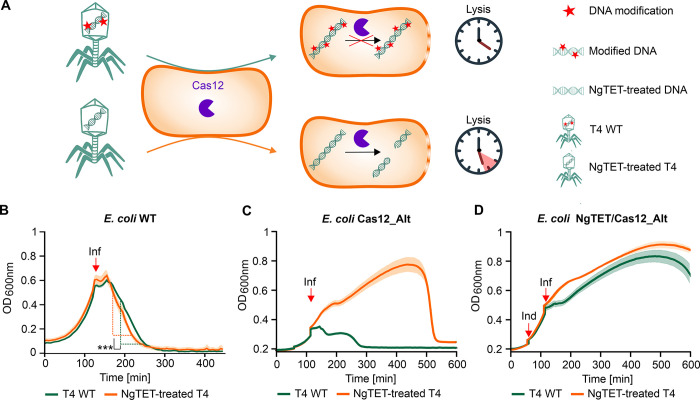
Fig 2. Impact of T4 DNA modifications on T4 phage lysis behaviour in the presence and absence of CRISPR-Cas12.
(A) T4 DNA modifications protect phage DNA against Cas12 nuclease targeting, ensuring efficient phage propagation cell lysis. Reduced DNA modifications increase Cas12 nuclease susceptibility, leading to impeded and therewith delayed lysis of bacterial culture. (B) Lysis kinetics of E. coli infected by T4 WT and NgTET-treated T4. Red arrow highlights the time point of the phage addition (Inf) (two-sided Student’s t-test, P = 0.0096 at Psignif <0.05). n = 3 biological replicates. A multiplicity of infection (MOI) of 0.8 was applied. (C) Lysis kinetics of E. coli Cas12_Alt by T4 WT and NgTET-treated T4. Red arrows highlight the time point of NgTET expression induction (Ind) and the addition of the phage (Inf). n = 3 biological replicates. (D) Lysis kinetics of E. coli NgTET/Cas12_Alt by T4 WT and NgTET-treated T4. Red arrows highlight the time point of NgTET expression induction (Ind) and the addition of the phage (Inf). n = 3 biological replicates.
Fig 3
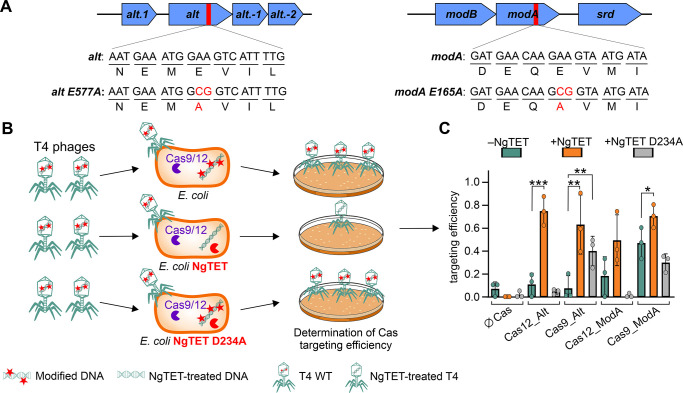
Fig 3. Effect of NgTET overexpression on CRISPR-Cas targeting efficiency in vivo.
(A) Target mutations in alt and modA genes that lead to the abolishment of ADP-ribosylation activity. (B) Design of TE experiment. (C) Evaluation of Cas-mediated T4 DNA TE in vivo in the presence or absence of NgTET/NgTET D234A (two-sided Student’s t-test, *—Psignif < 0.05, **—Psignif < 0.025, ***—Psignif < 0.0125). n = 3 biological replicates.
Fig 4
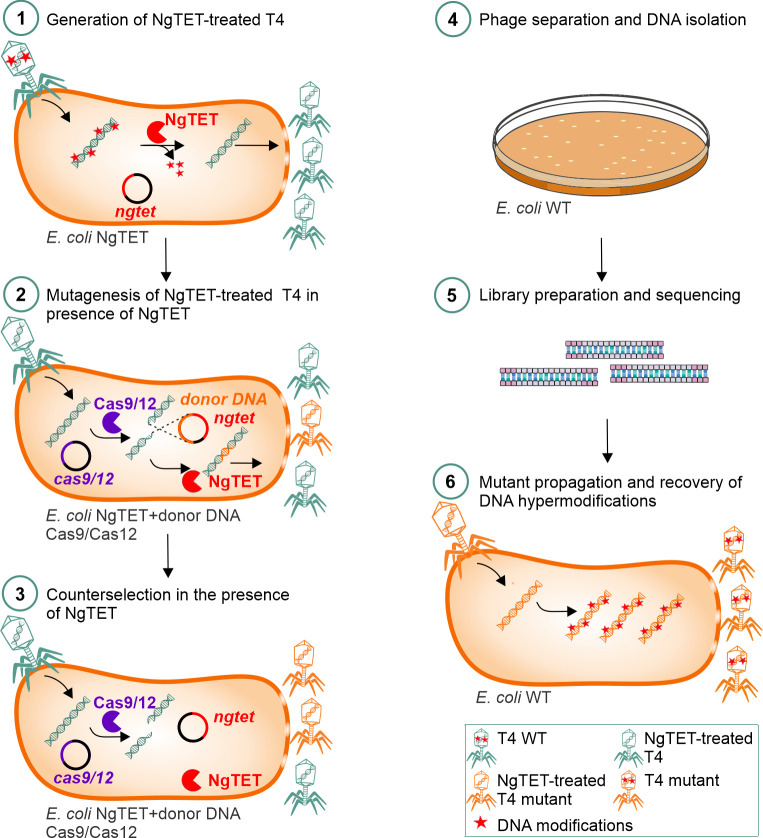
Fig 4. Established workflow for T4 phage mutagenesis and mutants screening.
Fig 5
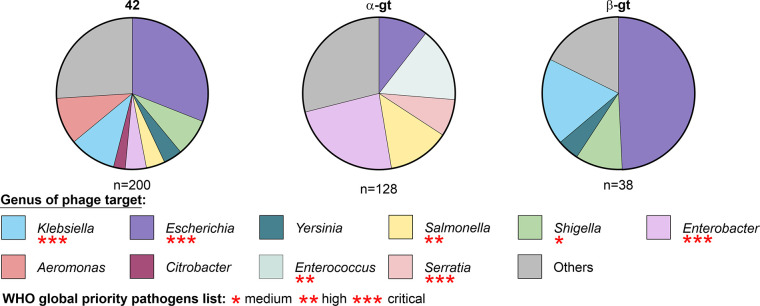
Fig 5. Distribution of cytosine modifying enzymes homologous to T4-originating enzymes 42, α-gt and β-gt among phages based on the genus of infected bacteria (BLAST score >80).
Red asterisks highlight the global priority pathogens classification of the bacterial genus according to the WHO.

References

    1. Moye ZD, Woolston J, Sulakvelidze A. Bacteriophage Applications for Food Production and Processing. Viruses-Basel. 2018;10(4). Epub 20180419. doi: 10.3390/v10040205 ; PubMed Central PMCID: PMC5923499. - DOI - PMC - PubMed
    1. Schroven K, Aertsen A, Lavigne R. Bacteriophages as drivers of bacterial virulence and their potential for biotechnological exploitation. Fems Microbiol Rev. 2021;45(1). doi: 10.1093/femsre/fuaa041 . - DOI - PubMed
    1. Vandamme EJ, Mortelmans K. A century of bacteriophage research and applications: impacts on biotechnology, health, ecology and the economy! J Chem Technol Biot. 2019;94(2):323–42. doi: 10.1002/jctb.5810 WOS:000455262100001. - DOI
    1. Elois MA, Silva RD, Pilati GVT, Rodriguez-Lazaro D, Fongaro G. Bacteriophages as Biotechnological Tools. Viruses-Basel. 2023;15(2). Epub 20230126. doi: 10.3390/v15020349 ; PubMed Central PMCID: PMC9963553. - DOI - PMC - PubMed
    1. Wolfram-Schauerte M, Pozhydaieva N, Viering M, Glatter T, Höfer K. Integrated Omics Reveal Time-Resolved Insights into T4 Phage Infection of E. coli on Proteome and Transcriptome Levels. Viruses-Basel. 2022;14(11). Epub 20221112. doi: 10.3390/v14112502 ; PubMed Central PMCID: PMC9697503. - DOI - PMC - PubMed

LinkOut - more resources