


Excess Triglycerides in Very Low-Density Lipoprotein (VLDL) Estimated from VLDL-Cholesterol could be a Useful Biomarker of Metabolic Dysfunction Associated Steatotic Liver Disease in Patients with Type 2 Diabetes
- PMID: 39231648
- PMCID: PMC11802249
- DOI: 10.5551/jat.65164
Excess Triglycerides in Very Low-Density Lipoprotein (VLDL) Estimated from VLDL-Cholesterol could be a Useful Biomarker of Metabolic Dysfunction Associated Steatotic Liver Disease in Patients with Type 2 Diabetes
Abstract
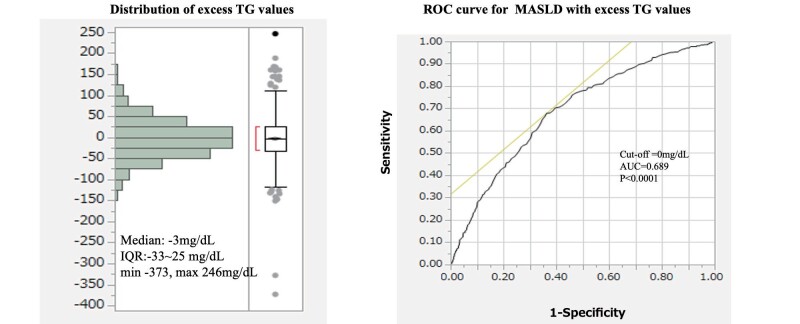
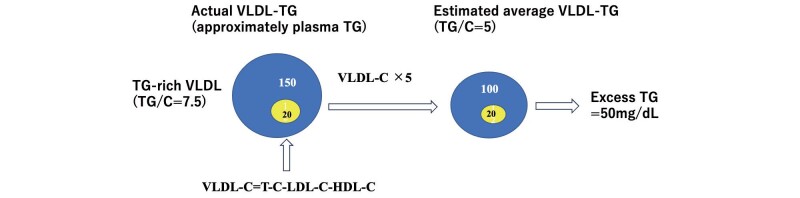
Aims: We report that small dense low-density lipoprotein cholesterol (sdLDL-C) levels are sensitive biomarkers of metabolic dysfunction-associated steatotic liver disease (MASLD). Since triglyceride (TG)-rich very low-density lipoprotein (VLDL) is a precursor of sdLDL and is overproduced by MASLD, the composition of VLDL may be more directly associated with MAFLD than sdLDL-C or plasma TG. To identify TG-rich VLDL, this author proposed "Excess TG" and examined its association with MASLD.
Methods: Patients with type 2 diabetes (n=1295), excluding fasting hypertriglyceridemia (TG ≥ 400 mg/dL) and heavy drinkers were examined. Liver steatosis and visceral fat area (VFA) were evaluated using CT. VLDL-C was calculated as the total C minus direct LDL-C minus HDL-C. The average VLDL-TG level can be estimated using VLDL-C×5, according to the principle of the Friedewald equation for LDL-C. Thus, VLDL-TG was estimated as VLDL-C×5, and Excess TG was calculated as plasma TG minus VLDL-C×5.
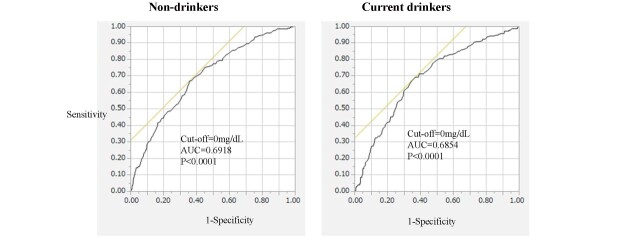
Results: Patients with MASLD were younger, more likely to be men and drinkers, and had higher VFA, TG, sdLDL-C, and excess TG, while VLDL-C was comparable. Excess TG was found to be the most sensitive lipid parameter for identifying MASLD, independent of sdLDL-C, TG, TG/VLDL-C, and VFA. The odds ratios for MASLD were 2.4-, 3.7-, and 3.9-fold higher for Excess TG ranges of 0-24, 25-49, and ≥ 50 mg/dL, respectively, relative to <0 mg, and a close relationship remained significant after adjustment for lipid- and adiposity-related parameters.
Conclusions: Excess TG in VLDL was strongly associated with MASLD beyond TG and sdLDL-C levels, which may reflect the presence of TG-rich VLDL.
Keywords: Excess triglycerides; MASLD; Small dense LDL; VLDL.
Figures
References
-
- Eslam M, Newsome PN, Sarin SK, Anstee QM, Targher G, Romero-Gomez M, Zelber-Sagi S, Wai-Sun Wong V, Dufour JF, Schattenberg JM, Kawaguchi T, Arrese M, Valenti L, Shiha G, Tiribelli C, Yki-Järvinen H, Fan JG, Grønbæk H, Yilmaz Y, Cortez-Pinto H, Oliveira CP, Bedossa P, Adams LA, Zheng MH, Fouad Y, Chan WK, Mendez-Sanchez N, Ahn SH, Castera L, Bugianesi E, Ratziu V, George J. A new definition for metabolic dysfunction-associated fatty liver disease: An international expert consensus statement. J Hepatol, 2020; 73: 202-209 - PubMed
-
- Targher G, Day CP, Bonora E. Risk of cardiovascular disease in patients with nonalcoholic fatty liver disease. N Engl J Med, 2010; 363: 1341-1350 - PubMed
-
- Stahl EP, Dhindsa DS, Lee SK, Sandesara PB, Chalasani NP, Sperling LS. Nonalcoholic Fatty Liver Disease and the Heart. J Am Coll Cardiol, 2019; 73: 948-963 - PubMed
-
- Nordestgaard BG. Triglyceride-rich lipoproteins and atherosclerotic cardiovascular disease: new insights from epidemiology, genetics, and biology. Circ Res, 2016; 118: 547-563 - PubMed
MeSH terms
Substances
LinkOut - more resources
Full Text Sources
Medical
Miscellaneous
