


High serological and molecular prevalence of Ehrlichia canis and other vector-borne pathogens in dogs from Boa Vista Island, Cape Verde
- PMID: 39232789
- PMCID: PMC11373305
- DOI: 10.1186/s13071-024-06437-9
High serological and molecular prevalence of Ehrlichia canis and other vector-borne pathogens in dogs from Boa Vista Island, Cape Verde
Abstract
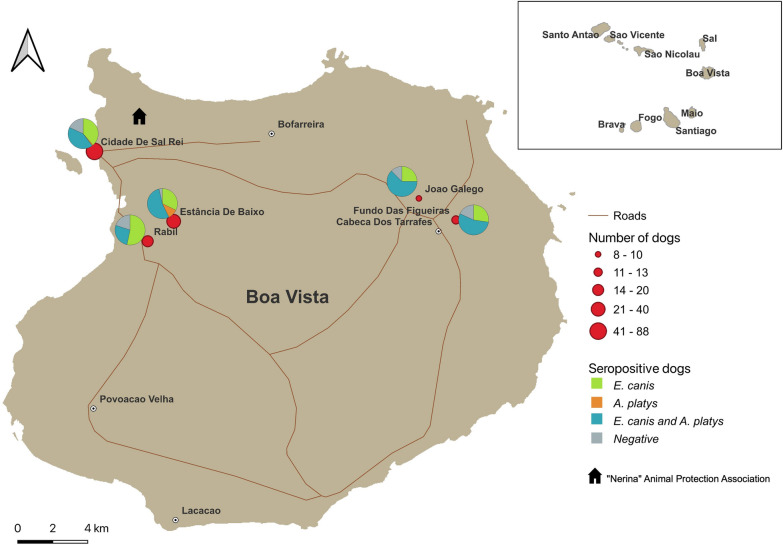
Despite the high global impacts of canine vector-borne diseases (CVBD) due to their wide distribution and zoonotic potential, the current epidemiological situation of CVBD in many tropical and subtropical regions remains unknown. This study examines the seroprevalence and molecular prevalence of Ehrlichia canis and other pathogens causing CVBDs (Leishmania infantum, Dirofilaria immitis, Babesia spp., Anaplasma spp. and Hepatozoon canis) in dogs living on the island of Boa Vista (Cape Verde Republic). Blood samples and infesting ticks were taken from 150 dogs across the island (stray, shelter, and pet dogs). Serum samples were tested using a rapid immunochromatographic test (Uranotest® Quattro) that detects antibodies against E. canis, L. infantum, Anaplasma spp. and D. immitis antigen. Levels of serum antibodies against E. canis were measured using the immunofluorescence antibody test (IFAT). In addition, tick-borne pathogens in blood samples (Anaplasma spp., Babesia spp., Hepatozoon spp., and Ehrlichia canis) were detected by microscopy observation and/or PCR plus sequencing. The seroprevalence of E. canis was extremely high at 82% (123/150), as revealed by both immunochromatography and IFAT. Most dogs returning a seropositive test result (82.92%; 102/123) had antibody titres > 1:1280 but showed no clinical signs or notable laboratory abnormalities. Of the 123 animals testing seropositive for E. canis, 67 (54.47%) also presented antibodies against Anaplasma spp., and 13 (10.56%) showed the presence of Hepatozoon spp. gamonts in the blood smear. Ehrlichia canis infection was detected in 17.1% (25/146) of dogs tested by direct sequencing of polymerase chain reaction (PCR) products. Co-infections were detected in seven of these dogs: four dogs tested PCR-positive for both E. canis and A. platys, two dogs tested positive for E. canis and Hepatozoon spp., and one dog tested positive for E. canis, A. platys and Hepatozoon spp. Rhipicephalus sanguineus sensu lato was the only tick species found infesting the canine study population. The high prevalence of tick-borne pathogens detected in dogs from Boa Vista Island highlights a need for improved control measures designed to prevent the transmission of these pathogens.
Keywords: Anaplasma platys; Ehrlichia canis; Rhipicephalus sanguineus s.l.; Boa Vista; Dog.
© 2024. The Author(s).
Conflict of interest statement
The authors declare no competing interests.
Figures
References
-
- Dumler JS, Barbet AF, Bekker CP, Dasch GA, Palmer GH, Ray SC, et al. Reorganization of genera in the families Rickettsiaceae and Anaplasmataceae in the order Rickettsiales: unification of some species of Ehrlichia with Anaplasma, Cowdria with Ehrlichia and Ehrlichia with Neorickettsia, descriptions of six new species combinations and designation of Ehrlichia equi and “HGE agent” as subjective synonyms of Ehrlichia phagocytophila. Int J Syst Evol Microbiol. 2001;51:2145–65. 10.1099/00207713-51-6-2145 - DOI - PubMed
-
- Neer TM, Harrus S. Canine monocytotropic ehrlichiosis and neorickettsiosis (E. canis, E. chaffeensis, E. ruminantium, N. sennetsu, and N. risticii infections). In: Greene CE, editor. Infectious diseases of the dog and cat. St. Louis: Saunders Elsevier; 2006. p. 203–16.
MeSH terms
Substances
LinkOut - more resources
Full Text Sources
Research Materials
Miscellaneous
