


Trends and inequalities in antenatal care coverage in Benin (2006-2017): an application of World Health Organization's Health Equity Assessment Toolkit
- PMID: 39232790
- PMCID: PMC11376089
- DOI: 10.1186/s12913-024-11261-z
Trends and inequalities in antenatal care coverage in Benin (2006-2017): an application of World Health Organization's Health Equity Assessment Toolkit
Abstract
Introduction: Between 2006 and 2017, antenatal care (ANC) coverage in Benin declined, potentially exacerbating inequalities and substantiating the need for health inequality monitoring. This study examines inequalities in ANC attendance in Benin, disaggregated by women's age, educational level, economic status, place of residence, region of residence, and the extent to which they have changed over time.
Methods: Three rounds of the Benin Demographic and Health Surveys (2006, 2011-12, and 2017-18) were analyzed to examine inequalities in ANC coverage. An exploratory descriptive approach was adopted for the analysis. Simple [difference (D) and ratio (R)] and complex [population attributable risk (PAR) and population attributable fraction (PAF)] measures of inequalities were computed using the World Health Organization's Health Equity Assessment Toolkit (WHO's HEAT) online platform. The measures were computed separately for each of the three surveys, and their estimates were compared.
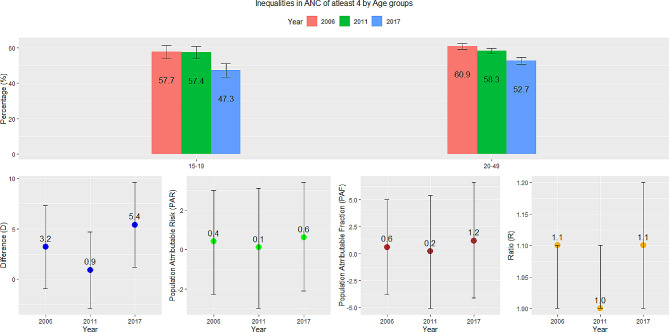
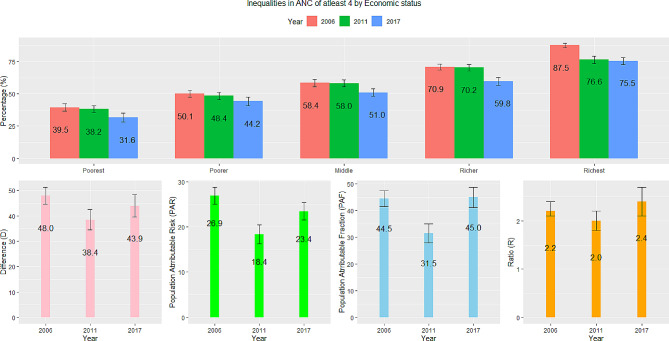
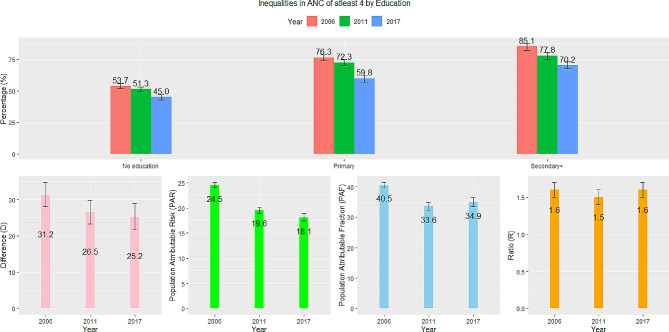
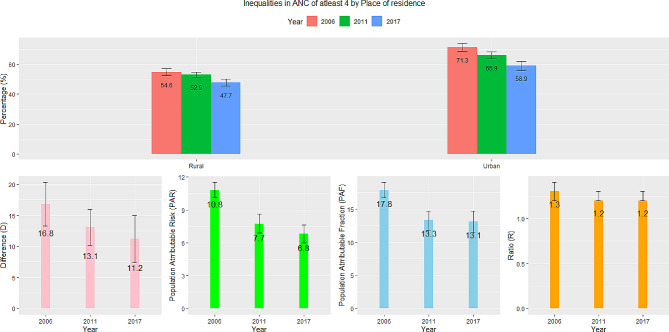
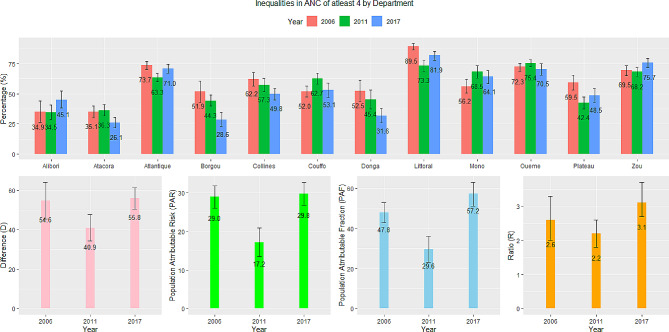
Results: The findings revealed an 8.4% decline in at least four ANC visits between 2006 and 2017-18. The decline occurred irrespective of age, educational status, economic status, place of residence, and region. Region-related inequalities were the largest and increased slightly between 2006 (D = 54.6; R = 2.6; PAF = 47.8, PAR = 29.0) and 2017-18 (D = 55.8; R = 3.1; PAF = 57.2, PAR = 29.8). Education (2006: D = 31.3, R = 1.6, PAF = 40.5, PAR = 24.5; 2017-18: D = 25.2, R = 1.6, PAF = 34.9, PAR = 18.1) and rural-urban (2006: D = 16.8, R = 1.3, PAF = 17.8, PAR = 10.8; 2017-18: D = 11.2, R = 1.2, PAF = 13.1, PAR = 6.8) inequalities reduced while economic status inequalities did not improve (2006: D = 48, R = 2.2, PAF = 44.5, PAR = 26.9; 2017-18: D = 43.9, R = 2.4, PAF = 45.0, PAR = 23.4). Age inequalities were very minimal.
Conclusion: ANC inequalities remain deeply ingrained in Benin. Addressing their varying levels requires comprehensive strategies that encompass both supply-and demand-side interventions, focusing on reaching uneducated women in the poorest households and those residing in rural areas and Atacora.
Keywords: Antenatal care; Benin; Demographic and Health Survey; Inequalities; Trends.
© 2024. The Author(s).
Conflict of interest statement
The authors declare no competing interests.
Figures
References
-
- Turi E, Fekadu G, Taye B, Kejela G, Desalegn M, Mosisa G, et al. The impact of antenatal care on maternal near-miss events in Ethiopia: a systematic review and meta-analysis. Int J Afr Nurs Sci. 2020;13:100246.
-
- World Health Organization. WHO recommendations on antenatal care for a positive pregnancy experience [Internet]. Geneva: World Health Organization. 2016 [cited 2023 May 2]. 152 p. https://apps.who.int/iris/handle/10665/250796. - PubMed
MeSH terms
LinkOut - more resources
Full Text Sources
Medical
