


Advancements in Postpartum Rehabilitation: A Systematic Review
- PMID: 39233964
- PMCID: PMC11372501
- DOI: 10.7759/cureus.66165
Advancements in Postpartum Rehabilitation: A Systematic Review
Abstract
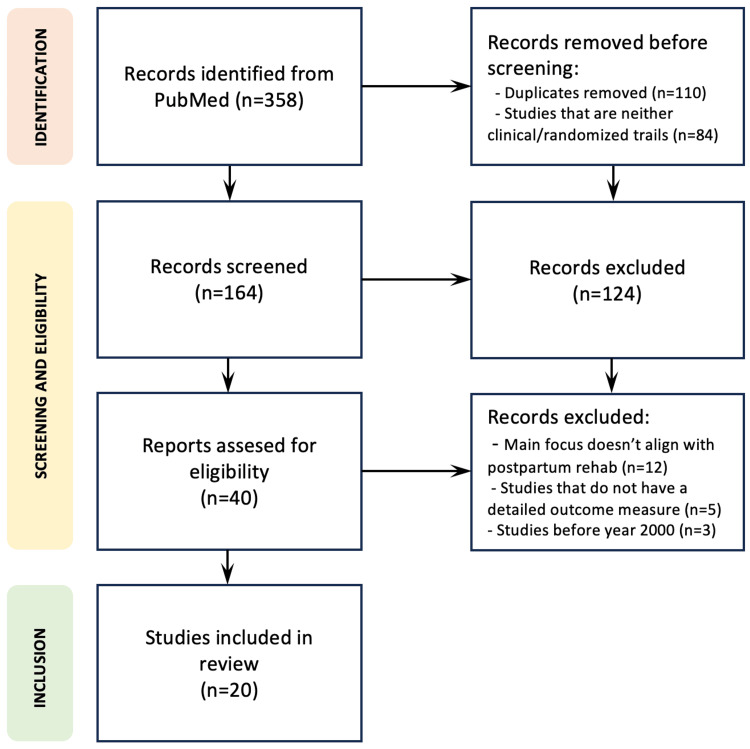
Postpartum rehabilitation plays a crucial role in promoting maternal health and well-being following childbirth. This systematic review aims to explore recent trends and advancements in postpartum rehabilitation interventions across various categories. A comprehensive search was conducted on PubMed and Embase databases, yielding a total of 358 search results. After applying strict inclusion and exclusion criteria, 20 relevant studies were selected for detailed analysis. These studies were categorized into four distinct categories: exercise-based techniques, technology integration, medical interventions, and multi-modal approaches. Within the exercise-based technique category, pelvic floor exercises, trunk stabilization exercises, and physiotherapy emerged as the most commonly utilized interventions. Studies in this category typically involved population sizes ranging from n = 20 to 200 participants, with study durations spanning from six weeks to 12 weeks. In the technology integration category, predominant techniques included electrical stimulation, biofeedback, acupuncture, and vibrating vaginal balls. Population sizes ranged from n = 50 to 200 participants, with study durations ranging from three days to three months. Only one study was identified in the medical intervention category, which investigated the use of intrathecal analgesia and continuous ropivacaine after cesarean section, involving 200 participants. Multimodal approaches encompassed various combinations of technology, artificial intelligence, image processing, and exercise-based interventions, with population sizes ranging from n = 10 to 500 participants and study durations ranging from six weeks to 12 months. This systematic review provides insights into the diverse landscape of postpartum rehabilitation interventions, highlighting the prominence of exercise-based techniques and the growing utilization of technology integration. While medical interventions remain limited, multimodal approaches show promise in optimizing postpartum care outcomes. Continued research and innovation in this field are warranted to further refine rehabilitation strategies and improve maternal health outcomes following childbirth.
Keywords: exercises; postpartum; pregnancy; rehabilitation; technology integration.
Copyright © 2024, Shaik et al.
Conflict of interest statement
Conflicts of interest: In compliance with the ICMJE uniform disclosure form, all authors declare the following: Payment/services info: All authors have declared that no financial support was received from any organization for the submitted work. Financial relationships: All authors have declared that they have no financial relationships at present or within the previous three years with any organizations that might have an interest in the submitted work. Other relationships: All authors have declared that there are no other relationships or activities that could appear to have influenced the submitted work.
Figures
References
-
- Systematic review of the literature on postpartum care: effectiveness of postpartum support to improve maternal parenting, mental health, quality of life, and physical health. Shaw E, Levitt C, Wong S, Kaczorowski J. Birth. 2006;33:210–220. - PubMed
-
- Postpartum period: three distinct but continuous phases. Romano M, Cacciatore A, Giordano R, La Rosa B. https://www.ncbi.nlm.nih.gov/pmc/articles/PMC3279173/ J Prenat Med. 2010;4:22–25. - PMC - PubMed
-
- Magnitude and risk factors for postpartum symptoms: a literature review. Norhayati MN, Hazlina NH, Asrenee AR, Emilin WM. J Affect Disord. 2015;175:34–52. - PubMed
Publication types
LinkOut - more resources
Full Text Sources