


Pathological response and safety of albumin-bound paclitaxel as a neoadjuvant treatment for HER2-positive breast cancer compared to docetaxel combined with anti-HER2 therapy: a real-world study
- PMID: 39234401
- PMCID: PMC11371605
- DOI: 10.3389/fonc.2024.1412051
Pathological response and safety of albumin-bound paclitaxel as a neoadjuvant treatment for HER2-positive breast cancer compared to docetaxel combined with anti-HER2 therapy: a real-world study
Abstract
Background: This study aimed to retrospectively analyse the pathological response and safety of combining albumin-bound paclitaxel (nab-paclitaxel) or docetaxel with anti-HER2 therapy as a neoadjuvant treatment for HER2-positive breast cancer.
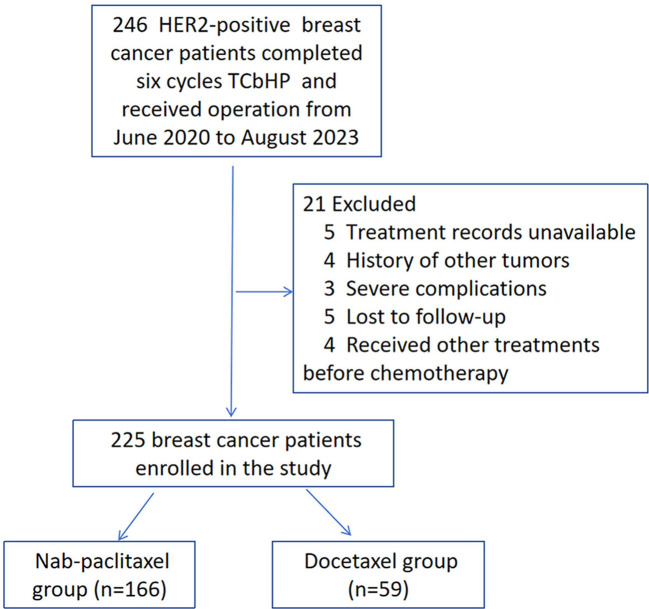
Methods: From June 2020 to August 2023, 225 HER2-positive breast cancer patients who underwent radical surgery following neoadjuvant treatment were enrolled in this study. The patients were divided into two groups based on the drugs they received: the nab-paclitaxel group (n=166, receiving nab-paclitaxel + platinum along with trastuzumab and pertuzumab) and the docetaxel group (n=59, receiving docetaxel + platinum along with trastuzumab and pertuzumab). The pathological response and adverse events related to the drugs were collected and evaluated in both groups.
Results: In the nab-paclitaxel group, the rates of breast and total pathological complete response (bpCR and tpCR) were significantly greater than those in the docetaxel group (69.27% vs. 47.45%, P=0.003; 68.67% vs. 45.76%, P=0.002). For patients who did not achieve pCR after chemotherapy, the pathological response of chemotherapy was analysed using MP grading and RCB grading. The results showed that there was a statistically significant difference between the two groups (P<0.05). Multivariate analysis revealed that therapeutic drugs, clinical stage, ER status, and Ki-67 level were independent predictors of pCR. The nab-paclitaxel group had a significantly greater proportion of patients with peripheral sensory neuropathy than did the docetaxel group (58.43% vs. 38.98%, P=0.035), while the docetaxel group had a greater proportion of patients with allergies and elevated ALT (31.93% vs. 69.49%, P=0.000; 23.49% vs. 40.68%, P=0.021).
Conclusions: Our real-world study revealed that nab-paclitaxel combined with anti-HER2 therapy was an effective neoadjuvant therapy for HER2-positive breast cancer. The multivariate analysis revealed that chemotherapy drugs, clinical stage, ER status, and Ki-67 level was the significant factor influencing treatment outcome. These findings offer a valuable reference for the neoadjuvant treatment of patients with HER2-positive breast cancer.
Keywords: HER2-positive breast cancer; albumin-bound paclitaxel; docetaxel; neoadjuvant treatment; pathological complete response.
Copyright © 2024 Lyu and Gao.
Conflict of interest statement
The authors declare that the research was conducted in the absence of any commercial or financial relationships that could be construed as a potential conflict of interest.
Figures

References
-
- Gianni L, Eiermann W, Semiglazov V, Manikhas A, Lluch A, Tjulandin S, et al. . Neoadjuvant chemotherapy with trastuzumab followed by adjuvant trastuzumab versus neoadjuvant chemotherapy alone, in patients with HER2-positive locally advanced breast cancer (the NOAH trial): a randomised controlled superiority trial with a parallel HER2-negative cohort. Lancet. (2010) 375:377–84. doi: 10.1016/S0140-6736(09)61964-4 - DOI - PubMed
-
- Swain SM, Ewer MS, Viale G, Delaloge S, Ferrero JM, Verrill M, et al. . Pertuzumab, trastuzumab, and standard anthracycline- and taxane-based chemotherapy for the neoadjuvant treatment of patients with HER2-positive localized breast cancer (BERENICE): a phase II, open-label, multicenter, multinational cardiac safety study. Ann Oncol. (2018) 29:646–53. doi: 10.1093/annonc/mdx773 - DOI - PMC - PubMed
LinkOut - more resources
Full Text Sources
Research Materials
Miscellaneous
