Cost-Effectiveness of AI for Risk-Stratified Breast Cancer Screening
- PMID: 39235813
- PMCID: PMC11377997
- DOI: 10.1001/jamanetworkopen.2024.31715
Cost-Effectiveness of AI for Risk-Stratified Breast Cancer Screening
Abstract
Importance: Previous research has shown good discrimination of short-term risk using an artificial intelligence (AI) risk prediction model (Mirai). However, no studies have been undertaken to evaluate whether this might translate into economic gains.
Objective: To assess the cost-effectiveness of incorporating risk-stratified screening using a breast cancer AI model into the United Kingdom (UK) National Breast Cancer Screening Program.
Design, setting, and participants: This study, conducted from January 1, 2023, to January 31, 2024, involved the development of a decision analytical model to estimate health-related quality of life, cancer survival rates, and costs over the lifetime of the female population eligible for screening. The analysis took a UK payer perspective, and the simulated cohort consisted of women aged 50 to 70 years at screening.
Exposures: Mammography screening at 1 to 6 yearly screening intervals based on breast cancer risk and standard care (screening every 3 years).
Main outcomes and measures: Incremental net monetary benefit based on quality-adjusted life-years (QALYs) and National Health Service (NHS) costs (given in pounds sterling; to convert to US dollars, multiply by 1.28).
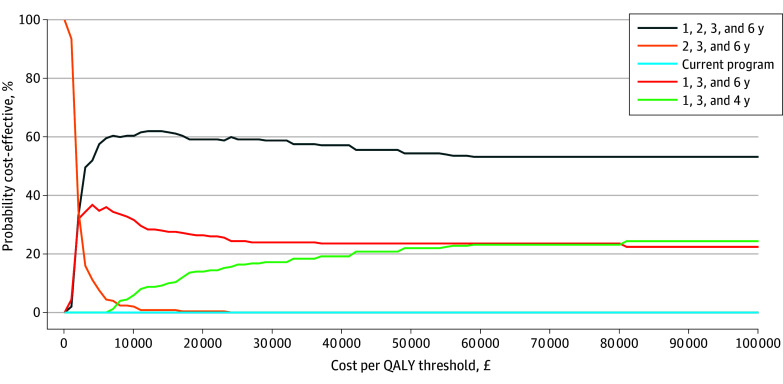
Results: Artificial intelligence-based risk-stratified programs were estimated to be cost-saving and increase QALYs compared with the current screening program. A screening schedule of every 6 years for lowest-risk individuals, biannually and triennially for those below and above average risk, respectively, and annually for those at highest risk was estimated to give yearly net monetary benefits within the NHS of approximately £60.4 (US $77.3) million and £85.3 (US $109.2) million, with QALY values set at £20 000 (US $25 600) and £30 000 (US $38 400), respectively. Even in scenarios where decision-makers hesitate to allocate additional NHS resources toward screening, implementing the proposed strategies at a QALY value of £1 (US $1.28) was estimated to generate a yearly monetary benefit of approximately £10.6 (US $13.6) million.
Conclusions and relevance: In this decision analytical model study of integrating risk-stratified screening with a breast cancer AI model into the UK National Breast Cancer Screening Program, risk-stratified screening was likely to be cost-effective, yielding added health benefits at reduced costs. These results are particularly relevant for health care settings where resources are under pressure. New studies to prospectively evaluate AI-guided screening appear warranted.
Conflict of interest statement
Figures