


Nurses' perceptions of patient safety culture and adverse events in Hail City, Saudi Arabia: a cross-sectional approach to improving healthcare safety
- PMID: 39237280
- PMCID: PMC11381649
- DOI: 10.1136/bmjopen-2024-084741
Nurses' perceptions of patient safety culture and adverse events in Hail City, Saudi Arabia: a cross-sectional approach to improving healthcare safety
Abstract
Objective: This study aimed to assess nurses' perceptions of patient safety culture (PSC) and its relationship with adverse events in Hail City, Saudi Arabia.
Design: A cross-sectional study was conducted between 1 August 2023 and the end of November 2023 at 4 governmental hospitals and 28 primary healthcare centres.
Setting: Hail City, Saudi Arabia.
Participants: Data were collected from 336 nurses using 3 instruments: demographic and work-related questions, PSC and adverse events.
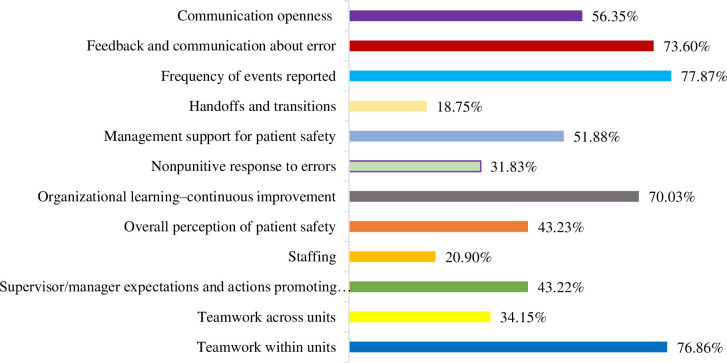
Results: Nurses had positive responses in the dimensions of 'teamwork within units' (76.86%) and 'frequency of events reported' (77.87%) but negative responses in the dimensions of 'handoffs and transitions' (18.75%), 'staffing' (20.90%), 'non-punitive response to errors' (31.83%), 'teamwork across units' (34.15%), 'supervisor/manager expectations' (43.22%) and 'overall perception of patient safety' (43.23%). Significant associations were found between nationality, experience, current position and total safety culture, with p values of 0.015, 0.046 and 0.027, respectively. Nurses with high-ranking perceptions of PSC in 'handoffs and transitions,' 'staffing' and 'teamwork across hospital units' reported a lower incidence of adverse events than those with low-ranking perceptions, particularly in reporting pressure ulcers (OR 0.86, 95% CI 0.78 to 0.94, OR 0.82, 95% CI 0.71 to 0.94 and OR 0.83, 95% CI 0.70 to 0.99, respectively) (p<0.05). Nurses with high-ranking perceptions of PSC in UK 'handoffs and transitions' reported a lower incidence of patient falls. Similarly, those with high-ranking perceptions in both 'handoffs and transitions' and 'overall perception of patient safety reported a lower incidence of adverse events compared with those with low-ranking perceptions, especially in reporting adverse drug events (OR 0.83, 95% CI 0.76 to 0.91 and OR 0.75, 95% CI 0.61 to 0.92, respectively) (p<0.05).
Conclusion: From a nursing perspective, hospital PSCs have both strengths and weaknesses. Examples include low trust in leadership, staffing, error-reporting and handoffs. Therefore, to improve staffing, communication, handoffs, teamwork, and leadership, interventions should focus on weak areas of low confidence and high rates of adverse events.
Keywords: Nurses; Patients; Safety.
© Author(s) (or their employer(s)) 2024. Re-use permitted under CC BY-NC. No commercial re-use. See rights and permissions. Published by BMJ.
Conflict of interest statement
Competing interests: None declared.
Figures
References
-
- World Health Organization Patient safety. 2023. [28-Dec-2023]. https://www.who.int/news-room/fact-sheets/detail/patient-safety Available. Accessed.
-
- Chirinos Muñoz MS, Orrego C, Montoya C, et al. Relationship between adverse events prevalence, patient safety culture and patient safety perception in a single sample of patients: a cross-sectional and correlational study. BMJ Open. 2023;13:e060695. doi: 10.1136/bmjopen-2021-060695. - DOI - PMC - PubMed
Publication types
MeSH terms
LinkOut - more resources
Full Text Sources
Medical
