


Establishing the robustness of chip trade networks by dynamically considering topology and risk cascading propagation
- PMID: 39237532
- PMCID: PMC11377747
- DOI: 10.1038/s41598-024-71345-y
Establishing the robustness of chip trade networks by dynamically considering topology and risk cascading propagation
Erratum in
-
Author Correction: Establishing the robustness of chip trade networks by dynamically considering topology and risk cascading propagation.Sci Rep. 2024 Oct 15;14(1):24186. doi: 10.1038/s41598-024-75856-6. Sci Rep. 2024. PMID: 39406815 Free PMC article. No abstract available.
Abstract
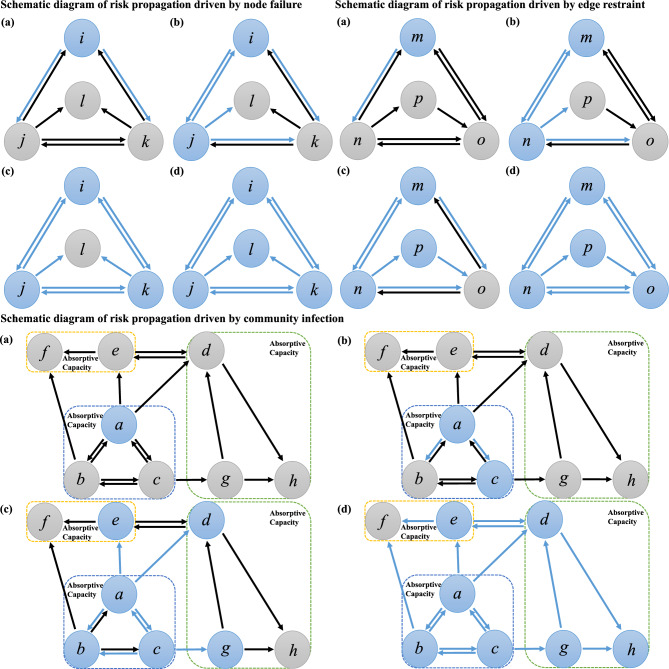
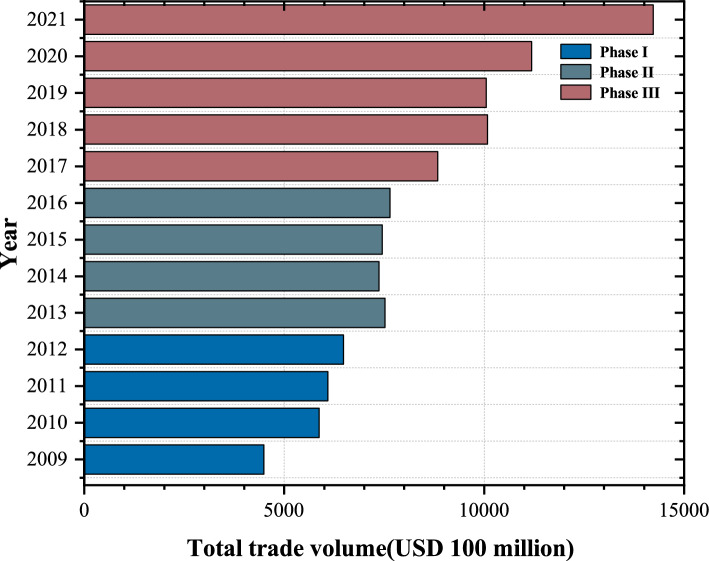
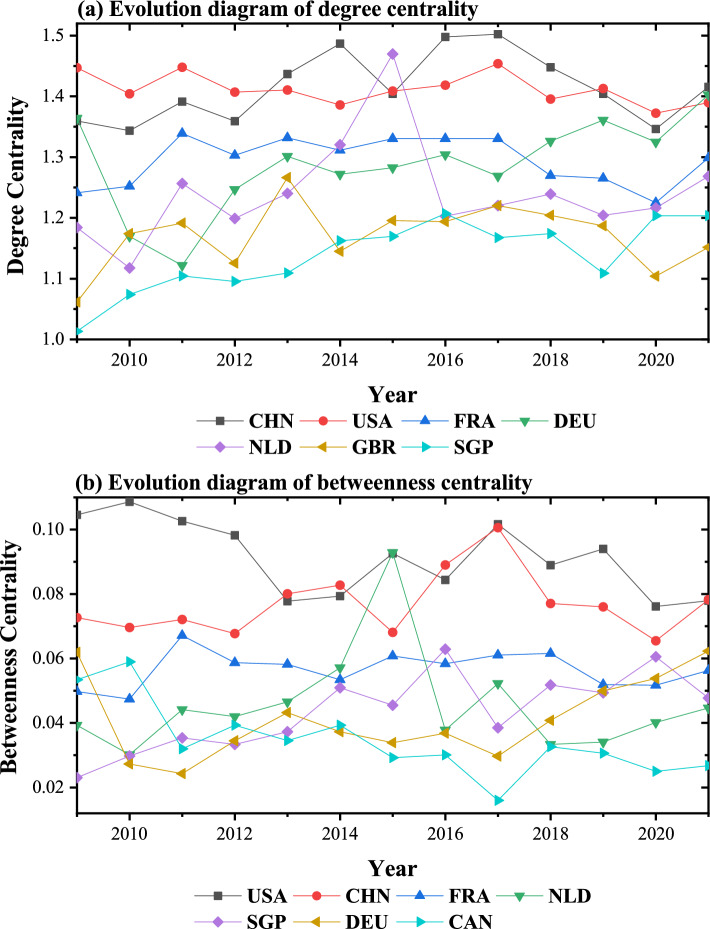
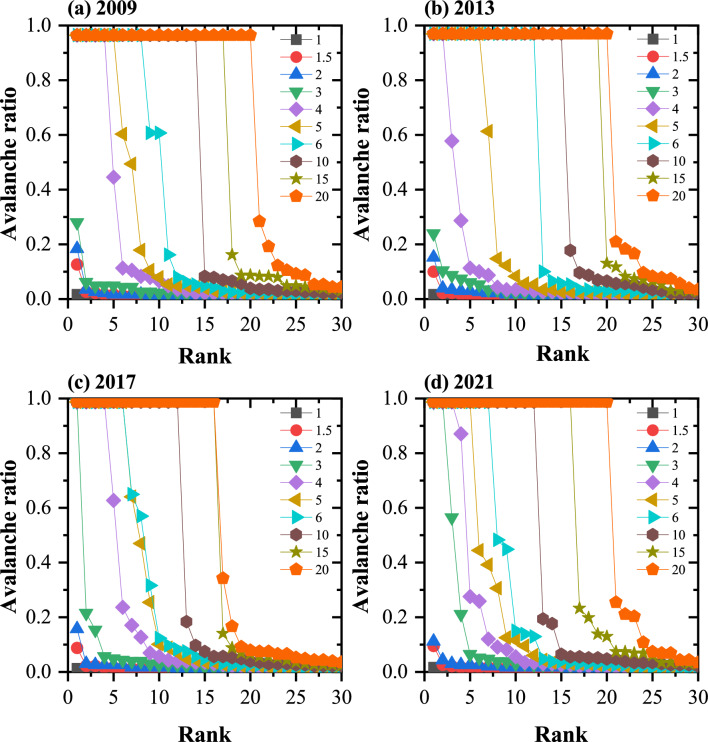
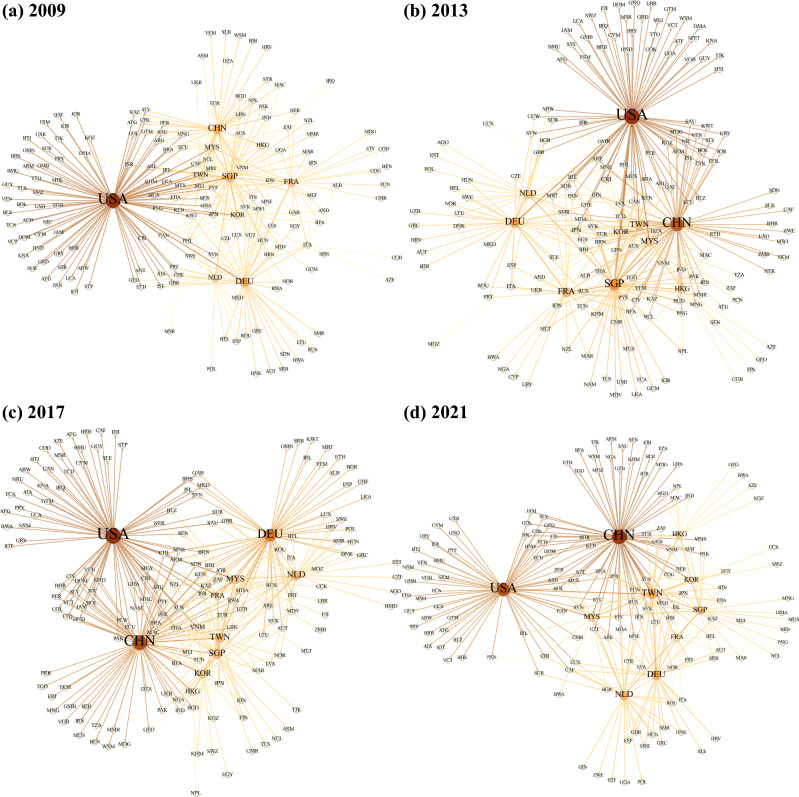
Risk cascading propagation research mostly focuses on complex theoretical networks. Recently, the vulnerability of international chip supply has increased notably, and it is strategically important to explore how shortage risk affects the emergence dynamics of the real chip trade systems. This study abstracts the global chip trade relationship data for 2009-2021 into multiple asymmetrically weighted networks. Using macro-network and micro-node indicators, we explore the topological traits of international chip trade networks and their evolutionary laws. Accordingly, we propose risk cascading propagation models driven by node failure and edge restraint and further innovate to open up the research paradigm of focused-edge networks. Furthermore, a community infection-driven risk cascading propagation mechanism that incorporates community risk absorption capacity is introduced, considering both the propagation attenuation effects and the trade dependency degree. A multi-dimensional dynamic perspective reveals the hidden systemic risks in international chip trade. The main results are as follows: first, international chip trade networks are highly connected and cohesive, consistent with small-world characteristics. Second, the proportion of economies that collapse because of supply shortage risk shocks increases with the impact coefficient . The dominant power in chip crisis propagation has shifted from Europe and America to Asia, and mainland China's risk penetration capacity has enhanced significantly. Third, focused-edge networks conform to a multi-hub radiation pattern. Before the COVID-19 pandemic, the degree of control and spillover effects of chip supply shortages in hub economies on the international trade was increasing progressively. Fourth, an increase in absorption capacity or attenuation factor consistently leads to a decline in avalanche scale, with exhibiting critical thresholds. These findings will help policymakers pursue efficient management strategies for chip trade, thereby improving supply stability and security.
© 2024. The Author(s).
Conflict of interest statement
The authors declare no competing interests.
Figures





References
-
- Khan, S. M., Mann, A. & Peterson, D. The semiconductor supply chain: Assessing national competitiveness. Center for Security and Emerging Technology 8 (2021).
-
- Un comtrade database (2021). [Online; accessed 14-March-2022].
-
- Hosoe, N. Impact of tighter controls on Japanese chemical exports to Korea. Econ. Model.94, 631–648 (2021). - DOI
-
- Cha, V. D. Collective resilience: Deterring china’s weaponization of economic interdependence. Int. Secur.48, 91–124 (2023). - DOI
Grants and funding
LinkOut - more resources
Full Text Sources
