


Circadian disturbances, anxiety and motor disturbances differentiate delirium superimposed on dementia from dementia-only
- PMID: 39238933
- PMCID: PMC11374723
- DOI: 10.3389/fpsyt.2024.1407213
Circadian disturbances, anxiety and motor disturbances differentiate delirium superimposed on dementia from dementia-only
Abstract
Background: To ensure adequate treatment, individuals with delirium superimposed on dementia (DSD) need to be differentiated reliably from those with dementia only (DO). Therefore, we aimed to examine the clinical indicators of DSD by assessing motor subtypes, cognitive performance and neuropsychiatric symptoms in DSD and DO patients.
Methods: Cross-sectional design with the Delirium-Motor-Subtyping Scale (DMSS), Mini-Mental-State-Examination (MMSE), Clock-Drawing-Test (CDT), DemTect, and Neuropsychiatric Inventory assessed after admission to an acute hospital.
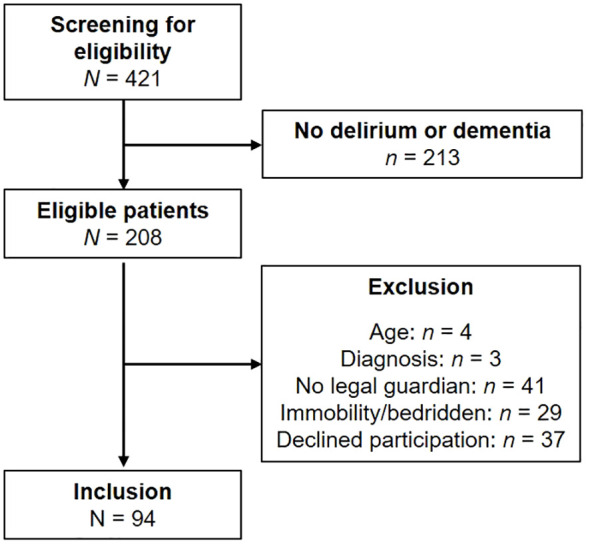
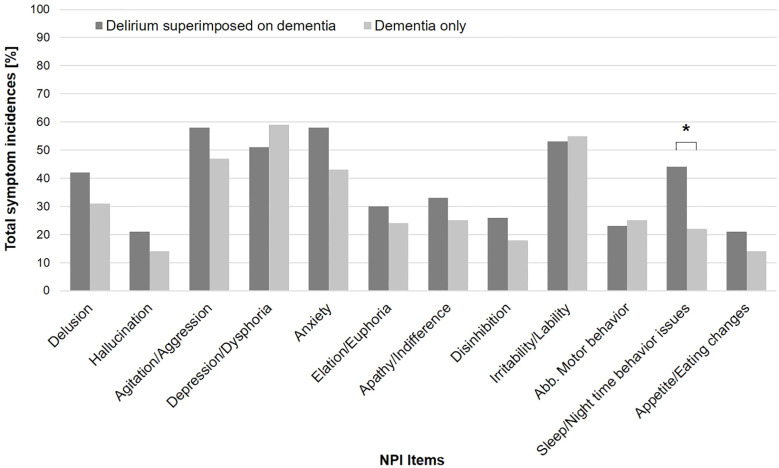
Results: 94 patients were included, 43 with DSD (78 ± 7 years, MMSE = 11 ± 9) and 51 with DO (79 ± 7 years, MMSE = 9 ± 8). DMSS "no subtype" was more common in the DO group (26% vs. 10%, p = .04). The DSD group showed lower CDT scores (DSD: M = 4 ± 3 vs. DO: M = 6 ± 1; p < .001) and higher anxiety (DSD: MED = 3 ± 8 vs. DO: MED = 3 ± 4; p = .01) and sleep/night-time behavior disturbances (DSD: MED = 0 ± 6 vs. DO: MED = 0 ± 0; p = .02).
Conclusions: Sleep/night-time behavior disturbances appear to be a clinical indicator of DSD. Motor subtypes can identify cases at increased risk of developing delirium or unrecognized delirium.
Clinical trial registration: https://drks.de/search/de/trial/DRKS00025439, identifier DRKS00025439.
Keywords: acute hospital; delirium superimposed on dementia; motor subtypes; neuropsychiatric symptoms; sleep disturbances.
Copyright © 2024 Schnorr, Fleiner, Trumpf, Prüter-Schwarte, Fanselow, Zijlstra and Haussermann.
Conflict of interest statement
The authors declare that the research was conducted in the absence of any commercial or financial relationships that could be construed as a potential conflict of interest.
Figures
References
LinkOut - more resources
Full Text Sources
