


Serum Lipoprotein(a) as Predictive Factor for Early Neurological Deterioration of Acute Ischemic Stroke After Thrombolysis
- PMID: 39239148
- PMCID: PMC11375750
- DOI: 10.2147/IJGM.S475767
Serum Lipoprotein(a) as Predictive Factor for Early Neurological Deterioration of Acute Ischemic Stroke After Thrombolysis
Abstract
Objective: This study aimed to explore the relationship between serum lipoprotein(a) (LP(a)) levels and early neurological deterioration (END) in patients with acute ischemic stroke (AIS) after thrombolysis.
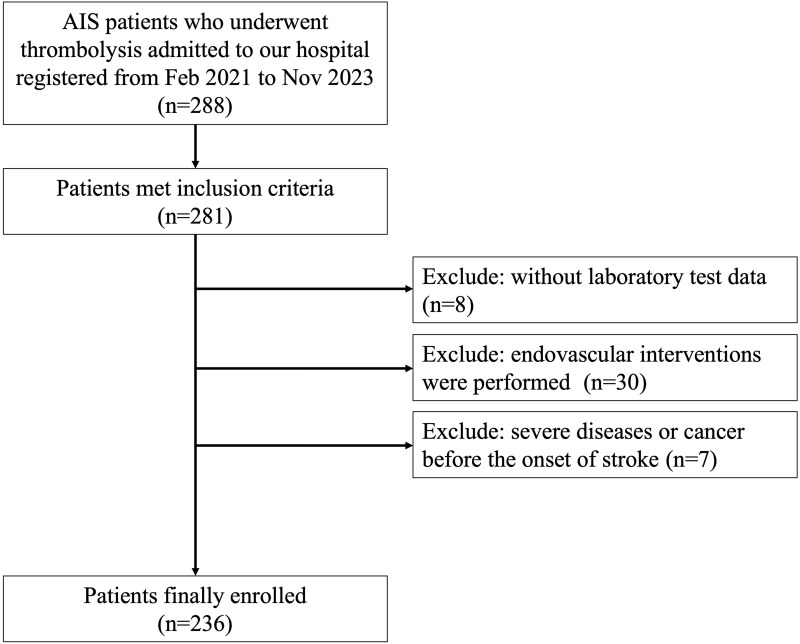
Methods: In total, 236 patients with AIS after thrombolysis were enrolled in this study. Serum LP(a) levels were measured on admission after thrombolysis. END was defined as an increase of at least two points in the NIHSS score within 48 hours after thrombolysis. Binary logistic regression analysis was used to assess the association between serum LP(a) levels and END.
Results: Overall, patients with END had higher LP(a) than those without END (high LP(a): 38.3% vs 22.2%, intermediate LP(a): 40.3% vs 41.8%, low LP(a): 21.3% vs 36.0%, p<0.005). In the multivariate analysis, high LP(a) (defined as LP(a) level≥ 300 mg/L) was an independent risk factor for END post-thrombolysis (OR=3.154, 95% CI=1.067-9.322, p=0.038).
Conclusion: Our findings demonstrated that LP(a) was an independent risk factor for END post-thrombolysis and that LP(a) level≥ 300 mg/L could be associated with END post-thrombolysis in this study population.
Keywords: Lipoprotein(a); acute ischemic stroke; early neurological deterioration; thrombolysis.
© 2024 Wang et al.
Conflict of interest statement
The authors report no conflicts of interest in this work.
Figures


References
LinkOut - more resources
Full Text Sources
Miscellaneous
