


A myriad of methods to determine temporal summation of pain in people with musculoskeletal pain and healthy participants: a scoping review
- PMID: 39239632
- PMCID: PMC11377091
- DOI: 10.1097/PR9.0000000000001176
A myriad of methods to determine temporal summation of pain in people with musculoskeletal pain and healthy participants: a scoping review
Abstract
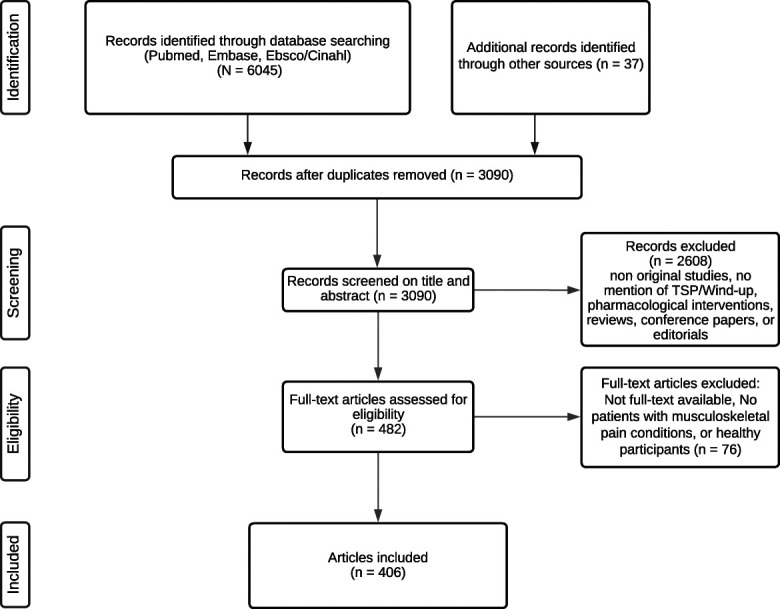
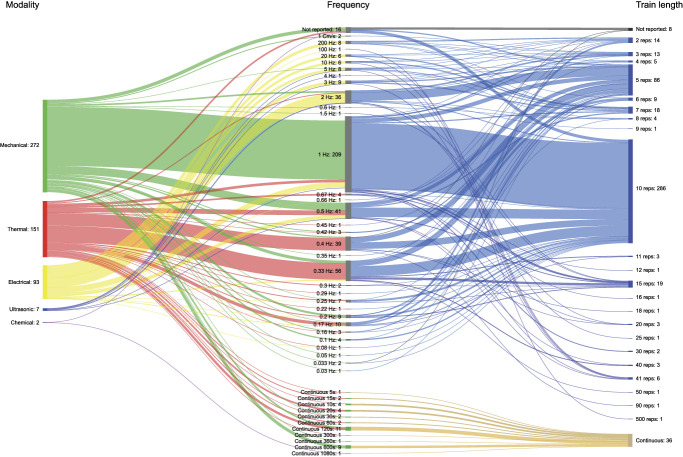
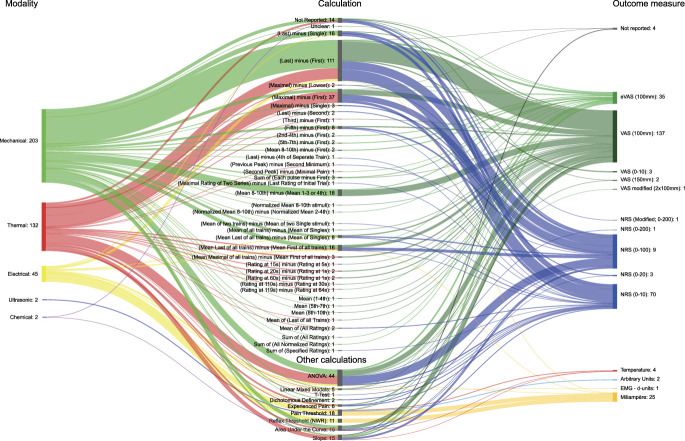
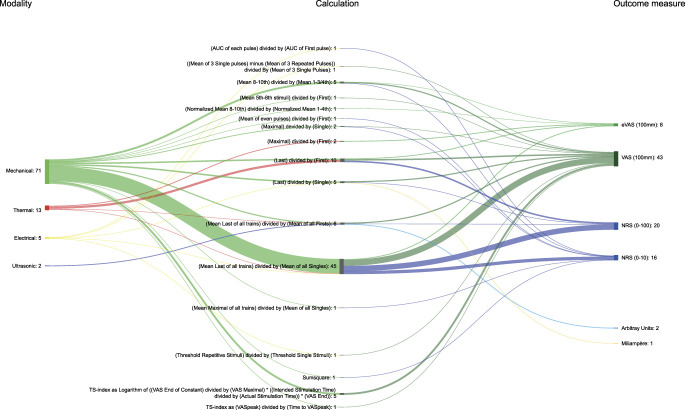
Temporal summation of pain (TSP) is a human proxy for wind-up of dorsal horn neurons as assessed in animals. The common paradigm for eliciting TSP is evoked by repetitive nociceptive stimuli of equal intensity. Various stimulation and assessment protocols have been used. This scoping review aims to provide insight into key elements of TSP stimulation and assessment: modality, instruments, test location, familiarization, train characteristics, and calculations. PubMed, Embase, and Ebsco/CINAHL were searched for studies that measured TSP in adults with musculoskeletal conditions and healthy people. Four hundred six studies were included. Mechanical stimuli were the most commonly used modality (250 studies), followed by thermal stimuli (125 studies). Forty-six different instruments were used. Disregarding studies on widespread musculoskeletal pain and healthy participants, 40 studies evaluated TSP at painful sites, 77 in remote areas, and 66 in both locations. Of the 13 tested locations in patients, the hand (74 studies), lower leg (64 studies), and forearm (59 studies) were most commonly tested. A single practice round was the most common familiarization method (46 studies). Repeated stimuli were applied using 31 different frequencies (0.03-200 Hz) and sustained stimulations ranging from 5 to 1080 seconds were used. Twenty-two different train lengths, 63 different calculations (37 absolute, 19 relative, and 7 alternatives using data directly), and 14 different outcome measures (eg, self-reported pain rating scales and reflex thresholds) were used. Temporal summation of pain protocols vary excessively, hindering the comparison and pooling of results. None of the studies provided substantiation for their protocol choice.
Keywords: Pain measurement; Pain modulation; Pain perception; Quantitative sensory testing; Temporal summation of pain; Wind-up ratio.
Copyright © 2024 The Author(s). Published by Wolters Kluwer Health, Inc. on behalf of The International Association for the Study of Pain.
Conflict of interest statement
The authors have no conflicts of interest to declare.Sponsorships or competing interests that may be relevant to content are disclosed at the end of this article.
Figures
References
-
- Allison C, Korey L, John Z S. A novel computational technique for the quantification of temporal summation in healthy individuals. Musculoskelet Sci Pract 2021;54:102400. - PubMed
-
- Aoyagi K, Liew JW, Farrar JT, Wang N, Carlesso L, Kumar D, Frey Law L, Lewis CE, Nevitt M, Neogi T. Does weight-bearing versus non-weight-bearing pain reflect different pain mechanisms in knee osteoarthritis? The Multicenter Osteoarthritis Study (MOST). Osteoarthritis Cartilage 2022;30:545–50. - PMC - PubMed
-
- Arendt-Nielsen L, Nie H, Laursen MB, Laursen BS, Madeleine P, Simonsen OH, Graven-Nielsen T. Sensitization in patients with painful knee osteoarthritis. PAIN 2010;149:573–81. - PubMed
-
- Arendt-Nielsen L, Sonnenborg FA, Andersen OK. Facilitation of the withdrawal reflex by repeated transcutaneous electrical stimulation: an experimental study on central integration in humans. Eur J Appl Physiol 2000;81:165–73. - PubMed
-
- Arksey H, O'Malley L. Scoping studies: towards a methodological framework. Int J Soc Res Methodol 2005;8:19–32.
Publication types
LinkOut - more resources
Full Text Sources
Miscellaneous