


Traumatic injury to vascular prosthetic anastomosis: A case report and diagnostic approach
- PMID: 39241476
- PMCID: PMC11408839
- DOI: 10.1016/j.ijscr.2024.110239
Traumatic injury to vascular prosthetic anastomosis: A case report and diagnostic approach
Abstract
Introduction: Traumatic injury of a vascular prosthesis-to-prosthesis anastomosis leading to an extravasation and pseudoaneurysm is rare. If not identified the complications associated with this condition can lead to high morbidity and mortality and require surgical treatment.
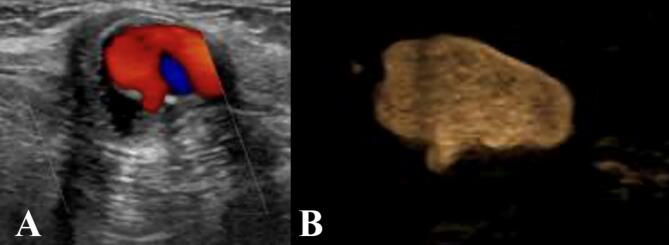
Case: We describe a patient who presented with a tear in prosthesis-prosthesis anastomosis eight years after implantation resulting in a pseudoaneurysm. The patient had a severe fall prior to the non-symptomatic leakage. The complication was successfully treated by re-lining the graft with a new anastomosis at the Department of Vascular and Endovascular Surgery, Kolding Hospital in Denmark.
Discussion: Cause of tear is speculated to be due to weakness at site of reconstruction, fabric degradation, and/or degradation of suture material.
Conclusion: Late prosthesis-prosthesis anastomosis tear caused by a traumatic event is rare. In the event of a late tear, anamnesis and histological analysis of involved material is important.
Keywords: Case report; Prosthesis; Pseudoaneurysm; Traumatic; Vascular.
Copyright © 2024 The Authors. Published by Elsevier Ltd.. All rights reserved.
Conflict of interest statement
Declaration of competing interest No conflict of interest.
Figures


References
-
- Franklin J., Brigham D., Bogey W., Powell C. Treatment of iatrogenic false aneurysms. J. Am. Coll. Surg. 2003;197(2):293–301. - PubMed
-
- Seabrook G.R., Schmitt D.D., Bandyk D.F., Edmiston C.E., Krepel C.J., Towne J.B. Anastomotic femoral pseudoaneurysm: an investigation of occult infection as an etiologic factor. J. Vasc. Surg. 1990;11(5):629–634. - PubMed
-
- Mulder E.J., van Bockel J.H., Maas J., van den Akker P.J., Hermans J. Morbidity and mortality of reconstructive surgery of noninfected false aneurysms detected long after aortic prosthetic reconstruction. Archives of surgery (Chicago 1960). 1998;133(1):45–49. - PubMed
Publication types
LinkOut - more resources
Full Text Sources
