


The land and sea routes to 2030: a call for greater attention on all small islands in global environmental policy
- PMID: 39242820
- PMCID: PMC11332114
- DOI: 10.1038/s44185-023-00023-5
The land and sea routes to 2030: a call for greater attention on all small islands in global environmental policy
Abstract
Islands have unique vulnerabilities to biodiversity loss and climate change. Current Nationally Determined Contributions under the Paris Agreement are insufficient to avoid the irreversible loss of critical island ecosystems. Existing research, policies, and finance also do not sufficiently address small islands' social-environmental challenges. For instance, the new Global Biodiversity Framework (GBF) mentions islands in the invasive species management target. This focus is important, as islands are at high risk to biological invasions; however, this is the only GBF target that mentions islands. There are threats of equal or greater urgency to small islands, including coastal hazards and overexploitation. Ecosystems such as coral reefs and mangroves are crucial for biodiversity, coastal protection, and human livelihoods, yet are unaddressed in the GBF. While research and global policy, including targeted financial flows, have a strong focus on Small Island Developing States (SIDS), the situation of other small islands has been largely overlooked. Here, through a review of policy developments and examples from islands in the Philippines and Chile, we urge that conservation and climate change policies place greater emphasis on acknowledging the diversity of small islands and their unique governance challenges, extending the focus beyond SIDS. Moving forward, global policy and research should include the recognition of small islands as metacommunities linked by interacting species and social-ecological systems to emphasize their connectivity rather than their isolation. Coalition-building and knowledge-sharing, particularly with local, Indigenous and traditional knowledge-holders from small islands, is needed to meet global goals on biodiversity and sustainable development by 2030.
© 2023. The Author(s).
Conflict of interest statement
The authors declare no competing interests.
Figures

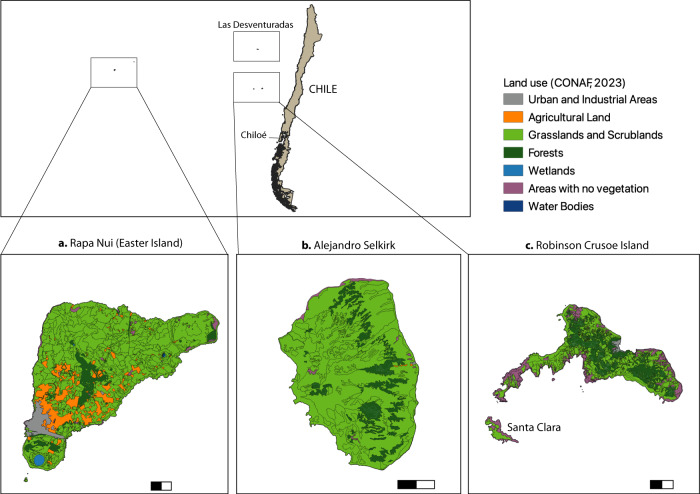

References
-
- Mycoo, M. et al. Small Islands. In Climate Change 2022: Impacts, Adaptation and Vulnerability. Contribution of Working Group II to the Sixth Assessment Report of the Intergovernmental Panel on Climate Change (eds. Pörtner, H.-O. et al.) 2043–2121 (Cambridge University Press, 2022). 10.1017/9781009325844.017.
-
- Kueffer, C. & Kinney, K. What is the importance of islands to environmental conservation? Environ. Conserv.44, 311–322 (2017). 10.1017/S0376892917000479 - DOI
-
- Petzold, J. & Magnan, A. K. Climate change: thinking small islands beyond Small Island Developing States (SIDS). Clim. Change152, 145–165 (2019). 10.1007/s10584-018-2363-3 - DOI
-
- Scandurra, G., Romano, A. A., Ronghi, M. & Carfora, A. On the vulnerability of Small Island Developing States: A dynamic analysis. Ecol. Indic.84, 382–392 (2018). 10.1016/j.ecolind.2017.09.016 - DOI
Publication types
Grants and funding
LinkOut - more resources
Full Text Sources
Miscellaneous
