. 2025 Jul:73:427-442.
doi: 10.1016/j.jare.2024.09.005. Epub 2024 Sep 5.

Serum taurine affects lung cancer progression by regulating tumor immune escape mediated by the immune microenvironment

Affiliations

Serum taurine affects lung cancer progression by regulating tumor immune escape mediated by the immune microenvironment

Tu-Liang Liang et al. J Adv Res. 2025 Jul.

Abstract

Introduction: Taurine is a naturally occurring sulfonic acid involved in various physiological and pathological processes, such as the regulation of calcium signaling, immune function, inflammatory response, and cellular aging. It has the potential to predict tumor malignant transformation and formation. Our previous work discovered the elevated taurine in lung cancer patients. However, the precise impact and mechanism of elevated serum taurine levels on lung cancer progression and the suitability of taurine or taurine-containing drinks for lung cancer patients remain unclear.

Objectives: Our study aimed to systematically investigate the role of taurine in lung cancer, with the ultimate goal of contributing novel strategies for lung cancer treatment.

Methods: Lung cancer C57 and nude mice models, RNA sequencing, and stable transfection were applied to explored the effects and mechanisms of taurine on lung cancer. Tissues of 129 non-small cell lung cancer (NSCLC) patients derived from 2014 to 2017 for immunohistochemistry were collected in Taihe Hospital.

Results: Low doses of taurine, as well as taurine-infused beverages at equivalent doses, significantly enhanced lung tumor growth. Equally intriguing is that the promoting effect of taurine on lung cancer progression wanes as the dosage increases. The Nuclear factor erythroid 2-like 1 (Nfe2l1 or Nrf1)-reactive oxygen species (ROS)-PD-1 axis may be a potential mechanism for dual role of taurine in lung cancer progression. However, taurine's impacts on lung cancer progression and the anti-tumor function of Nfe2l1 were mainly determined by the immune competence. Taurine inhitited lung tumor growth probably by inhibiting NF-κB-mediated inflammatory responses in nude mice rather than by affecting Nfe2l1 function. As patients age increased, Nfe2l1 gene and protein gradually returned to the levels observed in healthy individuals, but lost its anti-lung cancer effects.

Conclusions: Taurine emerges as a potential biomarker for lung cancer progression, predicting poor prognosis and unsuitability for specific patients. Lung cancer patients, especially young patients, should be conscious of potential effects of taurine-containing drinks. Conversely, taurine or its drinks may be more suitable for older or immune-deficient patients.

Keywords: Dual role; Lung cancer; NF-κB-mediated inflammation; Nfe2l1-ROS-PD-1 axis; Taurine.


Conflict of interest statement

Declaration of competing interest The authors declare that they have no known competing financial interests or personal relationships that could have appeared to influence the work reported in this paper.

Figures

None
Graphical abstract
Fig. 1
Fig. 1
Taurine demonstrates a dual role in lung cancer progression in immune-competent mice. (A) Experimental flow chart of taurine’s dual effect on lung cancer progression in vivo (n = 6). (B-C) Body weight and tumor volumes of mice were examined every three days. (D) After dissection, tumor size was significantly reduced or increased in different doses of taurine or taurine beverage (0.4 ml/20 g, p.o.) groups compared to the control group according to representative images of tumors from C57 mice. (E-F) Weights of tumors and organ/body ratios were measured and calculated. (G) Taurine significantly regulated plasma ROS levels in C57 mice but not in nude mice (n = 3). (H) Different taurine doses led to differences in PD-1 levels in both CD4+ and CD8+ T cells (n = 4). Statistical significance was calculated by means of ANOVA analysis. All data are presented as the mean ± SEM, *p < 0.05, **p < 0.01, and ***p < 0.001.
Fig. 2
Fig. 2
The promoting effect of low-dose taurine on lung cancer progression is related to the up-regulation of oxidative stress functions and the down-regulation of immune response functions. Enrichment analysis of GO Terms and KEGG based on GSEA of hallmark gene sets was used to analyse the potential mechanism of taurine in regulating lung cancer progression. (A-F) Gene sets related to functions of oxidative stress were significantly enriched in model group, while their enrichment was lower in taurine 25 mg/kg group. And gene sets related to immune system functions were significantly enriched in taurine 25 mg/kg group, but were less pronounced in model group. (G-L) Gene sets related to immune response pathways were significantly enriched in taurine 25 mg/kg group, but were less pronounced in model group.
Fig. 3
Fig. 3
Taurine might influence tumor immune response through the Nfe2l1-ROS-PD-1 axis in immune-competent mice. (A-B) RNA sequencing revealed GO analyses and 100 DEGs in subcutaneous lung tumors of C57 mice induced by different doses of taurine (n = 3). (C) Seven representative DEGs were finally identified among the taurine low, taurine high and model group. (D) Different taurine doses significantly affected the expression of Nfe2l1, 41BBL, and PD-1 proteins in tumors of C57 mice, as determined by western blot assay (n = 4). (E) For in vivo experiments, LLC (wt) or LLC (Nfe2l1 overexpression) cells were injected by subcutaneously into wild type C57 mice (5 × 105 cells per mouse, n = 6). (F) Overexpressed Nfe2l1 gene did not significantly affect mouse body weight. (G) Overexpressed Nfe2l1 gene could significantly inhibit LLC-xenografted tumor growth in C57 mice. (H) Representative images of tumors revealed significant anti-tumor effects of overexpressed Nfe2l1 gene in C57 mice. (I) Overexpressed Nfe2l1 gene could cause a decrease in tumor weight. (J) Overexpressed Nfe2l1 gene significantly affected the expression of Nfe2l1, 41BBL, and PD-1 proteins in tumors of C57 mice (n = 4). Statistical significance was calculated by means of ANOVA analysis, *p < 0.05, **p < 0.01, and ***p < 0.001.
Fig. 4
Fig. 4
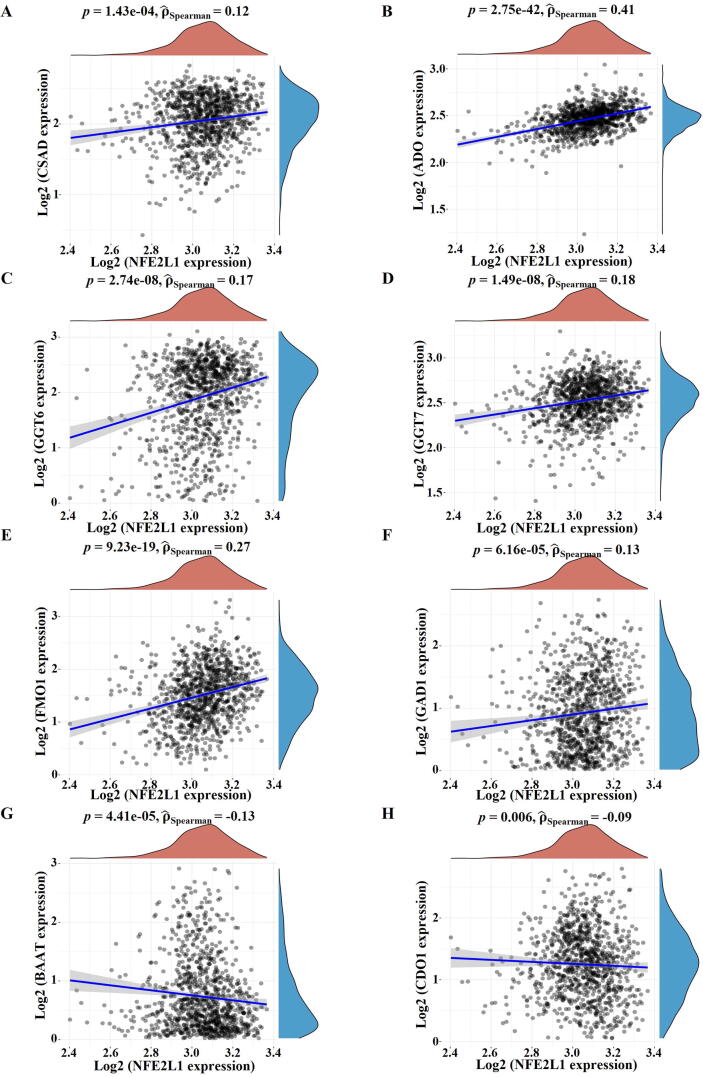
Nfe2l1 is highly significantly correlated with key targets of taurine metabolism pathway. (A-H) Nfe2l1 was significantly correlated with key targets in the taurine metabolism pathway, including CSAD, ADO, GGT6, GGT7, FMO1, GAD1, BAAT, and. CDO1. Spearman correlation analysis was applied to analyse the correlation between Nfe2l1 and the taurine metabolism pathway in 1017 lung cancer samples (including lung adenocarcinoma and lung squamous cell carcinoma) from the TCGA data.
Fig. 5
Fig. 5
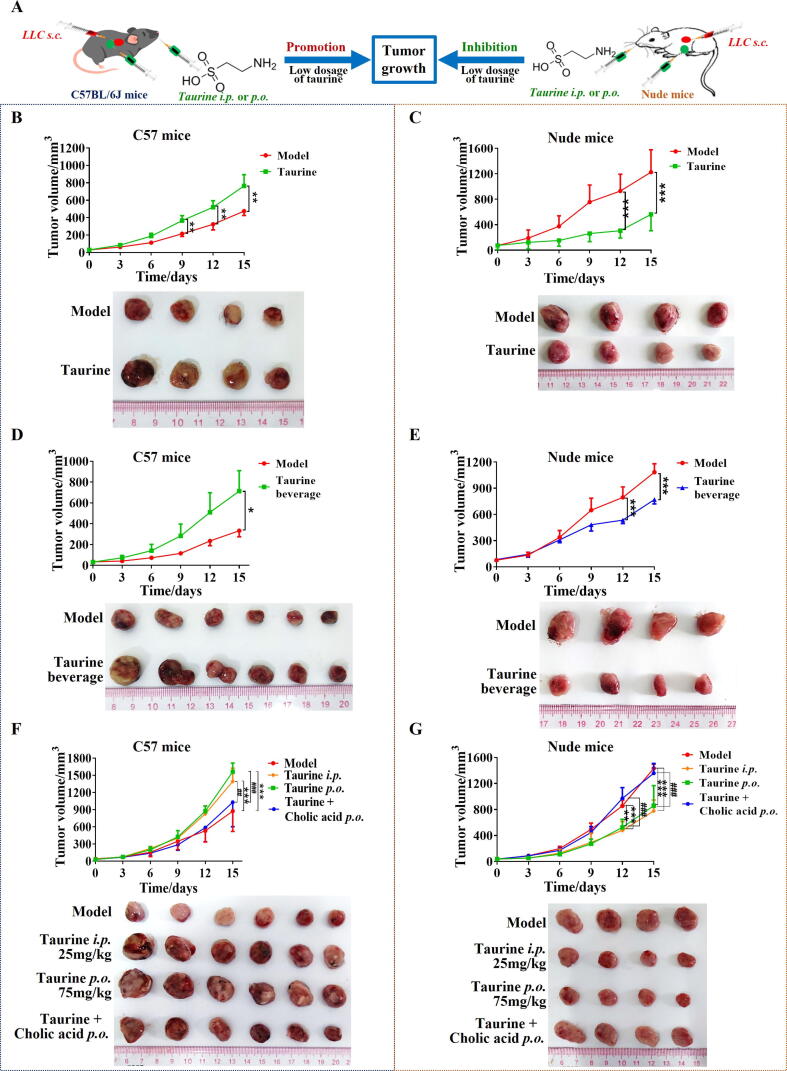
Immune competence determines taurine's impacts on lung cancer progression. (A) Diagram of taurine showing opposite results in lung cancer progression in C57 and nude mice. (B) Taurine potentially promoted lung tumor growth in C57 mice (n = 4). (C) Conversely, taurine with the same dose potentially inhibited lung tumor growth in nude mice (n = 4). (D) Taurine beverage similarly accelerated lung cancer progression in C57 mice (n = 6). (E) However, taurine beverage revealed anti-lung tumor effects in nude mice (n = 4). (F) The tumor-promoting effects of taurine could be reversed by bile acids in C57 mice (n = 6). (G) Similarly, the anti-tumor effects of taurine could also be reversed by bile acids in nude mice (n = 4). Statistical significance was calculated by means of ANOVA analysis. All data are presented as the mean ± SEM, *p < 0.05, **p < 0.01, and ***p < 0.001.
Fig. 6
Fig. 6
Taurine might exert anti-tumor effects by inhibiting NF-κB-mediated inflammatory responses in immune-deficient mice. (A) Taurine failed significantly affecting plasma ROS levels in nude mice (n = 3). (B) The anti-tumor effects of taurine were related to inflammation mediated by NF-κB in GO analyses from nude mice. (C) The heat-map showed the comparison of the top 24 regulatory genes of tumors among the taurine (25 mg/kg) and model groups (n = 3). (D) Ultimately, 4 DEGs including Ace, Plac8, Gbp4 and Nod1 were identified among the two groups in the histogram. The criteria of |log2FC| ≥ 1 and adjust p < 0.05 was utilized to identify the DEGs with biological significance. (E-F) Taurine showed opposite regulatory effects on the expression of p-NF-κb and Nfe2l1 proteins in C57 and nude mouse tumors (n = 4). Experiments were independently repeated four times. Experiments were independently repeated four times. (G) LLC (wt) or LLC (Nfe2l1 overexpression) cells were injected by subcutaneously into nude mice (1.5 × 106 cells per mouse, n = 6). (H-J) Overexpressed Nfe2l1 gene did not significantly affect mouse body weight, tumor volumes, and tumor weight in nude mice. (K) Overexpressed Nfe2l1 gene failed inhibiting lung tumor growth in nude mice according to the representative images of tumors. Statistical significance was calculated by means of ANOVA analysis, *p < 0.05, **p < 0.01, and ***p < 0.001.
Fig. 7
Fig. 7
Immune competence potentially determines the anti-lung tumor function of Nfe2l1. (A) A positive correlation between the expression of Nfe2l1 gene and the age of lung cancer patients. (B) Nfe2l1 positive cells with different proportions were showed in sections examples. (C) Sections without positive cells had the corresponding staining intensity of 0. And staining intensity score of 1 and 2 were showed in sections examples. (D) A similarly positive correlation between the expression of Nfe2l1 protein and the age of lung cancer patients in immunohistochemistry results. (E) High expression of Nfe2l1 protein failed significantly improving the survival of lung cancer patients. Statistical significance was calculated by means of ANOVA analysis. All data are presented as the mean ± SEM, *p < 0.05, **p < 0.01, and ***p < 0.001.
Fig. 8
Fig. 8
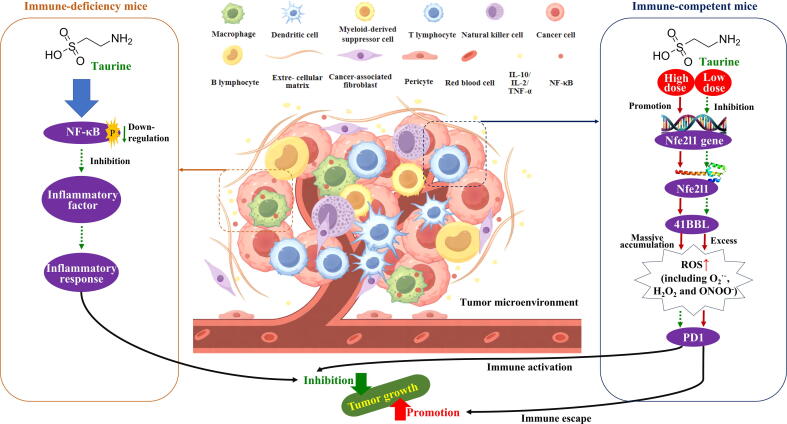
The potential mechanism of taurine’s dual role in lung cancer progression.

References

    1. Ferlay J., Colombet M., Soerjomataram I., Mathers C., Parkin D.M., Piñeros M., et al. Estimating the global cancer incidence and mortality in 2018: GLOBOCAN sources and methods. Int J Cancer. 2019;144(8):1941–1953. - PubMed
    1. Siegel R.L., Miller K.D., Wagle N.S., Jemal A. Cancer statistics, 2023. CA Cancer J Clin. 2023;73(1):17–48. - PubMed
    1. Siegel R.L., Giaquinto A.N., Jemal A. Cancer statistics, 2024. CA Cancer J Clin. 2024;74(1):12–49. - PubMed
    1. Gao S., Li N., Wang S., Zhang F., Wei W., Li N., et al. Lung cancer in People's Republic of China. J Thorac Oncol. 2020;15(10):1567–1576. - PubMed
    1. Bade B.C., Dela Cruz C.S. Lung cancer 2020: epidemiology, etiology, and prevention. Clin Chest Med. 2020;41(1):1–24. - PubMed

MeSH terms