


High-risk factors for massive haemorrhage in medical abortion patients with missed miscarriage
- PMID: 39245736
- PMCID: PMC11382378
- DOI: 10.1186/s12884-024-06682-x
High-risk factors for massive haemorrhage in medical abortion patients with missed miscarriage
Abstract
Background: Recently, the incidence of missed miscarriage has gradually increased, and medical abortion is a common method to terminate a pregnancy. In the process of medical abortion, massive vaginal bleeding takes place, leading to emergency surgical haemostasis. Emergency surgery may produce infection and organ damage. Our study aimed to investigate the high-risk factors for massive haemorrhage during a medical abortion.
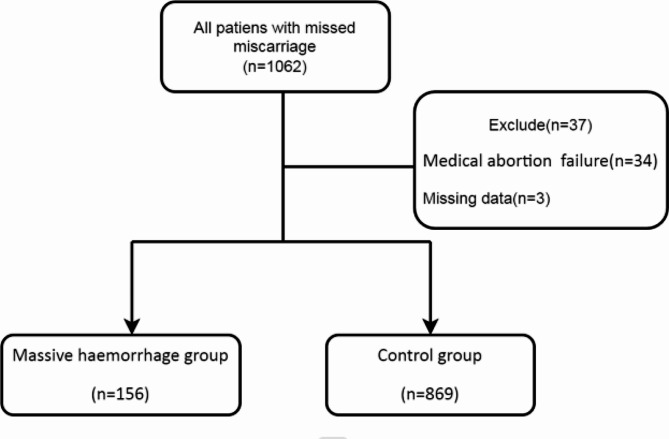
Methods: A total of 1062 missed miscarriage patients who underwent medical abortion participated in this retrospective study. According to the amount of bleeding, the patients were divided into a massive haemorrhage group and a control group. By comparing the general conditions of the two groups, such as fertility history, uterine surgery history, uterine fibroids, etc., the high-risk factors for massive haemorrhage during medical abortion were identified.
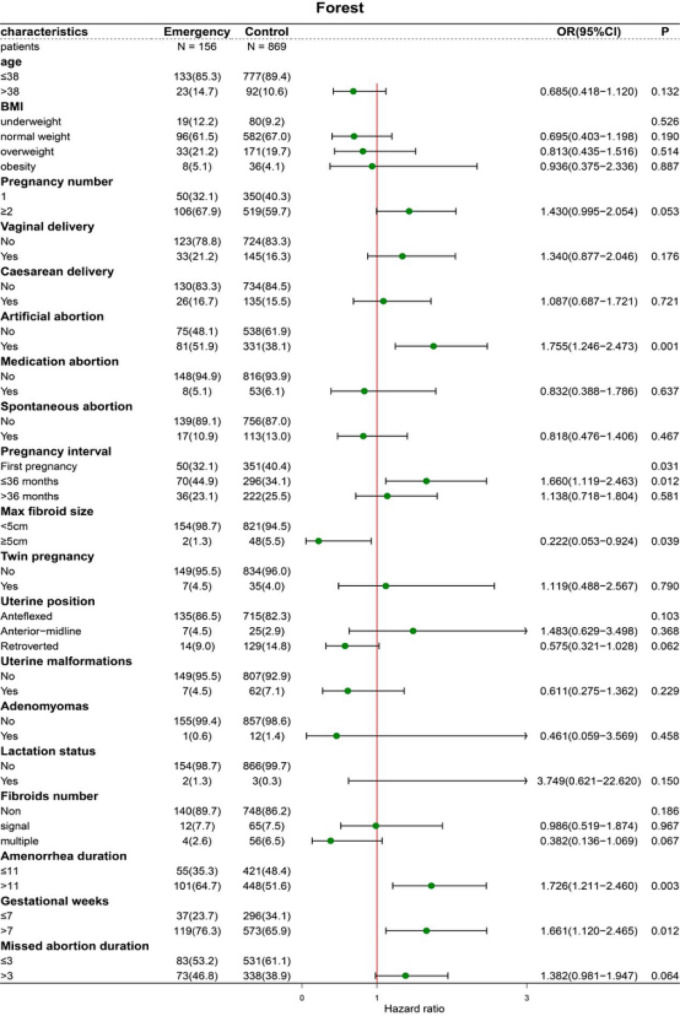
Results: Relative to the control group, the massive haemorrhage group exhibited a higher proportion of patients with a previous artificial abortion (51.9% vs. 38.1%, P = 0.001). Additionally, the massive haemorrhage group had a lower percentage of first-time pregnant women (32.1% vs. 40.4%) and a higher proportion of women with shorter pregnancy intervals (44.9% vs. 33.1%, P = 0.03). Furthermore, there were notable differences between the two groups regarding maximum fibroid size, the duration of amenorrhea, and gestational week (P < 0.05).
Conclusion: In this study, we determined that a history of artificial abortion and an amenorrhea duration of > 11 weeks represented high-risk factors for massive vaginal bleeding during medical abortion in missed miscarriage patients.
Keywords: Emergency surgery; Massive haemorrhage; Medical abortion; Missed miscarriage.
© 2024. The Author(s).
Conflict of interest statement
The authors declare no competing interests.
Figures
References
-
- 2019 exceptional surveillance of ectopic pregnancy. And miscarriage: diagnosis and initial management (NICE guideline NG126) [Internet]. London: National Institute for Health and Care Excellence (NICE); 2019. Nov 15. - PubMed
MeSH terms
Grants and funding
LinkOut - more resources
Full Text Sources
Medical
