Review
. 2024 Nov;13(11):e202400185.
doi: 10.1002/open.202400185. Epub 2024 Sep 9.

Recent Advances in the Application of 2-Aminobenzothiazole to the Multicomponent Synthesis of Heterocycles

Affiliations
Review

Recent Advances in the Application of 2-Aminobenzothiazole to the Multicomponent Synthesis of Heterocycles

Ramin Javahershenas et al. ChemistryOpen. 2024 Nov.

Abstract

Heterocycles are a vital class of compounds in numerous fields, including drug discovery, agriculture, and materials science. Efficient methods for the synthesis of heterocycles remain critical for meeting the demands of these industries. Recent advances in multicomponent reactions (MCRs) utilizing 2-aminobenzothiazole (ABT) have shown promising results for the formation of heterocycles. The versatility of 2-aminobenzothiazole in this context has enabled the rapid and efficient construction of diverse heterocyclic structures. Various synthetic methodologies and reactions involving 2-aminobenzothiazole are discussed, highlighting its importance as a valuable building block in the synthesis of complex heterocycles. The potential applications of these heterocycles in drug discovery and material science are also explored. Overall, this review provides a comprehensive overview of the current state of research in the field and offers insights into the future directions of this promising area of study. We highlight the potential of ABT as a versatile and sustainable starting material in heterocyclic synthesis via MCRs, with significant implications for the chemical industry.

Keywords: 2-aminobenzothiazole; heterocycles; multicomponent reactions; synthesis.


Conflict of interest statement

The authors declare no conflict of interest.

Figures

Figure 1
Figure 1
Structure of 2‐aminobenzothiazole.
Figure 2
Figure 2
2‐Aminobenzothiazoles containing bioactive molecules.
Figure 3
Figure 3
Reactions of 2‐aminobenzothiazole.
Figure 4
Figure 4
Synthesis of 2‐aminobenzothiazole.
Scheme 1
Scheme 1
Synthesis of 13‐aryl‐13H‐benzo[g]benzothiazolo [2,3‐b]quinazoline‐5,14‐diones.
Scheme 2
Scheme 2
Synthesis of tetrahydrobenzo[g]benzo[4,5]thiazolo[2,3‐b]quinazolin‐14‐ium hydroxides.
Scheme 3
Scheme 3
Synthesis of various pyrimidine derivatives.
Scheme 4
Scheme 4
Synthesis of 4H‐pyrimido[2,1‐b]benzothiazole derivatives.
Scheme 5
Scheme 5
A proposed mechanism for preparation of 4H‐pyrimido[2,1‐b]benzothiazole derivatives.
Scheme 6
Scheme 6
Synthetic procedure for 4H‐benzo[4,5]thiazolo[3,2‐a]pyrimidine‐3‐carboxylates.
Scheme 7
Scheme 7
Synthesis of 4H‐pyrimido[2,1‐b]benzothiazoles derivatives.
Scheme 8
Scheme 8
Synthesis of 4H‐pyrimido[2,1‐b]benzothiazole derivatives.
Scheme 9
Scheme 9
Synthesis of 4H‐pyrimido[2,1‐b]benzothiazoles.
Scheme 10
Scheme 10
Synthesis of tricyclic 4H‐pyrimido[2,1‐b]benzothiazoles derivatives.
Scheme 11
Scheme 11
Synthesis of 4H‐pyrimido[2,1‐b]benzothiazoles.
Scheme 12
Scheme 12
Synthesis of pyrimido[2,1‐b][1,3]benzothiazole (PBT) scaffolds.
Scheme 13
Scheme 13
Synthesis of pyrimidine derivatives.
Scheme 14
Scheme 14
Synthesis of pyrimido[1,2‐b]benzazole derivatives.
Scheme 15
Scheme 15
Suggested mechanism for the model reaction.
Scheme 16
Scheme 16
Synthesis of 4H‐pyrimido[2,1‐b]benzothiazole derivatives.
Scheme 17
Scheme 17
Synthesis of benzothiazolo quinazolinones.
Scheme 18
Scheme 18
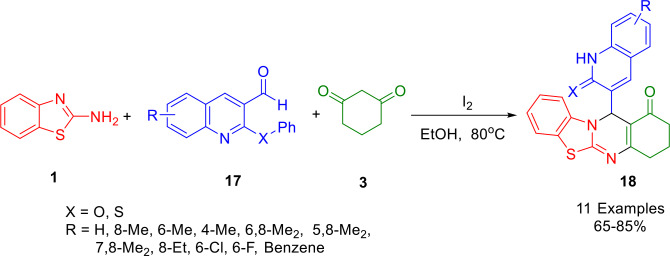
Synthesis of tetraheterocyclicbenzothiazolo quinazolin‐1‐ones.
Scheme 19
Scheme 19
Synthesis of tetrahydro‐1H‐benzo[4,5]thiazolo [2,3‐b]quinazolin‐1‐one.
Scheme 20
Scheme 20
Synthesis of 4H‐pyrimido[2,1‐b]benzothiazoles.
Scheme 21
Scheme 21
Synthesis of quinazoline analogs.
Scheme 22
Scheme 22
Synthesis of thiazolo[3,2‐a]pyrimidine.
Scheme 23
Scheme 23
Synthesis of 2,3‐dihydroquinazolin‐4(1H)‐one derivatives and benzothiazolo[2,3‐b]quinazolin‐1‐one derivatives.
Scheme 24
Scheme 24
Synthesis of mono‐ and bis‐4H‐pyrimido[2,1‐b]benzothiazoles.
Scheme 25
Scheme 25
Synthesis of pyrimido[4,5‐d]pyrimidine derivatives.
Scheme 26
Scheme 26
Synthesis of benzo[4,5]thiazolo[3,2‐a]chromeno[4,3‐d]pyrimidin‐6‐one derivatives.
Scheme 27
Scheme 27
Synthesis of fused pyrimidine derivatives.
Scheme 28
Scheme 28
Synthesis of N‐methyl‐3‐nitro‐4H‐pyrimido[2,1‐b] benzothiazole‐2‐amine derivatives.
Scheme 29
Scheme 29
Synthesis of 3‐benzothiazol‐2‐yl‐2‐phenyl‐thiazolidin‐4‐one.
Scheme 30
Scheme 30
Plausible mechanistic pathway of reaction.
Scheme 31
Scheme 31
Synthesis of N,1‐bis(benzo[d]thiazol‐2‐yl)‐6‐hydroxy‐2,4‐diaryl‐1,4‐dihydropyridine‐3‐carboxamides.
Scheme 32
Scheme 32
Synthesis of (benzo[d]imidazo[2,1‐b]thiazol‐3‐yl)‐2H‐chromen‐2‐one derivatives.
Scheme 33
Scheme 33
Synthesis of benzo[d]imidazo[2,1‐b]thiazoles.
Scheme 34
Scheme 34
Synthesis of 2‐(1H‐indol‐3‐yl)‐N‐(phenyl)imidazo[2,1‐b][1,3]benzothiazol‐3‐amine derivatives.
Scheme 35
Scheme 35
Synthesis of tricyclic fused imidazoles.
Scheme 36
Scheme 36
Synthesis of benzo[d]imidazo[2,1‐b]thiazoles.
Scheme 37
Scheme 37
Plausible one‐pot GBBR/SNAr/ring‐chain azido‐tautomerization mechanism.
Scheme 38
Scheme 38
Synthesis of a new series of benzo[d]imidazo[2,1‐b]thiazole‐1‐ium hydroxides.
Scheme 39
Scheme 39
Synthesis of 2‐arylbenzo[d]imidazo[2,1‐b]thiazoles.
Scheme 40
Scheme 40
Synthesis of benzo[d]imidazo[2,1‐b]thiazole derivatives.
Scheme 41
Scheme 41
Synthesis of imidazo[2,1‐b]benzothiazoles.
Scheme 42
Scheme 42
Synthesis of benzo[d]imidazo[2,1‐b]thiazol‐2‐yl)‐2,3‐dihydropyrimidin‐4(1H)‐ones.
Scheme 43
Scheme 43
Synthesis of 2′‐aminobenzothiazolomethylnaphthol derivatives.
Scheme 44
Scheme 44
Synthesis of 1‐(benzothiazolylamino)methyl‐2‐naphthol derivatives.
Scheme 45
Scheme 45
Synthesis of 1‐(benzothiazolylamino)phenylmethyl‐2‐naphthol derivatives.
Scheme 46
Scheme 46
Proposed mechanism for the synthesis of 1‐(benzothiazolylamino) phenylmethyl‐2‐naphthols.
Scheme 47
Scheme 47
Different methods for the synthesis of 1‐(benzothiazolylamino)phenylmethyl‐2‐naphthol derivatives.
Scheme 48
Scheme 48
Synthesis of spiroheterocycles.
Scheme 49
Scheme 49
Plausible mechanism for the synthesis of spiroheterocycles.
Scheme 50
Scheme 50
synthesis of spirooxindoles.
Scheme 51
Scheme 51
Synthesis of novel bis‐thiazole derivatives.
Scheme 52
Scheme 52
Synthesis of 2‐pyrrolidinone derivatives.
Scheme 53
Scheme 53
The proposed mechanism for the synthesis of polyfunctionalized 2‐pyrrolidinones.
Scheme 54
Scheme 54
Synthesis of 3‐(benzo[d]thiazol‐2‐yl)‐2‐alkyl‐4(3H)‐quinazolinones.

References

    1. Kerru N., Gummidi L., Maddila S., Gangu K. K., Jonnalagadda S. B., Molecules 2020, 25, 1909. - PMC - PubMed
    1. Jangale A. D., Dalal D. S., Synth. Commun. 2017, 47, 2139.
    1. Taylor A. P., Robinson R. P., Fobian Y. M., Blakemore D. C., Jones L. H., Fadeyi O., Org. Biomol. Chem. 2016, 14, 6611. - PubMed
    1. Zhang T. Y., in Advances in Heterocyclic Chemistry, Academic Press, 2017, 121, 1.
    1. Jampilek J., Molecules 2019, 24, 3839. - PubMed

LinkOut - more resources