


Multiple Bee Stings and Acute Kidney Injury: A Case Report
- PMID: 39246940
- PMCID: PMC11381098
- DOI: 10.7759/cureus.66488
Multiple Bee Stings and Acute Kidney Injury: A Case Report
Abstract
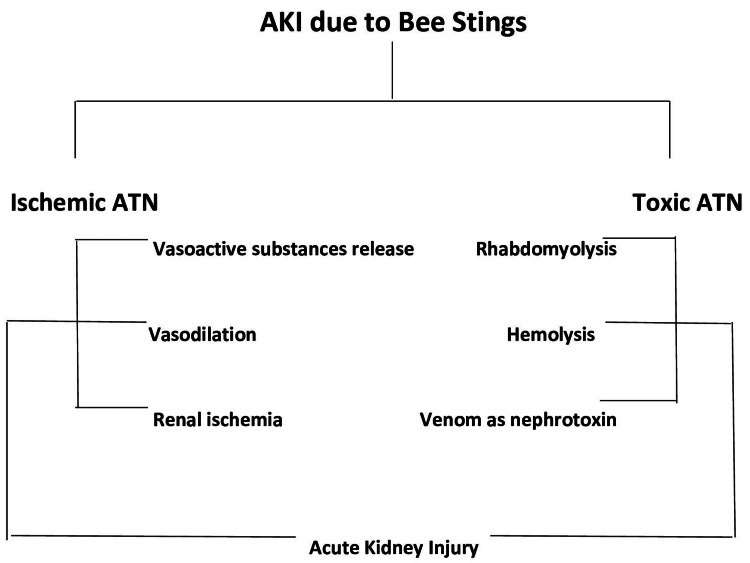
Acute kidney injury (AKI) is a common complication following multiple honey bee stings and usually presents after 24-48 hours following the incidence. The severity of AKI is related to the number of stings. A single sting can cause an allergic reaction, and as the stings increase, a higher amount of venom is inoculated, leading to systemic poisoning. Bee venom can have direct or indirect effects on the kidneys. AKI is a combination of toxic and ischemic acute tubular necrosis. Patients may require dialysis, and the usual renal recovery time is 4-120 days. The patient with multiple honey bee stings needs emergency medical treatment, sometimes in the ICU setting, with the aim of treating or preventing anaphylaxis reactions. A case of AKI due to multiple honey bee stings is presented, which is rare but a known occurrence. The patient survived with a recovery of renal function.
Keywords: acute kidney injury; bee sting induced aki case report; conservative management of aki; pathophysiology of bee sting induced aki; recovery from aki after bee stings; retrieval of a dead honeybee from a living patient.
Copyright © 2024, V et al.
Conflict of interest statement
Human subjects: Consent was obtained or waived by all participants in this study. Conflicts of interest: In compliance with the ICMJE uniform disclosure form, all authors declare the following: Payment/services info: All authors have declared that no financial support was received from any organization for the submitted work. Financial relationships: All authors have declared that they have no financial relationships at present or within the previous three years with any organizations that might have an interest in the submitted work. Other relationships: All authors have declared that there are no other relationships or activities that could appear to have influenced the submitted work.
Figures

References
-
- Unusual reactions to hymenoptera stings: what should we keep in mind? Mingomataj EÇ, Bakiri AH, Ibranji A, Sturm GJ. Clin Rev Allergy Immunol. 2014;47:91–99. - PubMed
-
- Mechanisms of bee venom-induced acute renal failure. Grisotto LS, Mendes GE, Castro I, Baptista MA, Alves VA, Yu L, Burdmann EA. Toxicon. 2006;48:44–54. - PubMed
-
- Severe and fatal mass attacks by ‘killer’ bees (Africanized honey bees - Apis mellifera scutellata) in Brazil: clinicopathological studies with measurement of serum venom concentrations. Franca FOS, Benvenuti LA, Fan HW, et al. QJM. 1994;87:369–382. - PubMed
Publication types
LinkOut - more resources
Full Text Sources
Research Materials