


Efficacy and safety of Janus kinase inhibitors in non-infectious inflammatory ocular diseases: a prospective cohort study from the international AIDA network registries
- PMID: 39247640
- PMCID: PMC11377336
- DOI: 10.3389/fmed.2024.1439338
Efficacy and safety of Janus kinase inhibitors in non-infectious inflammatory ocular diseases: a prospective cohort study from the international AIDA network registries
Erratum in
-
Corrigendum: Efficacy and safety of Janus kinase inhibitors in non-infectious inflammatory ocular diseases: a prospective cohort study from the international AIDA network registries.Front Med (Lausanne). 2024 Sep 13;11:1489092. doi: 10.3389/fmed.2024.1489092. eCollection 2024. Front Med (Lausanne). 2024. PMID: 39346944 Free PMC article.
Abstract
Introduction: Non-infectious inflammatory ocular diseases pose significant challenges in diagnosis and management, often requiring systemic immunosuppressive therapy. Since Janus kinase (JAK) inhibitors may represent a novel therapeutic option for these disorders, the present study aimed to expand current knowledge about their efficacy and safety in patients with these conditions.
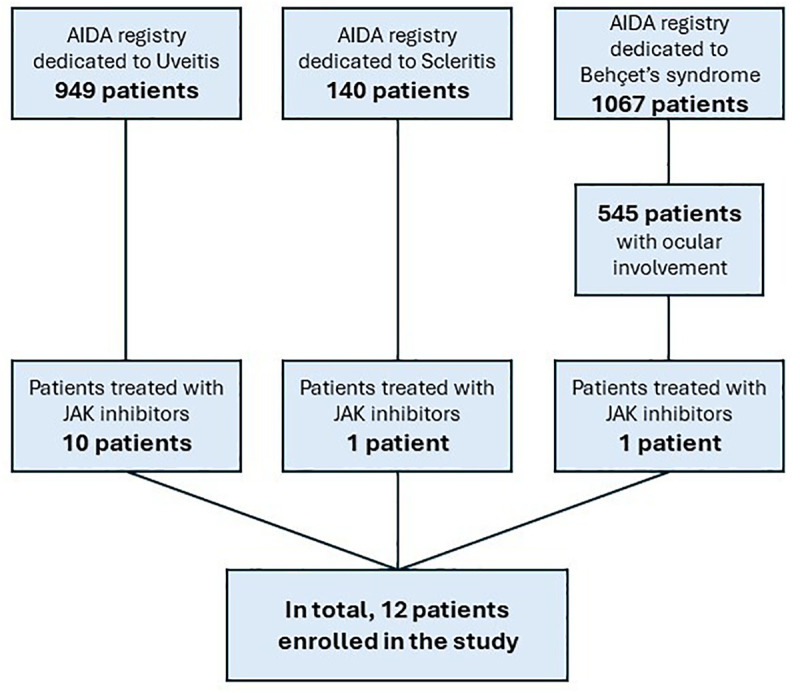
Methods: This prospective cohort study included 12 adult patients from the international AutoInflammatory Disease Alliance (AIDA) Network registries dedicated to non-infectious ocular inflammatory conditions. We assessed ocular flares, visual acuity, disease course, and complications before and after initiating JAK inhibitor therapy.
Results: Ocular inflammation was related to a systemic disease in 8 (66.7%) patients as follows: spondyloarthritis (n = 3), peripheral psoriatic arthritis (n = 1), rheumatoid arthritis (n = 1), antinuclear antibodies (ANA) positive juvenile idiopathic arthritis (n = 1), Behçet's syndrome (n = 1), Vogt-Koyanagi-Harada syndrome (n = 1). In total, 4 patients received baricitinib, 1 patient received tofacitinib, and 7 patients underwent upadacitinib treatment. The overall average duration of JAK inhibitors treatment was 8.6 ± 5.5 months (ranging from 3 to 20 months). At the last assessment, ocular disease control was complete in 12/12 patients. One patient discontinued baricitinib due to poor compliance after a 12-month relapse-free period. The incidence of ocular flares was 125 episodes/1.000 person-months prior to the initiation of JAK inhibitors and 28.6 episodes/1.000 person-months thereafter. The incidence rate ratio for experiencing a relapse before starting a JAK inhibitor compared to the following period was 4.37 (95% CI 1.3-14.7, p-value: 0.02).
Conclusion: JAK inhibitors demonstrate efficacy and safety in controlling ocular inflammatory relapses, confirming that they represent a valuable treatment option for patients with non-infectious inflammatory ocular diseases resistant to conventional treatments.
Keywords: baricitinib; scleritis; tofacitinib; upadacitinib; uveitis.
Copyright © 2024 Vitale, Palacios-Olid, Caggiano, Ragab, Hernández-Rodríguez, Pelegrín, Mejía-Salgado, Zarate-Pinzón, Gentileschi, Sota, Fonollosa, Carreño, Gaggiano, Amin, Balistreri, Narváez, Tosi, Frediani, Cantarini, de-la-Torre and Fabiani.
Conflict of interest statement
The authors declare that the research was conducted in the absence of any commercial or financial relationships that could be construed as a potential conflict of interest. The authors declared that they were an editorial board member of Frontiers, at the time of submission. This had no impact on the peer review process and the final decision.
Figures
References
-
- Generali E, Cantarini L, Selmi C. Ocular involvement in systemic autoimmune diseases. Clin Rev Allergy Immunol. (2015) 49:263–70. - PubMed
-
- McCluskey P, Powell R. The eye in systemic inflammatory diseases. Lancet. (2004) 364:2125–33. - PubMed
-
- Suhler E, Lim L, Beardsley R, Giles T, Pasadhika S, Lee S, et al. Rituximab therapy for refractory scleritis: Results of a phase I/II dose-ranging, randomized, clinical trial. Ophthalmology. (2014) 121:1885–91. - PubMed
LinkOut - more resources
Full Text Sources
