


Long-term outcome and predictors of neurological recovery in cervical spinal cord injury: a population-based cohort study
- PMID: 39251850
- PMCID: PMC11384781
- DOI: 10.1038/s41598-024-71983-2
Long-term outcome and predictors of neurological recovery in cervical spinal cord injury: a population-based cohort study
Abstract
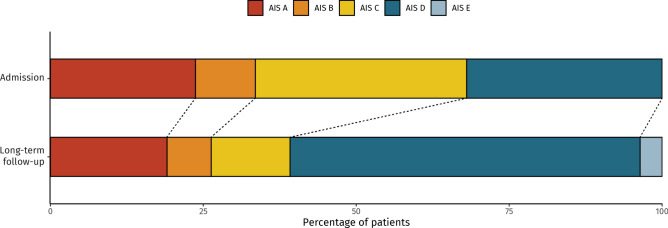
This retrospective study analyzed prognostic factors for neurological improvement and ambulation in 194 adult patients (≥ 15 years) with traumatic cervical spinal cord injuries treated at the neurological SCI unit (SCIU) at the Karolinska University Hospital Stockholm, Sweden, between 2010 and 2020. The primary outcome was American spinal injury association impairment scale (AIS) improvement, with secondary focus on ambulation restoration. Results showed 41% experienced AIS improvement, with 51% regaining ambulation over a median follow-up of 3.7 years. Significant AIS improvement (p < 0.001) and reduced bladder/bowel dysfunction (p < 0.001) were noted. Multivariable analysis identified initial AIS C-D (< 0.001), central cord syndrome (p = 0.016), and C0-C3 injury (p = 0.017) as positive AIS improvement predictors, while lower extremity motor score (LEMS) (p < 0.001) and longer ICU stays (p < 0.001) were negative predictors. Patients with initial AIS C-D (p < 0.001) and higher LEMS (p < 0.001) were more likely to regain ambulation. Finally, older age was a negative prognostic factor (p = 0.003). In conclusion, initial injury severity significantly predicted neurological improvement and ambulation. Recovery was observed even in severe cases, emphasizing the importance of tailored rehabilitation for improved outcomes.
Keywords: Ambulation; American spinal injury association impairment scale; Neurological outcome; Predictors; Spinal cord injury.
© 2024. The Author(s).
Conflict of interest statement
The authors declare no competing interests.
Figures
References
-
- Bennett J, Das JM, Emmady PD. Spinal Cord Injuries. StatPearls. https://www.ncbi.nlm.nih.gov/books/NBK560721/. Accessed 12 Aug 2023. (2022).
MeSH terms
LinkOut - more resources
Full Text Sources
Medical
Miscellaneous
