


Exploring the impact of housing insecurity on the health and wellbeing of children and young people in the United Kingdom: a qualitative systematic review
- PMID: 39251944
- PMCID: PMC11385840
- DOI: 10.1186/s12889-024-19735-9
Exploring the impact of housing insecurity on the health and wellbeing of children and young people in the United Kingdom: a qualitative systematic review
Abstract
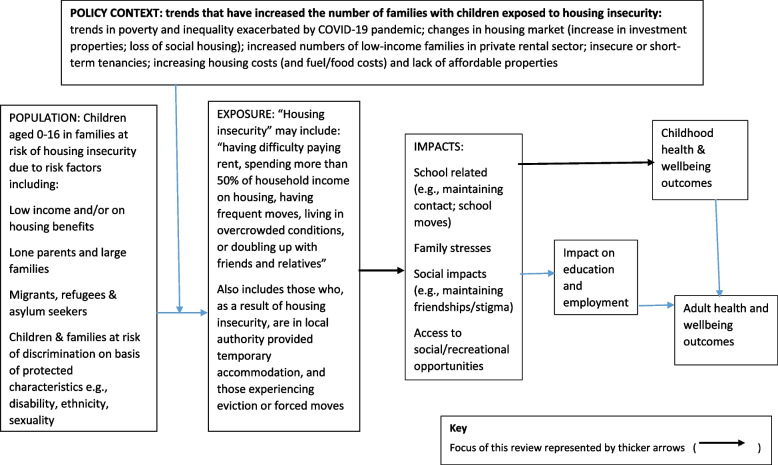
Background: Housing insecurity can be understood as experiencing or being at risk of multiple house moves that are not through choice and related to poverty. Many aspects of housing have all been shown to impact children/young people's health and wellbeing. However, the pathways linking housing and childhood health and wellbeing are complex and poorly understood.
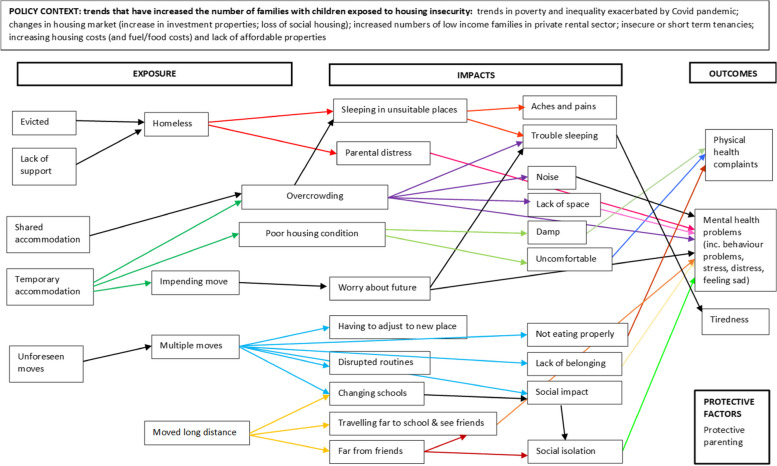
Methods: We undertook a systematic review synthesising qualitative data on the perspectives of children/young people and those close to them, from the United Kingdom (UK). We searched databases, reference lists, and UK grey literature. We extracted and tabulated key data from the included papers, and appraised study quality. We used best fit framework synthesis combined with thematic synthesis, and generated diagrams to illustrate hypothesised causal pathways.
Results: We included 59 studies and identified four populations: those experiencing housing insecurity in general (40 papers); associated with domestic violence (nine papers); associated with migration status (13 papers); and due to demolition-related forced relocation (two papers). Housing insecurity took many forms and resulted from several interrelated situations, including eviction or a forced move, temporary accommodation, exposure to problematic behaviour, overcrowded/poor-condition/unsuitable property, and making multiple moves. Impacts included school-related, psychological, financial and family wellbeing impacts, daily long-distance travel, and poor living conditions, all of which could further exacerbate housing insecurity. People perceived that these experiences led to mental and physical health problems, tiredness and delayed development. The impact of housing insecurity was lessened by friendship and support, staying at the same school, having hope for the future, and parenting practices. The negative impacts of housing insecurity on child/adolescent health and wellbeing may be compounded by specific life circumstances, such as escaping domestic violence, migration status, or demolition-related relocation.
Conclusion: Housing insecurity has a profound impact on children and young people. Policies should focus on reducing housing insecurity among families, particularly in relation to reducing eviction; improving, and reducing the need for, temporary accommodation; minimum requirements for property condition; and support to reduce multiple and long-distance moves. Those working with children/young people and families experiencing housing insecurity should prioritise giving them optimal choice and control over situations that affect them.
Keywords: Adolescents; Children; Health; Housing insecurity, Housing instability; Systematic review; Wellbeing; Young people.
© 2024. The Author(s).
Conflict of interest statement
AB is a Cochrane author and co-convenor of the Cochrane Qualitative and Implementation Methods Group, and was also previously a member of the NIHR Evidence Synthesis Advisory Group from 2018 to 2022 and a member of the NIHR HS&DR Funding Board from 2018 to 2022. No other authors have competing interests to declare.
Figures



References
-
- Weitzman M, Baten A, Rosenthal DG, Hoshino R, Tohn E, Jacobs DE. Housing and child health. Curr Probl Pediatr Adolesc Health Care. 2013;43(8):187–224. - PubMed
-
- Kohler L. Child public health: A new basis for child health workers. Eur J Public Health. 1998;8:253–5.
-
- Cresswell T. What is child public health? Curr Paediatr. 2004;14(7):612–8. 10.1016/j.cupe.2004.07.015 - DOI
Publication types
MeSH terms
LinkOut - more resources
Full Text Sources
