[Preprint]. 2024 Aug 28:2024.08.27.610011.
doi: 10.1101/2024.08.27.610011.

LncRNA-536 and RNA Binding Protein RBM25 Interactions in Pulmonary Arterial Hypertension

Affiliations

LncRNA-536 and RNA Binding Protein RBM25 Interactions in Pulmonary Arterial Hypertension

Aatish Mahajan et al. bioRxiv. .

Update in

Abstract

Objective: Hyperproliferation of pulmonary artery smooth muscle cells (PASMCs) is one of the essential features of the maladaptive inward remodeling of the pulmonary arteries in pulmonary arterial hypertension (PAH). In this study, we define the mechanistic association between long-noncoding RNA: ENST00000495536 (Lnc-536) and anti-proliferative HOXB13 in mediating smooth muscle hyperplasia.

Methods: Antisense oligonucleotide-based GapmeRs or plasmid overexpressing lnc-536 were used to evaluate the role of lnc-536 in mediating hyperproliferation of PDGF-treated or idiopathic PAH (IPAH) PASMCs. Further, we pulled down lnc536 to identify the proteins directly interacting with lnc536. The in-vivo role of lnc-536 was determined in Sugen-hypoxia and HIV-transgenic pulmonary hypertensive rats.

Results: Increased levels of lnc-536 in PDGF-treated or IPAH PASMCs promote hyperproliferative phenotype by downregulating the HOXB13 expression. Knockdown of lnc-536 in-vivo prevented increased RVSP, Fulton Index, and pulmonary vascular remodeling in Sugen-Hypoxia rats. The lncRNA-536 pull-down assay demonstrated the interactions of RNA binding protein: RBM25 with SFPQ, a transcriptional regulator that has a binding motif on HOXB13 exon Further, The RNA-IP experiment using the SFPQ antibody showed direct interaction of RBM25 with SFPQ and knockdown of RBM25 resulted in increased interactions of SFPQ and HOXB13 mRNA while attenuating PASMC proliferation. Finally, we examined the role of lnc-536 and HOXB13 axis in the PASMCs exposed to the dual hit of HIV and a stimulant: cocaine as well.

Conclusion: lnc-536 acts as a decoy for RBM25, which in turn sequesters SFPQ, leading to the decrease in HOXB13 expression and hyperproliferation of smooth muscle cells associated with PAH development.

Keywords: Long non-coding RNA; RNA binding proteins; pulmonary hypertension; smooth muscle dysfunction.


Conflict of interest statement

DISCLOSURES: The authors declare no competing interests.

Figures

Figure 1.
Figure 1.
(A) Effect of PDGF treatment on the expression of lncRNA536 (i), cell proliferation as assayed by MTS (ii) and Cyquant (iii) and on HOXB13 levels (iv) in human pulmonary arterial smooth muscle cells (HPASMCs). *p<0.05, **p <0.01, *** p<0.001 vs control (B). Effect of lncRNA knockdown in PDGF-treated HPASMCs on HOXB13 expression (i) and cell proliferation/survival as assayed by MTS (ii), Cyquant (iii), and Edu (iv). HPASMCs were transfected with LNA-gapmeR against lnc-536 (lnc536-AS1,40nM) or LNA-gapmeR scrambled control (n=3) for 24h followed by 24 h PDGF (100ng/ml) treatment. **p <0.01, *** p<0.001. (C). Effect of HOXB13 over-expression in PDGF treated HPASMCs on cell proliferation as assayed by MTS (i), Cyquant (ii), and effect on lnc-536 expression (iii). HPASMC were transfected with 2 μg of plasmid over-expressing HOXB13 (pCMv6-HOXB13), or pCMv6-empty as control (n=3) for 24h followed by treatment with PDGF (100ng/ml) for 24h. **p <0.01, *** p<0.001. Data is an average of a minimum of three independent experiments performed in triplicates. Representative images of Edu staining are shown.
Figure 2.
Figure 2.
Effect of knockdown of lnc536 in Sugen-hypoxia PAH rats. Adult male fisher rats received Su5416 (20 mg/kg) followed by immediate hypoxia exposure ( 10% O2 for 21 days). Rats (n=6/group) were treated with LNA-gapmeR against lnc-536 (LNA-AS536) or LNA-gapmeR scrambled control (LNA-Scr) ( 5 mg/kg body wt.) on days 4, 9, and 14. (A) Echocardiography and hemodynamic analysis: Mean BP, Heart rate, ΔEV/LV Ejection fraction(EF), ΔRV/LV end-diastolic area (EDA), At/Et, cardiac output (CO) along with RVSP, Fulton index data are shown. Representative micrographs of trichrome stained right ventricles (B) and alpha-smooth muscle actin (red) and vWF ( green) immuno-fluorescence stained lungs (C) from Sugen-hypoxia rats treated with LNA-AS536 or scrambled control (D) Expression of lnc536 (i) and HOXB13 (ii) in pulmonary arterial smooth muscle cells isolated from rats treated with LNA-AS536 or LNA-Scr control (24h). (E) Proliferation analysis of PASMCs isolated from rats were grown under no serum conditions for 2, 4 or 6 days assayed using MTS (i) and Cyquant (ii). Representative images of Edu (iii) stained RPASMCs serum starved for 2 days. *p<0.05, **p <0.01, *** p<0.001 vs LNA gapmeR scrambled control.
Figure 3.
Figure 3.
(A) RBM25-Immunoprecipitation (IP) in HPASMCs transfected with and without plasmid over-expressing lnc536. Levels of LNC536 (i) and HOXB13 (ii) RNA after incubation of total cellular extract with RBM-25 antibody. HPASMC were transfected with 2 μg of plasmid over-expressing lnc536 (PUC57-lnc536), or PUC57-empty as control (n=3) for 24h followed by RNA-IP using RBM25 antibody. (B) RNA-IP of PDGF-treated HPASMCs using RBM25 antibody showed an increase in lnc536 (i) binding with RBM25. Corresponding lower levels of HOXB13 (ii) were observed. (C) Effect of knockdown of RBM25 in HPASMCs over-expressing lnc-536 on HOXB13 expression (i) and cell proliferation as assayed by MTS (ii), Cyquant (iii) and Edu (iv). HPASMCs transfected with scrambled RNA (Scr-RNA) or small hairpin against RBM25 (RBM25 shRNA). (D) Effect of knockdown of RBM25 in HPASMCs treated with PDGF on (i) HOXB13 expression and cell proliferation as measured by MTS (ii) Cyquant (iii) and Edu (iv). HPASMCs were either transfected with shRBM25 or Scr-RNA followed by treatment with and without PDGF (100ng/ml). * p<0.05, **p <0.01, *** p<0.001. The data shown is the average of n=3 experiments. Representative Edu-stained images are shown.
Figure 4.
Figure 4.
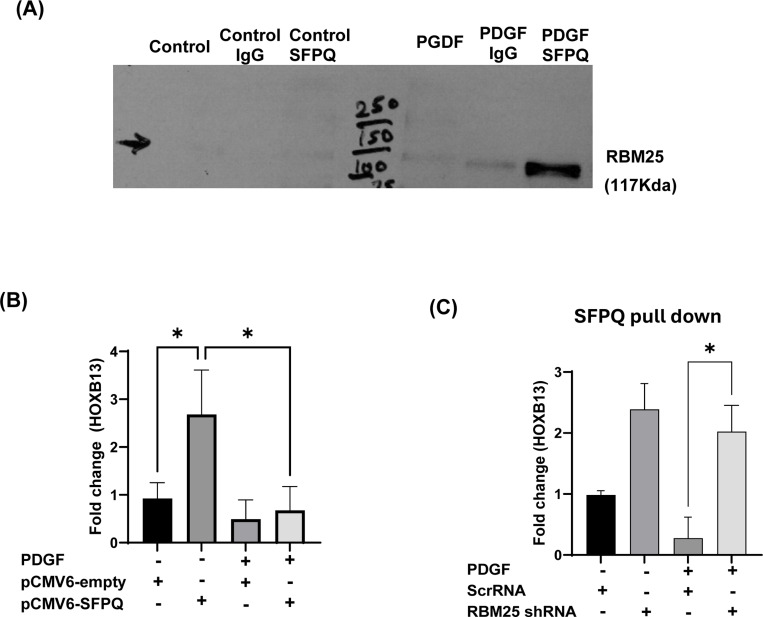
RBM25 acts as a decoy for a transcription factor: splicing factor proline/glutamine-rich (SFPQ) leading to decreased expression of HOXB13 in hyper-proliferative PDGF-treated smooth muscle cells. (A) HPASMC were treated for 24h with PDGF (100ng/ml), and IP was performed using SFPQ antibody followed by western blot analysis for RBM25. (B) Effect of SFPQ over-expression on HOXB13 levels in smooth muscle cells as assessed by qRT-PCR. HPASMCs were transfected with 2 μg plasmid over-expressing SFPQ (pCMV6-SFPQ) or empty plasmid control (pCMV6-empty) for 24h followed by treated with PDGF (C) Levels of HOXB13 mRNA bound to SFPQ in HPASMCs with and without knockdown of RBM25. HPASMC transfected with RBM25 shRNA or scrRNA were treated with and without PDGF (100ng/ml) for 24h followed by RNA-IP using SFPQ antibody and HOXB13 RT-PCR analysis of pulled down RNA (n=3). * p<0.05. The data shown is the average of n=3 experiments.
Figure 5.
Figure 5.
(A) Idiopathic pulmonary arterial smooth muscle cells (IPAH) show higher expression of lncRNA536 (i) and decreased expression of HOXB13 (ii) whereas no change in the expression of lncRNA536 (iii) and (iv) HOXB13 was observed in familial pulmonary arterial smooth muscle cells (FPAH). (B) Effect of lnc536 knockdown on (i) HOXB13 expression and cell proliferation as assayed by (ii) MTS. Cells obtained from IPAH and healthy donors were transfected with LNA-GapmeR against lnc536 (lnc536-AS1,40nM) or LNA-GapmeR scrambled control (n=3) for 24h.*p<0.05, *** p<0.001. (C) To study the effect of HOXB13 over-expression on IPAH cells (i) LNC536 expression (n=3) and cell proliferation as assayed using MTS (ii) and Cyquant (iii). *p<0.05, **p <0.01 and *** p<0.001. IPAH cells were treated with HOXB13 over-expressing plasmid (2ug) for 24h. (D) Effect of knockdown of RBM25 in IPAH cells on HOXB13 expression (i), cell proliferation assays as assessed by MTS (ii) and Cyquant (iii). IPAH cells were transfected with ScrRNA (control) and RBM25 shRNA (knockdown) (n=3) for 24h, (E) Effect of knockdown of RBM25 in IPAH cells and RNA-IP using SFPQ antibody on HOXB13 expression (n=3). *p<0.05, **p <0.01, *** p<0.001.
Figure 6.
Figure 6.
Involvement of lnc-536/RBM25 /HOXB13 axis in HIV and cocaine-mediated smooth muscle hyperplasia. (A) Effect of cocaine and HIV protein Tat (C+T) treatment on lnc536 expression (i) and cell proliferation as measured by MTS (ii) and Cyquant (iii) in HPASMCs over expressing HOXB13. HPASMCs were transfected with either plasmid over-expressing HOXB13 (pCMV6-HOXB13) or empty plasmid (pCMV6-empty) for 24h followed by treatment with cocaine (C) (1 μM and Tat (T) (25 ng/mL) for 48h. (B) Effect of knockdown of RBM25 on HOXB13 expression (i), cell proliferation as measured by MTS (ii) and Cyquant (iii). Cells were transfected with shRBM25 or scrRNA for 24h followed by treatment with C+T for 48h. * p<0.05, **p <0.01, *** p<0.001. (C) Effect of knockdown of lnc536 in HIV- transgenic cocaine treated PAH rats on normalized Δ EV/LV Ejection fraction (EF), ΔRV/LV end-diastolic area (EDA), RVSP, and Fulton index. HIV-Tg male Fisher rats (n = 6–8/group exposed to cocaine daily for 21 days were treated with LNA- scrambled GapmeR control (LNA-Scr) or LNA GapmeR against lnc536 (LNA-AS 536) on days 4, 9, and 14. (D) Representative images of trichrome stained right ventricles and (E) pulmonary vascular remodeling as represented by alpha-smooth muscle actin (red) and vWF ( green) immuno-fluorescence staining in lungs Scale bars, 100 mm. (F) Cyquant proliferation analysis of PASMCs isolated from rats grown under no serum conditions for 2, 4 or 6 days *p <0.01, *** p<0.001.
Figure 7:
Figure 7:
Schematic showing the lnc536 mediated regulation of hyperproliferative phenotype of pulmonary arterial smooth muscle cells in PAH. Lnc-536 is up-regulated in IPAH patient-derived PASMCs and in response to PDGF mitogen or HIV protein and cocaine stimulant, Lnc-536 acts as a decoy for an RNA binding protein, RBM25, which results in the sequestering of transcription regulator: SFPQ. This prevents SFPQ from binding to the promoter region of the anti-proliferative HOXB13 gene thereby decreasing its expression and augmenting the proliferation of PASMCs.

References

    1. Michelakis ED, Wilkins MR, Rabinovitch M. Emerging concepts and translational priorities in pulmonary arterial hypertension. Circulation. 2008;118:1486–1495. - PubMed
    1. Rabinovitch M. Pathobiology of pulmonary hypertension. Annu Rev Pathol. 2007;2:369–399. - PubMed
    1. Voelkel NF, Tuder RM. Cellular and molecular mechanisms in the pathogenesis of severe pulmonary hypertension. Eur Respir J. 1995;8:2129–2138. - PubMed
    1. Humbert M, Morrell NW, Archer SL, Stenmark KR, MacLean MR, Lang IM, Christman BW, Weir EK, Eickelberg O, Voelkel NF, Rabinovitch M. Cellular and molecular pathobiology of pulmonary arterial hypertension. J Am Coll Cardiol. 2004;43:13S–24S. - PubMed
    1. Alamri AK, Ma CL, Ryan JJ. Novel Drugs for the Treatment of Pulmonary Arterial Hypertension: Where Are We Going? Drugs. 2023;83:577–585. doi: 10.1007/s40265-023-01862-z - DOI - PMC - PubMed

Publication types

LinkOut - more resources