


This is a preprint.
TUMOR-INFILTRATING NOCICEPTOR NEURONS PROMOTE IMMUNOSUPPRESSION
- PMID: 39253487
- PMCID: PMC11382997
- DOI: 10.1101/2024.08.23.609450
TUMOR-INFILTRATING NOCICEPTOR NEURONS PROMOTE IMMUNOSUPPRESSION
Update in
-
Tumor-infiltrating nociceptor neurons promote immunosuppression.Sci Signal. 2025 Aug 5;18(898):eads7889. doi: 10.1126/scisignal.ads7889. Epub 2025 Aug 5. Sci Signal. 2025. PMID: 40763210 Free PMC article.
Abstract
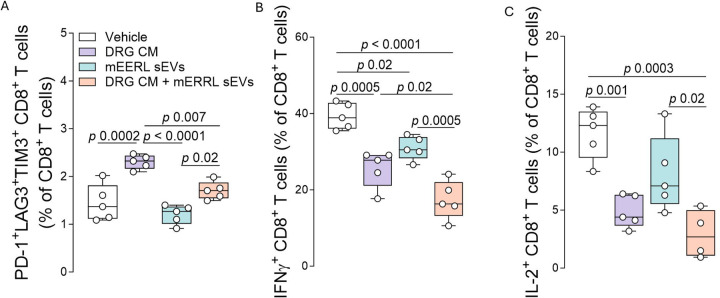
Nociceptor neurons impact tumor immunity. Removing nociceptor neurons reduced myeloid-derived suppressor cell (MDSCs) tumor infiltration in mouse models of head and neck carcinoma and melanoma. Carcinoma-released small extracellular vesicles (sEVs) attract nociceptive nerves to tumors. sEV-deficient tumors fail to develop in mice lacking nociceptor neurons. Exposure of dorsal root ganglia (DRG) neurons to cancer sEVs elevated expression of Substance P, IL-6 and injury-related neuronal markers while treatment with cancer sEVs and cytotoxic CD8 T-cells induced an immunosuppressive state (increased exhaustion ligands and cytokines). Cancer patient sEVs enhanced DRG responses to capsaicin, indicating increased nociceptor sensitivity. Conditioned media from DRG and cancer cell co-cultures promoted expression of MDSC markers in primary bone marrow cells while DRG conditioned media together with cancer sEVs induced checkpoint expression on T-cells. Our findings indicate that nociceptor neurons facilitate CD8+ T cell exhaustion and enhance MDSC infiltration. Targeting nociceptor-released IL-6 emerges as a novel strategy to disrupt harmful neuro-immune interactions in cancer and enhance anti-tumor immunity.
Conflict of interest statement
Sebastien Talbot is a minority stake holder in Nocion Therapeutics and received funding from Nocion Therapeutics and Cygnal Therapeutics. All other authors declare they have no competing interests.



References
-
- McIlwain W. R., Sood A. J., Nguyen S. A., Day T. A., Initial symptoms in patients with HPV-positive and HPV-negative oropharyngeal cancer. JAMA Otolaryngol Head Neck Surg 140, 441–447 (2014). - PubMed
-
- Siegel R. L., Miller K. D., Jemal A., Cancer Statistics, 2017. CA Cancer J Clin 67, 7–30 (2017). - PubMed
Publication types
Grants and funding
LinkOut - more resources
Full Text Sources
Molecular Biology Databases
Research Materials
