. 2024 Sep 10;14(1):21061.
doi: 10.1038/s41598-024-72321-2.

Comorbidity-based framework for Alzheimer's disease classification using graph neural networks

Affiliations

Comorbidity-based framework for Alzheimer's disease classification using graph neural networks

Ferial Abuhantash et al. Sci Rep. .

Abstract

Alzheimer's disease (AD), the most prevalent form of dementia, requires early prediction for timely intervention. Current deep learning approaches, particularly those using traditional neural networks, face challenges such as handling high-dimensional data, interpreting complex relationships, and managing data bias. To address these limitations, we propose a framework utilizing graph neural networks (GNNs), which excel in modeling relationships within graph-structured data. Our study employs GNNs on data from the Alzheimer's Disease Neuroimaging Initiative for binary and multi-class classification across the three stages of AD: cognitively normal (CN), mild cognitive impairment (MCI), and Alzheimer's disease (AD). By incorporating comorbidity data derived from electronic health records, we achieved the most effective multi-classification results. Notably, the GNN model (Chebyshev Convolutional Neural Networks) demonstrated superior performance with a 0.98 accuracy in multi-class classification and 0.99, 0.93, and 0.94 in the AD/CN, AD/MCI, and CN/MCI binary tasks, respectively. The model's robustness was further validated using the Australian Imaging, Biomarker & Lifestyle dataset as an external validation set. This work contributes to the field by offering a robust, accurate, and cost-effective method for early AD prediction (CN vs. MCI), addressing key challenges in existing deep learning approaches.


Conflict of interest statement

The authors declare no competing interests.

Figures
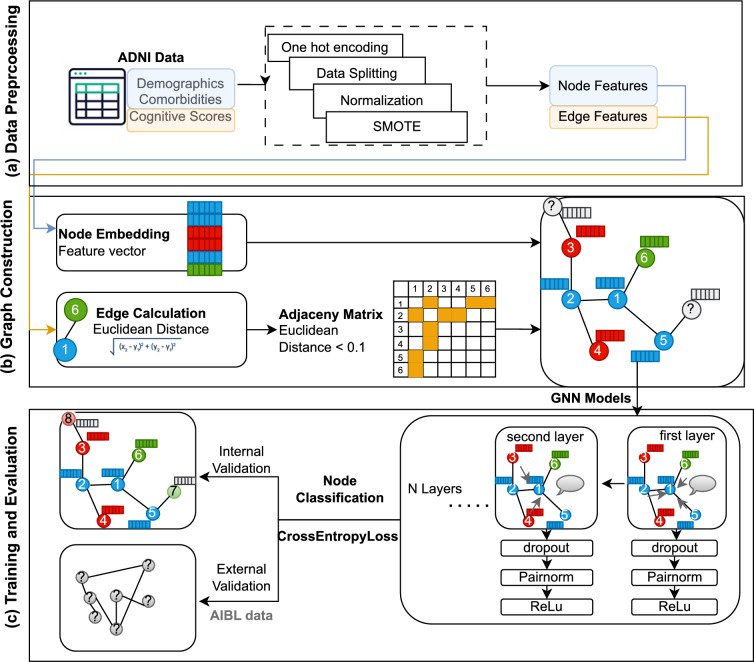
Figure 1
Figure 1
Overview of the system model for Alzheimer’s disease classification using graph neural networks. The model consists of three key stages: (a) data preprocessing, (b) graph construction, and (c) GNN model training and evaluation. In (b), patients are represented as nodes with edges connecting them based on cognitive score similarities. In (c), the trained models are validated on test set and also externally using the AIBL dataset.
Figure 2
Figure 2
Overview of the pipeline of the graph neural network machine learning system.
Figure 3
Figure 3
t-SNE visualization and performance metrics of the best performing Graph Neural Network (ChebConv) for the three binary classification tasks: CN vs. AD, MCI vs. AD, and CN vs. MCI. The first row (a–d) represents the CN vs. AD classification: (a) t-SNE visualization before training using the original feature set, (b) t-SNE visualization after training using the original feature set, (c) confusion matrix, and (d) ACC plot. The second row (e–h) represents the MCI vs. AD classification: (e) t-SNE visualization before training using the original feature set, (f) t-SNE visualization after training using the original feature set, (g) confusion matrix, and (h) ACC plot. The third row (i–l) represents the CN vs. MCI classification: (i) t-SNE visualization before training using the ablation 2 set, (j) t-SNE visualization after training using the ablation 2 set, (k) confusion matrix , and (l) ACC plot.
Figure 4
Figure 4
ChebConv Graph model performance for ADNI multi-class classification task visualized through t-SNE visualization of node representation of (a) graph inputs and (b) graph outputs. (c) Confusion matrix of multiclass classification for labels 0 (CN), 1 (MCI), and 2 (AD). The evaluation metrics with the 95% CI are seen in (d) AUC-ROC, (e) accuracy, and (f) F1-score.
Figure 5
Figure 5
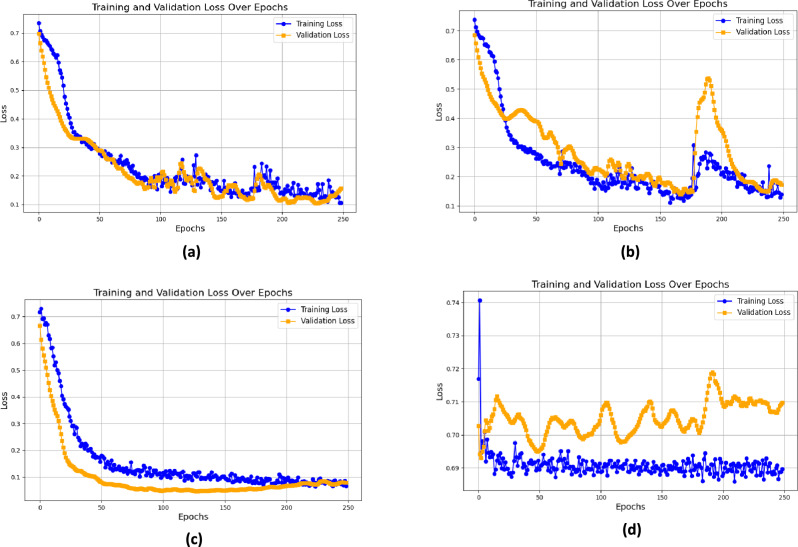
Loss comparison for the ChebConv model across different feature configurations in the CN vs. MCI classification task. (a) Loss with original feature set, (b) loss with Ablation Study 1 (comorbidities removed), (c) loss with Ablation Study 2 (comorbidities and cognitive scores switched), and (d) loss with Ablation Study 3 (cognitive scores removed).
Figure 6
Figure 6
Bar plots of feature importance with 95% confidence interval for three binary classification tasks using the top performing ChebConv model. The plot highlights the most significant features contributing to the classification task: (a) CN vs AD, (b) MCI vs AD, and (c) for CN vs MCI. Error bars represent the 95% confidence intervals for the mean importance scores across multiple folds.
Figure 7
Figure 7
Bar plots display the mean importance of features by the top-performing ChebConv model on the multi classification across different classes, with error bars representing the 95% confidence intervals. The three classes are: (a) cognitive normal, (b) mild cognitive impairment, and (c) Alzheimer’s disease.
Algorithm 1
Algorithm 1
Pseudo-code for GNN implementation.

References

    1. Castellani, R. J., Rolston, R. K. & Smith, M. A. Alzheimer disease. Dis. Mon. DM56, 484 (2010). 10.1016/j.disamonth.2010.06.001 - DOI - PMC - PubMed
    1. Dementia. https://www.who.int/news-room/fact-sheets/detail/dementia. Accessed 11 Dec 2023 (2023).
    1. Sperling, R. A. et al. Toward defining the preclinical stages of Alzheimer’s disease: Recommendations from the National Institute on Aging-Alzheimer’s Association Workgroups on diagnostic guidelines for Alzheimer’s disease. Alzheimer’s Dement.7, 280–292 (2011). 10.1016/j.jalz.2011.03.003 - DOI - PMC - PubMed
    1. Albert, M. S. et al. The diagnosis of mild cognitive impairment due to Alzheimer’s disease: Recommendations from the National Institute on Aging-Alzheimer’s Association Workgroups on diagnostic guidelines for Alzheimer’s disease. Alzheimer’s Dementia7, 270–279 (2011). 10.1016/j.jalz.2011.03.008 - DOI - PMC - PubMed
    1. McKhann, G. M. et al. The diagnosis of dementia due to Alzheimer’s disease: Recommendations from the National Institute on Aging-Alzheimer’s association workgroups on diagnostic guidelines for Alzheimer’s disease. Alzheimer’s Dementia7, 263–269 (2011). 10.1016/j.jalz.2011.03.005 - DOI - PMC - PubMed

LinkOut - more resources