


DNAm scores for serum GDF15 and NT-proBNP levels associate with a range of traits affecting the body and brain
- PMID: 39256775
- PMCID: PMC11389299
- DOI: 10.1186/s13148-024-01734-7
DNAm scores for serum GDF15 and NT-proBNP levels associate with a range of traits affecting the body and brain
Abstract
Background: Plasma growth differentiation factor 15 (GDF15) and N-terminal proB-type natriuretic peptide (NT-proBNP) are cardiovascular biomarkers that associate with a range of diseases. Epigenetic scores (EpiScores) for GDF15 and NT-proBNP may provide new routes for risk stratification.
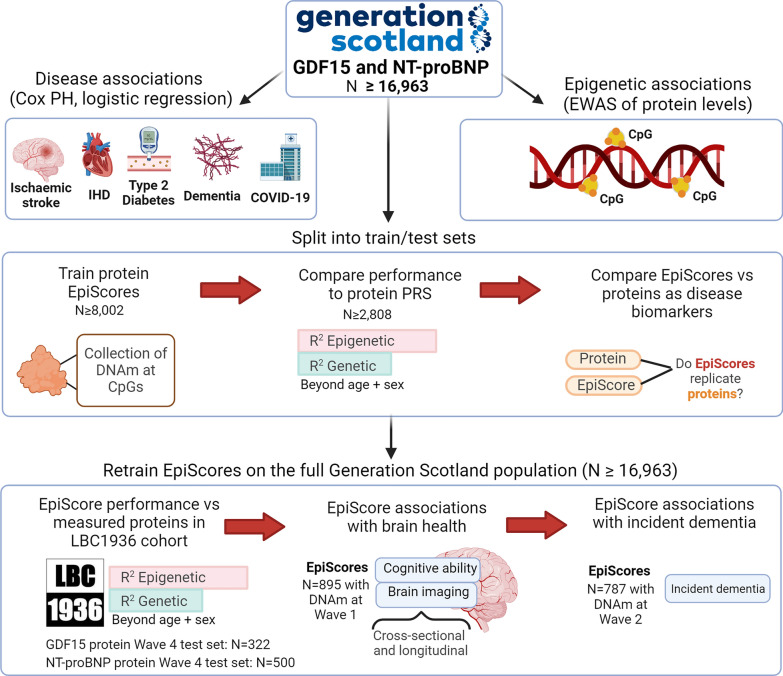
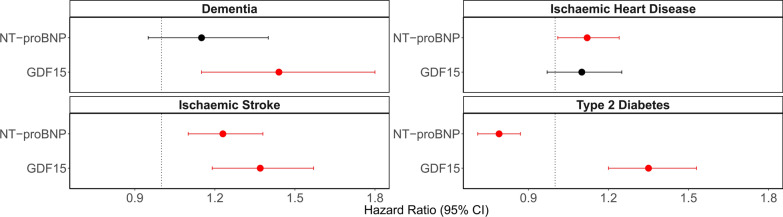
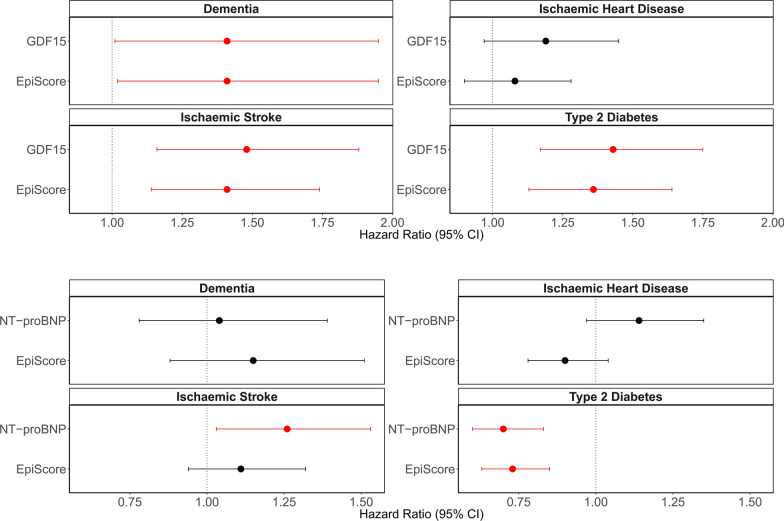
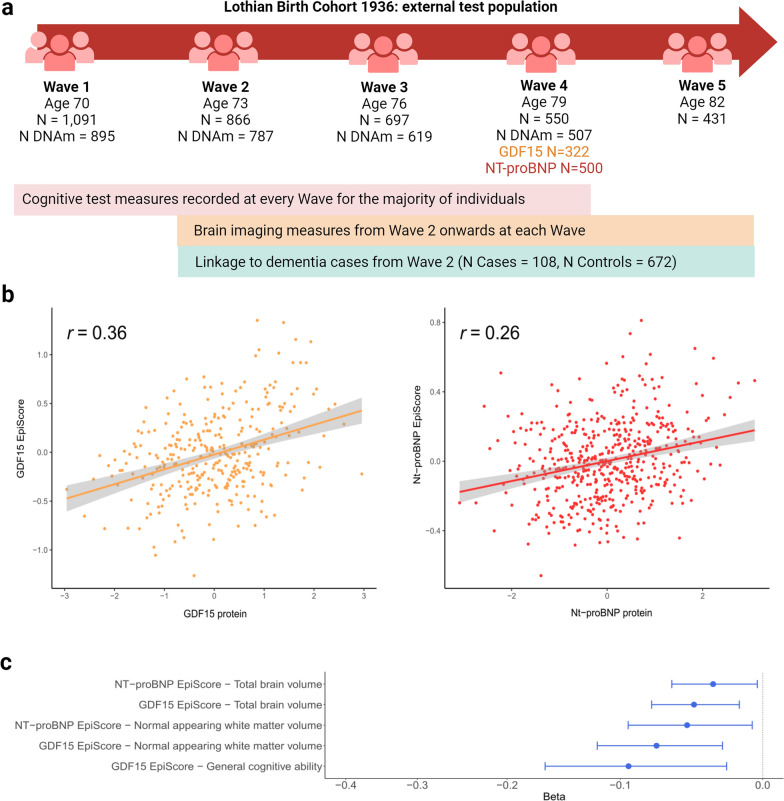
Results: In the Generation Scotland cohort (N ≥ 16,963), GDF15 levels were associated with incident dementia, ischaemic stroke and type 2 diabetes, whereas NT-proBNP levels were associated with incident ischaemic heart disease, ischaemic stroke and type 2 diabetes (all PFDR < 0.05). Bayesian epigenome-wide association studies (EWAS) identified 12 and 4 DNA methylation (DNAm) CpG sites associated (Posterior Inclusion Probability [PIP] > 95%) with levels of GDF15 and NT-proBNP, respectively. EpiScores for GDF15 and NT-proBNP were trained in a subset of the population. The GDF15 EpiScore replicated protein associations with incident dementia, type 2 diabetes and ischaemic stroke in the Generation Scotland test set (hazard ratios (HR) range 1.36-1.41, PFDR < 0.05). The EpiScore for NT-proBNP replicated the protein association with type 2 diabetes, but failed to replicate an association with ischaemic stroke. EpiScores explained comparable variance in protein levels across both the Generation Scotland test set and the external LBC1936 test cohort (R2 range of 5.7-12.2%). In LBC1936, both EpiScores were associated with indicators of poorer brain health. Neither EpiScore was associated with incident dementia in the LBC1936 population.
Conclusions: EpiScores for serum levels of GDF15 and Nt-proBNP associate with body and brain health traits. These EpiScores are provided as potential tools for disease risk stratification.
Keywords: Brain; Cardiovascular; DNA methylation; Dementia; Diabetes; Epigenetic; GDF15; NT-proBNP; Risk stratification; Stroke.
© 2024. The Author(s).
Conflict of interest statement
R.E.M is an advisor to the Epigenetic Clock Development Foundation and has received consultant fees from Optima partners. A.M.M has previously received speaker’s fees from Illumina and Janssen and research grant funding from The Sackler Trust. R.F.H. has received consultant fees from Illumina and Optima partners. D.A.G. has received consultant fees from and is currently employed in part-time capacity by Optima partners. D.L.M. is currently employed in part-time capacity by Optima partners. P.W. reports grant income from Roche Diagnostics in relation to and outside of the submitted work, as well as grant income from AstraZeneca, Boehringer Ingelheim and Novartis, outside the submitted work and speaker fees from Novo Nordisk, and Raisio outside the submitted work. N.S. has consulted for Afimmune, Amgen, AstraZeneca, Boehringer Ingelheim, Eli Lilly, Hanmi Pharmaceuticals, Merck Sharp & Dohme, Novartis, Novo Nordisk, Pfizer and Sanofi and received grant support paid to his University from AstraZeneca, Boehringer Ingelheim, Novartis and Roche Diagnostics outside the submitted work. All other authors declare no competing interest.
Figures
References
-
- Hageman SHJ, McKay AJ, Ueda P, Gunn LH, Jernberg T, Hagström E, et al. Estimation of recurrent atherosclerotic cardiovascular event risk in patients with established cardiovascular disease: the updated SMART2 algorithm. Eur Heart J. 2022;43(18):1715–27. 10.1093/eurheartj/ehac056 - DOI - PMC - PubMed
MeSH terms
Substances
Grants and funding
- FS/IBSRF/23/25161/British Heart Foundation Intermediate Basic Science Research Fellowship
- 104036/Z/14/Z/WT_/Wellcome Trust/United Kingdom
- HR03006/Scottish funding council
- 221890/Z/20/Z/WT_/Wellcome Trust/United Kingdom
- 221890/Z/20/Z/Sir Henry Dale Fellowship jointly funded by the Wellcome Trust and the Royal Society
- WT_/Wellcome Trust/United Kingdom
- CZD/16/6/Chief Scientist Office of the Scottish Government Health Directorate
- 108890/Z/15/Z/WT_/Wellcome Trust/United Kingdom
- award no. UKDRI - Edin002, DRIEdi17/18, and MRC MC_PC_17113/UK Dementia Research Institute Ltd which is funded by the Medical Research Council, Alzheimer's Society and Alzheimer's Research UK Institute
- 218493/Z/19/Z/WT_/Wellcome Trust/United Kingdom
- AS-PG-19b-010/ALZS_/Alzheimer's Society/United Kingdom
LinkOut - more resources
Full Text Sources
Medical
Research Materials
